
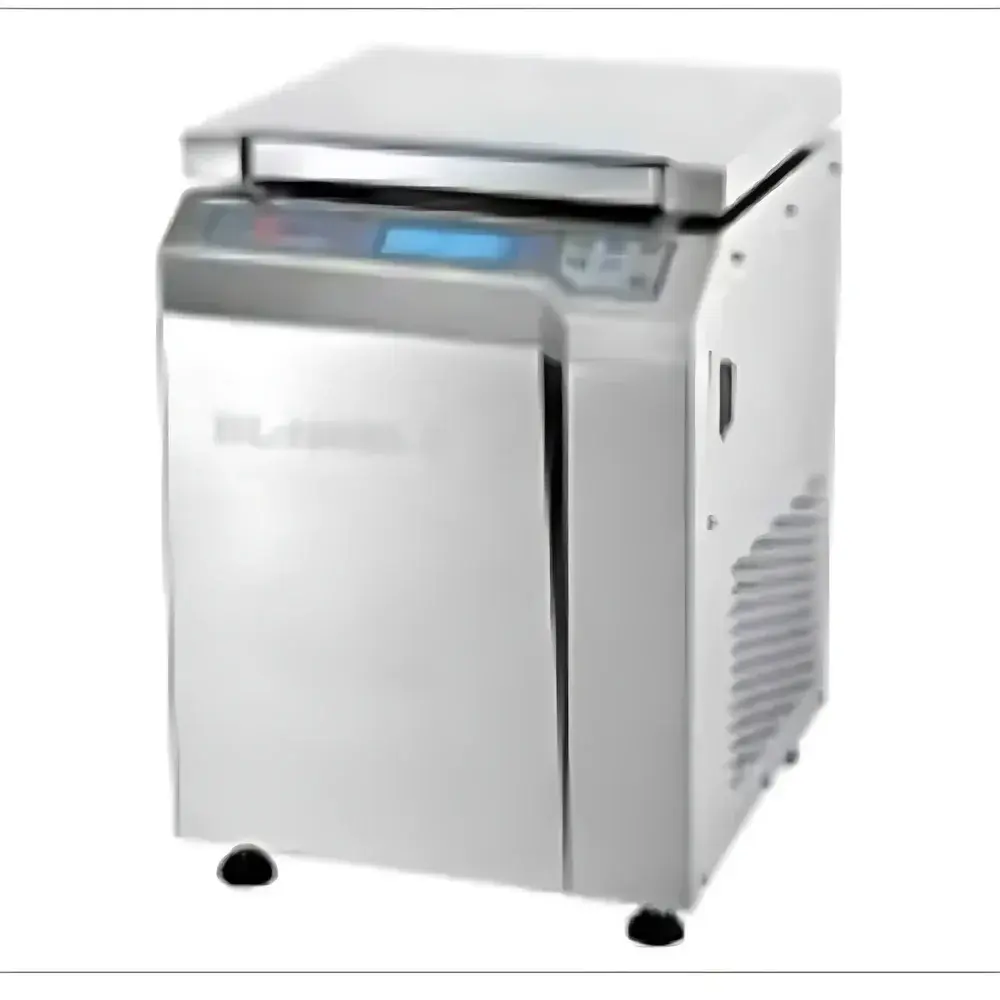
AnTing DL-4C Low-Speed High-Capacity Benchtop Centrifuge
| Brand | AnTing |
|---|---|
| Origin | Shanghai, China |
| Model | DL-4C |
| Type | Benchtop Centrifuge |
| Speed Range | 0–4000 rpm |
| Max RCF | 3776 ×g |
| Dimensions (L×W×H) | 580 mm × 630 mm × 650 mm |
| Weight | 160 kg |
| Power Supply | 220 V, 50 Hz, 750 W |
| Timer Range | 0–99 min |
| Rotor Configuration | Horizontal swing-out rotor |
| Standard Capacity Options | 500 mL × 4, 100 mL × 4, 50 mL × 16, 15 mL × 28, 10 mL × 48, 7 mL × 48, 5 mL × 48, or 192-well microplate support |
| Safety | Electronic door lock |
| Construction | Reinforced polymer housing |
Overview
The AnTing DL-4C is a robust, benchtop low-speed high-capacity centrifuge engineered for routine separation tasks in clinical laboratories, bioprocessing facilities, and academic research environments. Operating on the principle of sedimentation under controlled gravitational force, the DL-4C generates up to 3776 ×g at its maximum rotational speed of 4000 rpm—sufficient for pelleting mammalian cells, precipitating macromolecules, clarifying crude lysates, and processing whole blood into plasma or serum fractions. Its horizontal swing-out rotor design ensures uniform sample distribution during acceleration and deceleration, minimizing shear stress on delicate biological specimens while accommodating heterogeneous tube formats simultaneously. Unlike ultra-high-speed or refrigerated models, the DL-4C prioritizes operational stability, mechanical durability, and broad-volume throughput over extreme g-force generation—making it especially suitable for applications where sample integrity, reproducibility, and ease of loading are critical.
Key Features
- Reinforced polymer chassis providing structural rigidity while reducing overall mass and vibration transmission
- Microprocessor-controlled speed regulation with ±20 rpm accuracy across the full 0–4000 rpm range
- Electronic interlocked safety lid with automatic motor cutoff upon door opening
- Programmable digital timer (0–99 minutes) with audible end-of-run alert and auto-brake function
- Horizontal swing-out rotor assembly supporting interchangeable buckets for standardized and non-standard tube geometries
- Thermal management system ensuring continuous operation without thermal derating under nominal load conditions
- Low-noise brushless DC motor delivering consistent torque output and extended service life
Sample Compatibility & Compliance
The DL-4C accommodates a wide spectrum of primary sample containers—including polypropylene conical tubes (5–500 mL), glass centrifuge bottles, and standard 96-well and 192-well microplates—enabling parallel processing across diverse assay workflows. Its rotor geometry maintains balanced mass distribution even when partially loaded, supporting GLP-compliant documentation practices through repeatable run parameters. While not certified for IEC 61010-1 Class II medical device use, the unit conforms to general laboratory equipment safety standards applicable to non-refrigerated centrifugal systems operating below 5000 rpm. It supports traceable operation within ISO/IEC 17025-accredited laboratories when paired with validated rotor calibration records and maintenance logs.
Software & Data Management
The DL-4C operates via an embedded control panel with LED display; no external software or PC interface is required. All operational parameters—including set speed, actual RCF, elapsed time, and remaining runtime—are continuously visible during execution. The absence of network connectivity or data export functionality aligns with institutional requirements for air-gapped instrumentation in regulated environments. For audit readiness, users may manually record run conditions in laboratory notebooks or LIMS-integrated log sheets. Optional third-party rotor calibration services are available from authorized AnTing service centers to support periodic verification per internal SOPs or external quality assurance frameworks.
Applications
- Clinical hematology: Separation of whole blood into cellular and liquid phases for CBC analysis and serum biochemistry panels
- Cell culture harvesting: Recovery of adherent and suspension cells at speeds preserving membrane integrity and viability
- Environmental microbiology: Concentration of waterborne pathogens from large-volume filtration eluates
- Food and beverage QA/QC: Clarification of dairy emulsions, juice suspensions, and fermentation broths
- Educational laboratories: Demonstrating sedimentation kinetics, density gradient principles, and centrifugal force calculations
- Veterinary diagnostics: Processing animal serum, synovial fluid, and CSF samples prior to immunoassay or electrophoresis
FAQ
What is the maximum relative centrifugal force (RCF) achievable with the DL-4C?
The DL-4C achieves a maximum RCF of 3776 ×g at 4000 rpm using the standard 500 mL bucket configuration.
Can the DL-4C accommodate microcentrifuge tubes (1.5–2.0 mL)?
No—the rotor system is optimized for tubes ≥5 mL; smaller formats require adapter sleeves not supplied as standard equipment.
Is the unit compatible with continuous operation protocols?
Yes, provided ambient temperature remains ≤30°C and duty cycle does not exceed 80% over any 60-minute interval.
Does the DL-4C meet FDA 21 CFR Part 11 requirements?
No—this model lacks electronic audit trail, user authentication, and electronic signature capabilities required for Part 11 compliance.
What maintenance intervals are recommended for long-term reliability?
Biannual inspection of rotor threads, bucket alignment, and brake pad wear is advised; annual recalibration of speed and timer functions is recommended for GLP-aligned usage.



