
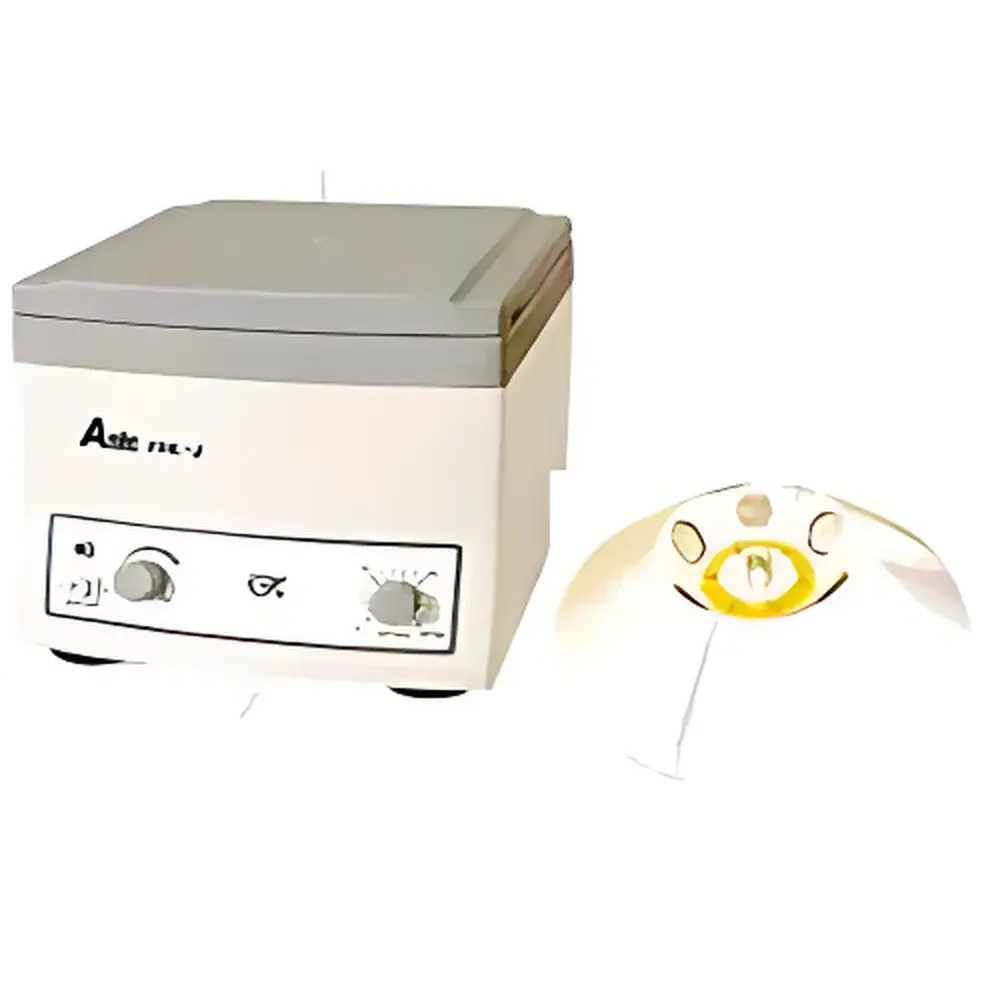
AnTing Feige TDL-4 Benchtop Low-Speed Centrifuge
| Brand | AnTing Feige |
|---|---|
| Origin | Shanghai, China |
| Model | TDL-4 |
| Type | Benchtop Angle Rotor Centrifuge |
| Max Speed | 4000 rpm |
| Max RCF | 1430 ×g |
| Capacity | 20 mL × 6 |
| Timer Range | 0–30 min |
| Power Supply | 220 V, 50 Hz, 65 W |
| Dimensions | 230 × 285 × 265 mm (L×W×H) |
| Weight | 10 kg |
| Compliance | Designed for GLP-compliant laboratory environments |
| Motor | Brushed DC motor with thermal protection |
| Rotor Type | Fixed-angle aluminum rotor (standard configuration) |
| Safety | Mechanical lid interlock, imbalance detection, automatic shutdown |
Overview
The AnTing Feige TDL-4 is a compact, benchtop low-speed centrifuge engineered for routine separation tasks in clinical, biochemical, and quality control laboratories. Operating on the principle of sedimentation under centrifugal force, the TDL-4 accelerates particle separation based on density, size, and shape differences within liquid suspensions. With a maximum rotational speed of 4000 rpm and a relative centrifugal force (RCF) of 1430 ×g, it delivers reproducible pelleting of cells, precipitates, and particulates—particularly suited for blood fractionation (e.g., serum/plasma separation), urine sediment analysis, and crude protein or nucleic acid pellet recovery. Its fixed-angle rotor design ensures rapid sedimentation into tightly packed pellets along the tube wall, optimizing recovery efficiency for volumes up to 20 mL per tube across six positions. The unit’s mechanical simplicity, brush-type DC motor with integrated thermal cutoff, and rigid cast-aluminum housing support long-term operational stability in high-throughput academic and diagnostic settings.
Key Features
- Benchtop footprint (230 × 285 × 265 mm) optimized for space-constrained lab benches and biosafety cabinets
- Fixed-angle aluminum rotor (standard configuration) supporting six 20 mL conical or round-bottom tubes (e.g., 15–20 mL polypropylene centrifuge tubes)
- Precise analog timer (0–30 minutes) with audible end-of-run signal and automatic rotor deceleration
- Mechanical lid interlock system preventing operation when lid is unlatched—compliant with IEC 61010-1 safety requirements for laboratory equipment
- Brushed DC motor with built-in thermal protection circuitry, rated at 65 W continuous duty
- Low-noise operation (<65 dB(A) at 4000 rpm) achieved via balanced rotor assembly and vibration-damping feet
- No user-serviceable electronics; all wiring conforms to Class I electrical safety standards
Sample Compatibility & Compliance
The TDL-4 accommodates standard 15–20 mL centrifuge tubes—including polypropylene, polycarbonate, and glass—with compatibility verified for common biological matrices: whole blood (EDTA/heparinized), serum, plasma, urine supernatants, bacterial culture lysates, and plant tissue homogenates. It is not intended for ultracentrifugation, sealed tube applications (e.g., radioactive or volatile solvents), or high-viscosity polymer solutions exceeding 100 cP. While not certified to ISO 13485 or FDA 21 CFR Part 11, its construction and operational repeatability align with general Good Laboratory Practice (GLP) expectations for non-regulated analytical workflows. Documentation includes factory calibration certificate for speed accuracy (±25 rpm at 4000 rpm) and RCF verification traceable to national metrology standards.
Software & Data Management
The TDL-4 operates as a standalone instrument without embedded microprocessor control or digital interface. All parameters—speed, time, and run initiation—are set manually via front-panel dials and toggle switches. No firmware, data logging, audit trail, or network connectivity is provided. This architecture eliminates software validation requirements and supports regulatory environments where deterministic, non-programmable operation is preferred (e.g., certain ISO/IEC 17025 accredited testing labs). Users maintain manual run logs consistent with internal SOPs; no electronic records are generated or stored.
Applications
- Clinical diagnostics: Separation of serum and plasma from whole blood specimens prior to immunoassay or clinical chemistry analysis
- Microbiology: Pellet recovery of bacterial or yeast cells from broth cultures for Gram staining or DNA extraction
- Food & beverage QA/QC: Clarification of juice, milk, or fermentation broths for turbidity assessment or fat layer isolation
- Environmental testing: Sedimentation of suspended solids in wastewater or soil extracts for gravimetric analysis
- Academic teaching labs: Demonstration of sedimentation kinetics, density gradient principles, and basic centrifugation safety protocols
FAQ
Is the TDL-4 suitable for use with infectious or biohazardous samples?
Yes—when operated inside a certified biosafety cabinet and paired with sealed, screw-cap centrifuge tubes rated for the specified RCF.
Can I replace the angle rotor with a swing-bucket rotor?
No—the TDL-4 is mechanically configured exclusively for its fixed-angle rotor; no alternative rotor adapters or kits are available or validated.
What maintenance is required for long-term reliability?
Routine cleaning of the rotor chamber and lid gasket with 70% ethanol; annual visual inspection of rotor threads and motor belt tension (if applicable); no lubrication or recalibration is required under normal use.
Does the unit meet electromagnetic compatibility (EMC) standards for laboratory deployment?
It complies with EN 61326-1:2013 for electromagnetic emissions and immunity in laboratory environments, as verified during CE marking.
Is rotor balancing mandatory before each run?
Yes—symmetrical tube loading (mass-matched to ±0.1 g) is essential to prevent vibration-induced wear and ensure bearing longevity.



