
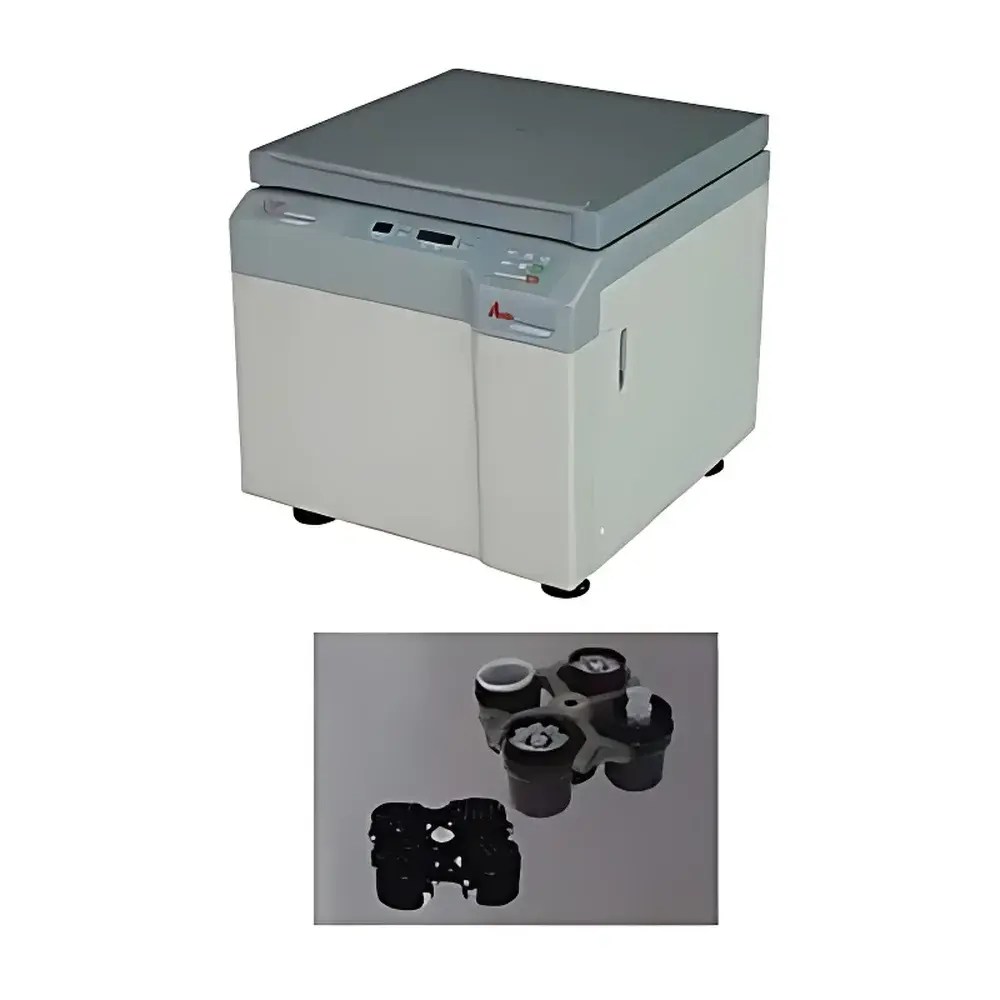
AnTing Feige TDL-5-A Low-Speed Benchtop High-Capacity Centrifuge
| Brand | AnTing Feige |
|---|---|
| Origin | Shanghai, China |
| Model | TDL-5-A |
| Instrument Type | Floor-Standing Low-Speed Centrifuge |
| Max. Speed | 5000 rpm |
| Max. RCF | 5000 ×g |
| Max. Capacity | 4 × 250 mL (horizontal rotor) |
| Dimensions | 460 × 510 × 680 mm |
| Rotor Configurations | Horizontal swing-out rotor with multiple adapter options (250 mL × 4, 100 mL × 4, 50 mL × 8, 15 mL × 16, 10 mL × 36, 2–5 mL × 48, 6 mL × 96, 96-well microplate × 2) |
| Control System | Microprocessor-based digital display with full computer control |
| Safety | Electronic lid lock, imbalance detection, automatic rotor recognition (via preset configuration), over-speed and over-temperature protection |
| Compliance | Designed for GLP-compliant laboratories |
Overview
The AnTing Feige TDL-5-A is a benchtop-configured, floor-standing low-speed centrifuge engineered for high-capacity routine separation tasks in life science, clinical diagnostics, pharmaceutical quality control, and environmental testing laboratories. Operating on the principle of sedimentation under controlled gravitational force (RCF), it delivers reproducible separation of biological suspensions—including whole blood, cell cultures, crude tissue homogenates, and polymer solutions—without inducing thermal stress or mechanical shear damage typical of high-speed systems. Its design prioritizes operational stability at moderate rotational velocities (up to 5000 rpm), minimizing vibrational transmission and acoustic emission (<65 dB(A) at maximum load), thereby supporting placement in shared lab environments without dedicated vibration-damping infrastructure. The unit integrates a robust cast-aluminum housing, precision-machined horizontal swing-out rotor assembly, and thermally insulated centrifuge chamber to limit temperature rise during extended runs—critical for preserving heat-labile analytes such as plasma proteins, exosomes, and enzymatic complexes.
Key Features
- Microprocessor-controlled operation with real-time digital display of speed (rpm), relative centrifugal force (×g), time, and remaining run duration
- Electronic lid interlock system with auto-braking and forced deceleration upon lid opening—certified to IEC 61010-1 Class II safety standards
- Dual-mode acceleration/deceleration profiles: standard (optimized for sample integrity) and rapid (for time-sensitive workflows)
- Pre-programmed rotor memory: stores up to 10 user-defined protocols linked to specific rotor configurations and adapter types
- Passive thermal management architecture: no active refrigeration, but low-power motor design and chamber insulation maintain ambient-equivalent temperature rise ≤3°C over 30-min continuous operation
- Horizontal swing-out rotor (Type 1) accommodating up to four 250 mL bottles or equivalent volumetric combinations via interchangeable adapters—including conical tube, round-bottom, and microcentrifuge tube formats
Sample Compatibility & Compliance
The TDL-5-A supports broad sample format compatibility across biospecimen processing workflows. Its standard horizontal rotor accepts common clinical and research containers: 250 mL polypropylene bottles (e.g., Corning 430776), 100 mL centrifuge tubes (Falcon 352070), 50 mL conical tubes (Falcon 352098), 15 mL and 10 mL conical tubes, 2–5 mL vacuum blood collection tubes (EDTA, heparin, serum separator), and 96-well microplates for high-throughput assay preparation. All rotor configurations are validated for mechanical integrity at rated speeds per ISO 15195:2018 (clinical laboratory centrifuge performance). While not a refrigerated unit, its thermal profile aligns with CLSI GP44-A4 recommendations for non-cryogenic plasma separation. The instrument’s firmware architecture supports audit-trail generation for critical parameters (start/stop time, speed, RCF, rotor ID), facilitating alignment with GLP documentation requirements and internal QA/QC record retention policies.
Software & Data Management
The TDL-5-A operates via embedded firmware with no external PC dependency. All operational data—including run logs, error codes, rotor usage counters, and calibration timestamps—are stored internally in non-volatile memory and exportable via USB port in CSV format. Each protocol includes metadata fields for operator ID, sample batch number, and purpose annotation. Though lacking network connectivity or LIMS integration, the device complies with FDA 21 CFR Part 11 principles through electronic signature support (via password-protected access levels), immutable event logging, and user-level permission tiers (Administrator, Technician, Guest). Firmware updates are performed offline using signed binary packages distributed by authorized service centers.
Applications
- Plasma and serum isolation from whole blood specimens in clinical chemistry and transfusion medicine labs
- Cell pellet recovery from suspension cultures (e.g., CHO, HEK293) prior to lysis or cryopreservation
- Sedimentation of particulate matter in environmental water samples (e.g., algae, suspended solids) per ASTM D3693
- Clarification of fermentation broths and protein expression lysates in biomanufacturing QC workflows
- Phase separation in food emulsion studies (e.g., dairy creaming index, oil-water partitioning)
- Preparative isolation of extracellular vesicles and lipoprotein fractions when coupled with density gradient media
FAQ
Is the TDL-5-A suitable for centrifuging infectious or biohazardous samples?
Yes—when used with sealed, certified biosafety-compatible rotors and tubes (e.g., OSHA-compliant leak-proof caps), and operated inside a certified BSL-2 cabinet if required by institutional biosafety protocols.
Does the instrument support rotor calibration verification?
Yes—built-in self-diagnostic routines verify rotor balance, drive shaft alignment, and speed sensor accuracy; calibration certificates traceable to NIM (National Institute of Metrology, China) are provided with initial commissioning.
Can the TDL-5-A be integrated into automated lab workflows?
No native Ethernet or RS-232 interface is included; however, third-party PLC-triggered start/stop signals can be implemented via optional dry-contact I/O module (sold separately).
What maintenance intervals are recommended?
Lubrication-free brushless DC motor requires no scheduled lubrication; annual inspection of rotor threads, lid seal integrity, and brake pad wear is advised per manufacturer service bulletin SB-TDL5A-2023-01.
Are replacement rotors and adapters available globally?
Original-equipment rotors and adapters are distributed through authorized AnTing Feige service partners in EMEA, APAC, and LATAM regions; lead time averages 4–6 weeks for non-stock items.



