
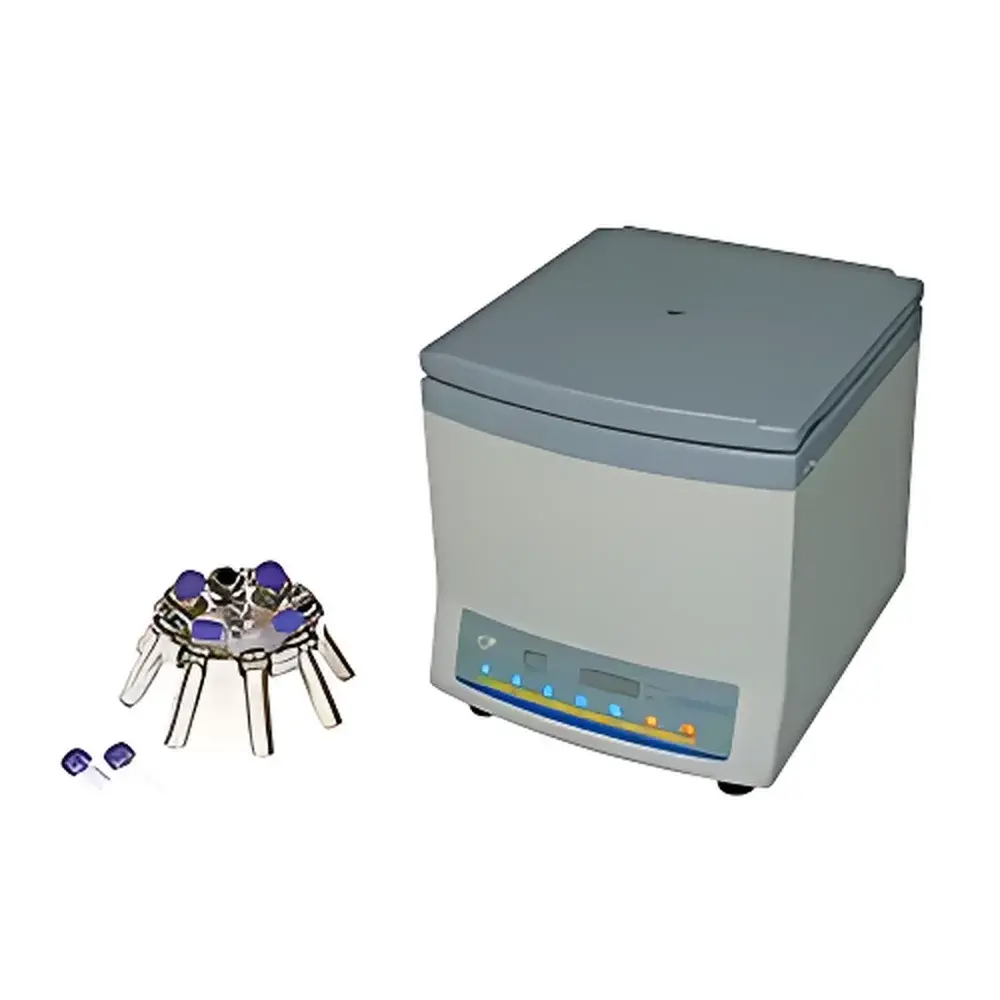
AnTing FeiGe TDL-50B Benchtop Low-Speed Centrifuge
| Brand | AnTing FeiGe |
|---|---|
| Origin | Shanghai, China |
| Instrument Type | Benchtop Centrifuge |
| Max. Speed | 5000 rpm |
| Max. RCF | 3800 ×g |
| Rotor Type | Swing-Bucket |
| Capacity | 15 mL × 8 |
| Timer Range | 0–60 min |
| Power Supply | 220 V, 50 Hz, 250 W |
| Dimensions (L×W×H) | 350 mm × 390 mm × 350 mm |
| Weight | 20 kg |
| Control System | Microprocessor-controlled with Frequency Converter |
| Safety Features | Electronic door lock, automatic imbalance detection, rotor recognition (mechanical) |
| Compliance | Designed per GB/T 13786–2008 (Chinese National Standard for Centrifuges), compatible with ISO 13485-aligned lab environments |
Overview
The AnTing FeiGe TDL-50B Benchtop Low-Speed Centrifuge is a microprocessor-controlled, swing-bucket centrifuge engineered for routine separation tasks in life science and clinical laboratories. It operates on the principle of sedimentation under controlled gravitational force—generating up to 3800 ×g at its maximum rotational speed of 5000 rpm—to separate components based on density differentials in heterogeneous liquid samples. Its design prioritizes operational stability, acoustic efficiency, and user safety, making it suitable for applications requiring gentle yet reproducible pelleting of cells, precipitates, or particulates without inducing shear-induced damage. The unit complies with fundamental mechanical and electrical safety requirements outlined in GB/T 13786–2008 and supports laboratory workflows aligned with GLP principles through consistent speed accuracy, time-based termination, and fail-safe lid interlock mechanisms.
Key Features
- Microprocessor-based digital control system with frequency converter-driven brushless motor, enabling precise speed regulation across the full 0–5000 rpm range and high-speed stability (±10 rpm typical deviation).
- Swing-bucket rotor configuration with eight positions accommodating standard 15 mL conical tubes (e.g., Falcon-style), ensuring uniform radial orientation during acceleration and deceleration for optimal sedimentation geometry.
- Integrated electronic door lock with automatic engagement/disengagement; rotor cannot spin unless lid is fully closed and secured, preventing accidental exposure during operation.
- Automatic imbalance detection algorithm halts rotation immediately if mass asymmetry exceeds safe thresholds, protecting both rotor integrity and drive assembly.
- Low-noise enclosure constructed from reinforced engineering-grade polymer housing, reducing operational sound pressure level to ≤65 dB(A) at 1 m distance—ideal for shared benchtop environments.
- Programmable timer with 1-minute resolution from 0 to 60 minutes, supporting unattended batch processing with audible end-of-run alert.
Sample Compatibility & Compliance
The TDL-50B accommodates common disposable polypropylene or polycarbonate centrifuge tubes (10–20 mL nominal volume), including those used for serum separation, urinalysis sediment preparation, and basic cell culture supernatant clarification. It is routinely deployed in pre-analytical sample preparation workflows compliant with CLSI GP42-A5 guidelines for centrifugal separation prior to immunoassay or clinical chemistry analysis. While not certified to IEC 61010-2-020 as a standalone medical device, its construction and performance parameters meet essential safety criteria referenced in ISO/IEC 17025-accredited testing laboratories for non-diagnostic sample conditioning. The rotor is mechanically balanced and marked with serial identification for traceability; no rotor certification documentation is supplied by default, but users may perform periodic balance verification using calibrated test masses.
Software & Data Management
The TDL-50B operates via embedded firmware without external software dependency. All operational parameters—including speed, time, and status—are displayed on a dual-digit LED interface with intuitive push-button navigation. No data logging, USB export, or network connectivity is provided; however, the instrument supports audit-ready manual recordkeeping through standardized run logs (date, operator ID, rotor type, speed, duration, observed anomalies). For labs operating under FDA 21 CFR Part 11 or EU Annex 11 requirements, external electronic lab notebook (ELN) integration is achievable via timestamped photo documentation of display readouts and handwritten entry cross-referenced to batch numbers.
Applications
- Serum and plasma separation from whole blood specimens (e.g., 15-min spin at 3000 rpm for routine clinical chemistry panels).
- Pelleting of mammalian cells post-harvest (e.g., HEK293 or CHO lines) prior to lysis buffer addition.
- Clarification of bacterial lysates or crude enzyme extracts before filtration or chromatography steps.
- Urine sediment concentration for microscopic examination in nephrology or urology screening protocols.
- Removal of insoluble aggregates from protein solutions during early-stage bioprocess development.
- Preparative isolation of extracellular vesicles using differential low-speed clearance prior to ultracentrifugation.
FAQ
What rotor types are compatible with the TDL-50B?
Only the factory-supplied swing-bucket rotor (15 mL × 8) is validated for use. Substitution with non-OEM rotors voids safety compliance and invalidates warranty coverage.
Is rotor calibration required before first use?
No factory calibration is needed—the rotor is statically balanced at manufacture. Users should verify visual symmetry and secure mounting before each run.
Can this centrifuge be used for clinical diagnostics under CAP or CLIA regulations?
Yes, provided that SOPs include documented preventive maintenance, speed verification using a certified tachometer annually, and logbook entries for every run.
Does the unit support continuous operation mode?
No—it is designed for timed intermittent runs only; the 60-minute maximum timer prevents thermal overload and ensures motor longevity.
What maintenance intervals are recommended?
Clean chamber weekly with 70% ethanol; inspect rotor threads and bucket hinges monthly; replace carbon brushes every 2000 hours of cumulative runtime (approx. 2 years at 3 runs/day).
Related Products



