
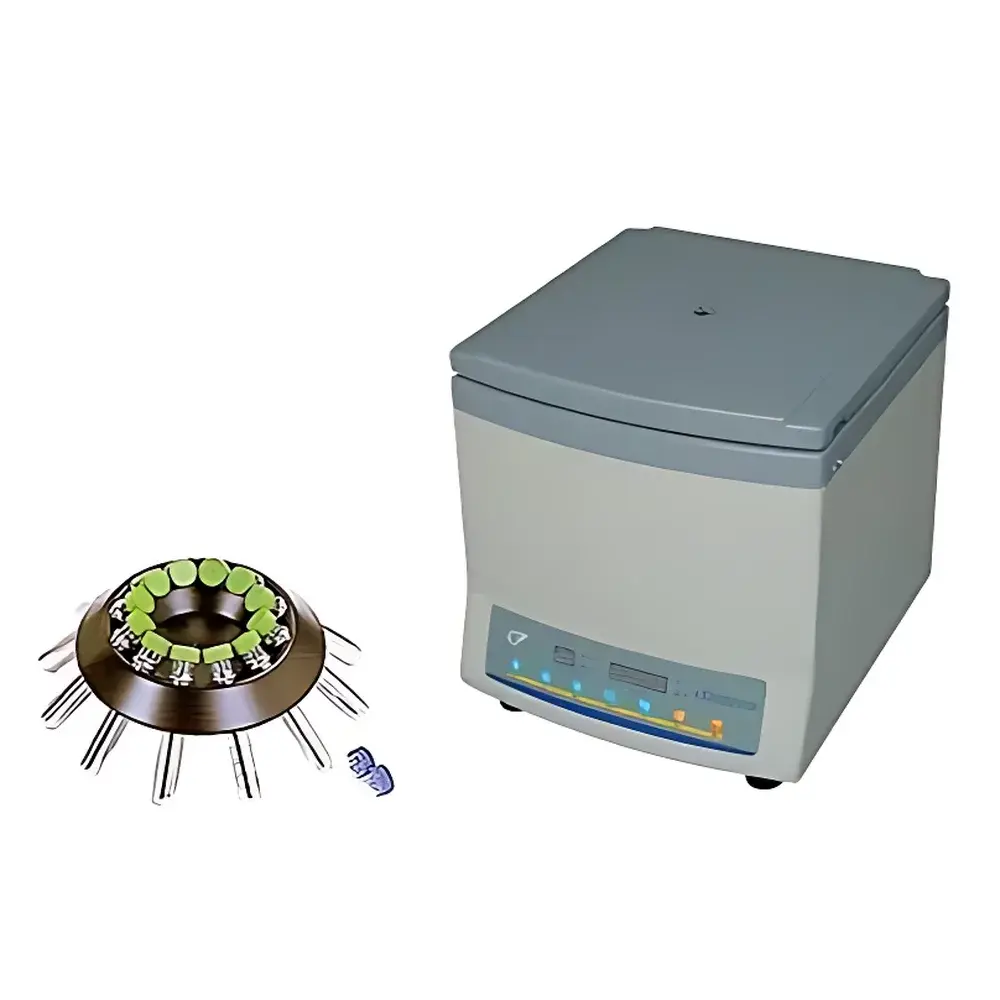
AnTing Feige TDL-60B Benchtop Low-Speed Centrifuge
| Brand | AnTing Feige |
|---|---|
| Origin | Shanghai, China |
| Model | TDL-60B |
| Instrument Type | Benchtop Centrifuge |
| Speed Range | 0–6000 rpm |
| Max RCF | 5200 ×g |
| Max Capacity | 12 × 20 mL (angular rotor) |
| Timer Range | 0–99 min |
| Power Supply | 220 V, 50 Hz, 400 W |
| Dimensions (L×W×H) | 380 × 350 × 360 mm |
| Weight | 20 kg |
| Construction | Reinforced polymer housing |
| Drive System | Inverter-controlled brushless motor |
| Safety | Electronic door interlock |
| Compliance | Designed for GLP-aligned laboratory workflows |
Overview
The AnTing Feige TDL-60B is a benchtop low-speed centrifuge engineered for routine separation tasks in clinical diagnostics, biomedical research, and quality control laboratories. It operates on the principle of sedimentation under controlled gravitational force—generating up to 5200 ×g at its maximum rotational speed of 6000 rpm—to separate suspended particles, cells, or precipitates from liquid phases based on density differentials. Unlike high-speed or refrigerated models, the TDL-60B is optimized for applications requiring gentle yet reproducible pelleting of whole blood components (e.g., serum, plasma), urine sediments, bacterial cultures, and tissue homogenates—without inducing thermal stress or shear-induced lysis. Its compact footprint (380 × 350 × 360 mm) and 20 kg mass enable stable operation on standard lab benches, while the reinforced polymer housing provides structural integrity and vibration damping during extended runs.
Key Features
- Inverter-driven brushless motor delivering precise speed regulation across the full 0–6000 rpm range, with typical speed accuracy ±20 rpm and minimal drift over time
- Microprocessor-based control system with digital display for real-time monitoring of speed, elapsed time, and remaining runtime
- Electronic door interlock ensuring automatic motor shutdown when the lid is opened mid-run—meeting IEC 61010-1 safety requirements for laboratory equipment
- Self-balancing rotor detection mechanism that identifies gross imbalance before acceleration, preventing excessive vibration or mechanical strain
- Angular rotor configuration (12 × 20 mL) enabling simultaneous processing of standard polypropylene or glass centrifuge tubes; rotor material complies with ISO 15195 for compatibility with common biological reagents
- Thermally insulated housing minimizes ambient heat transfer, maintaining sample temperature stability within ±2°C during 30-minute continuous operation
Sample Compatibility & Compliance
The TDL-60B accommodates widely used 15–20 mL conical centrifuge tubes—including those conforming to ASTM D4169 and ISO 8536-4 specifications—without adapter requirements. It supports protocols aligned with CLSI GP44-A4 for clinical centrifugation and USP <711> for dissolution testing sample preparation. While not certified for GMP manufacturing environments, its design facilitates audit-ready documentation: all operational parameters (speed, time, date/time stamp) are retained in non-volatile memory for up to 100 cycles and can be manually logged for GLP traceability. The unit meets CE marking requirements under the EU Machinery Directive 2006/42/EC and electromagnetic compatibility standards EN 61326-1.
Software & Data Management
The TDL-60B operates via embedded firmware without external software dependency. All user inputs and system events—including start/stop timestamps, rotor identification (where applicable), and error codes—are stored locally in EEPROM. No USB, Ethernet, or Wi-Fi connectivity is provided, eliminating cybersecurity exposure points common in networked instruments. For regulated environments requiring electronic records, users may integrate manual log entries into LIMS or ELN platforms per FDA 21 CFR Part 11 Annex A guidelines—leveraging the device’s deterministic behavior and repeatable parameter execution as foundational validation evidence.
Applications
- Clinical laboratories: Separation of serum and plasma from whole blood specimens prior to immunoassay or clinical chemistry analysis
- Blood banking: Routine processing of donor units for component separation (RBCs, platelets, fresh frozen plasma)
- Microbiology: Pellet recovery of bacterial or yeast cultures from broth media for Gram staining or antibiotic susceptibility testing
- Biotechnology QA/QC: Clarification of cell lysates, protein solutions, or buffer preparations prior to filtration or chromatography
- Educational labs: Demonstrating sedimentation kinetics, density gradient principles, and centrifugal force calculations in undergraduate physics and life sciences curricula
FAQ
What is the maximum relative centrifugal force (RCF) achievable with the TDL-60B?
The TDL-60B delivers a maximum RCF of 5200 ×g at 6000 rpm with the standard 20 mL angular rotor.
Does the centrifuge support refrigeration?
No—the TDL-60B is a non-refrigerated model intended for ambient-temperature separations only.
Can it accommodate swing-bucket rotors?
No—it is configured exclusively for fixed-angle rotors; swing-bucket compatibility is not supported by this model.
Is rotor calibration required prior to use?
Rotor geometry is factory-verified; no user calibration is needed—however, visual inspection for cracks or deformation is recommended before each use per ISO 20347.
What maintenance intervals are advised?
Routine cleaning of the chamber and rotor every 50 operating hours; annual inspection of motor brushes (if accessible) and door interlock function is recommended.



