
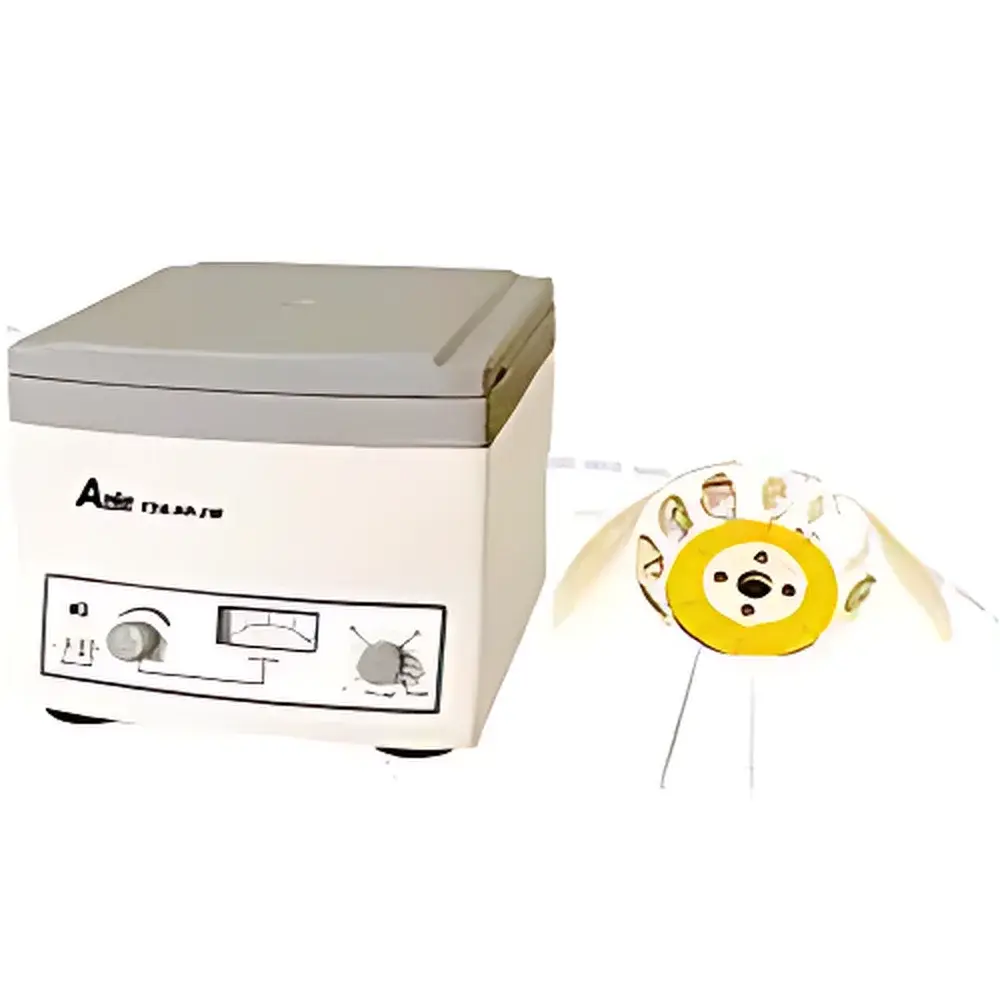
AnTing FeiGe TDL-80-2B Benchtop Low-Speed Centrifuge
| Brand | AnTing FeiGe |
|---|---|
| Origin | Shanghai, China |
| Model | TDL-80-2B |
| Type | Benchtop Centrifuge |
| Speed Range | 0–4000 rpm |
| Max RCF | 2325 ×g |
| Rotor Type | Fixed-angle rotor |
| Max Capacity | 12 × 20 mL |
| Power Supply | 220 V, 50 Hz, 135 W |
| Dimensions (L×W×H) | 280 × 310 × 265 mm |
| Weight | 12 kg |
| Compliance | CE-marked for laboratory use under IEC 61010-1 |
Overview
The AnTing FeiGe TDL-80-2B is a compact, benchtop low-speed centrifuge engineered for routine separation tasks in clinical, biochemical, and teaching laboratories. It operates on the principle of sedimentation under centrifugal force—accelerating phase separation by applying radial acceleration to heterogeneous mixtures. With a maximum rotational speed of 4000 rpm and a corresponding relative centrifugal force (RCF) of 2325 ×g, the instrument delivers sufficient g-force for pelleting whole blood components (e.g., erythrocytes, leukocytes), clarifying serum or plasma, and isolating cellular debris without compromising sample integrity. Its fixed-angle rotor design ensures rapid, reproducible sedimentation of samples in standard 20 mL tubes, making it particularly suitable for high-throughput batch processing in diagnostic workflows where thermal stability and mechanical consistency are prioritized over ultra-high g-force performance.
Key Features
- Compact footprint (280 × 310 × 265 mm) optimized for space-constrained lab benches and mobile clinical units.
- Lightweight construction (12 kg) with reinforced polymer housing offering impact resistance and corrosion resistance against common reagents.
- Brushless DC motor delivering quiet operation (<65 dB(A) at full speed) and extended service life with minimal maintenance.
- Intuitive analog control panel with dual-dial speed/RCF selection and mechanical timer (0–60 min), enabling rapid setup without software dependency.
- Automatic rotor recognition not supported; however, the fixed-angle aluminum rotor is precision-balanced and certified for continuous operation at rated speed.
- Over-speed and imbalance detection circuits comply with IEC 61010-1 safety requirements for Class II laboratory equipment.
Sample Compatibility & Compliance
The TDL-80-2B accommodates up to twelve 20 mL conical or round-bottom centrifuge tubes (e.g., polypropylene or glass), supporting standard protocols for serum separation (e.g., CLSI GP44-A4), plasma preparation, and cell washing in hematology and immunoassay workflows. It meets essential electrical and mechanical safety standards applicable to general-purpose centrifuges sold in the EU and North America, including conformity with IEC 61010-1:2010 (Safety Requirements for Electrical Equipment for Measurement, Control, and Laboratory Use). While not specifically validated for GLP/GMP environments requiring 21 CFR Part 11-compliant audit trails, its mechanical reliability and consistent RCF output support data traceability when integrated into documented SOPs. The device is not intended for biosafety level 3 (BSL-3) containment or ultracentrifugation applications involving nucleic acids or subcellular organelles.
Software & Data Management
The TDL-80-2B operates as a standalone, hardware-controlled instrument with no embedded microprocessor or digital interface. All operational parameters—including speed, time, and run status—are monitored via analog dials and LED indicators. No proprietary software, USB connectivity, or data logging capability is provided. This architecture eliminates firmware-related validation burdens and aligns with laboratories maintaining legacy infrastructure or adhering to simplified quality systems (e.g., ISO/IEC 17025 Clause 6.4.3 on equipment suitability). Users record run parameters manually in logbooks or LIMS-integrated forms, ensuring full procedural transparency and compatibility with paper-based or hybrid QA documentation practices.
Applications
- Routine serum/plasma separation from whole blood specimens prior to ELISA, radioimmunoassay (RIA), or clinical chemistry analysis.
- Sedimentation of precipitated proteins or immune complexes in qualitative agglutination assays.
- Clarification of bacterial culture supernatants and yeast lysates in undergraduate and vocational training labs.
- Preparative isolation of erythrocytes for hematocrit determination or red blood cell washing protocols.
- Processing of contrast media or radiopharmaceutical suspensions where low-shear, non-refrigerated separation is required.
FAQ
What is the maximum tube capacity per run?
The instrument accepts one fixed-angle rotor holding twelve 20 mL centrifuge tubes—total nominal capacity of 240 mL per run.
Does the TDL-80-2B include refrigeration?
No. This is a non-refrigerated centrifuge; ambient temperature operation only. Samples requiring thermal control must be pre-chilled.
Is rotor balancing mandatory before each run?
Yes. Symmetrical loading of all positions—or use of balance tubes filled with water—is required to prevent vibration-induced wear or shutdown.
Can this centrifuge be used for virus or exosome isolation?
No. Its maximum RCF (2325 ×g) is insufficient for pelleting extracellular vesicles or enveloped viruses, which typically require ≥100,000 ×g.
What safety certifications does the unit carry?
It conforms to IEC 61010-1:2010 for electrical safety and carries CE marking for laboratory equipment placed on the European market.



