
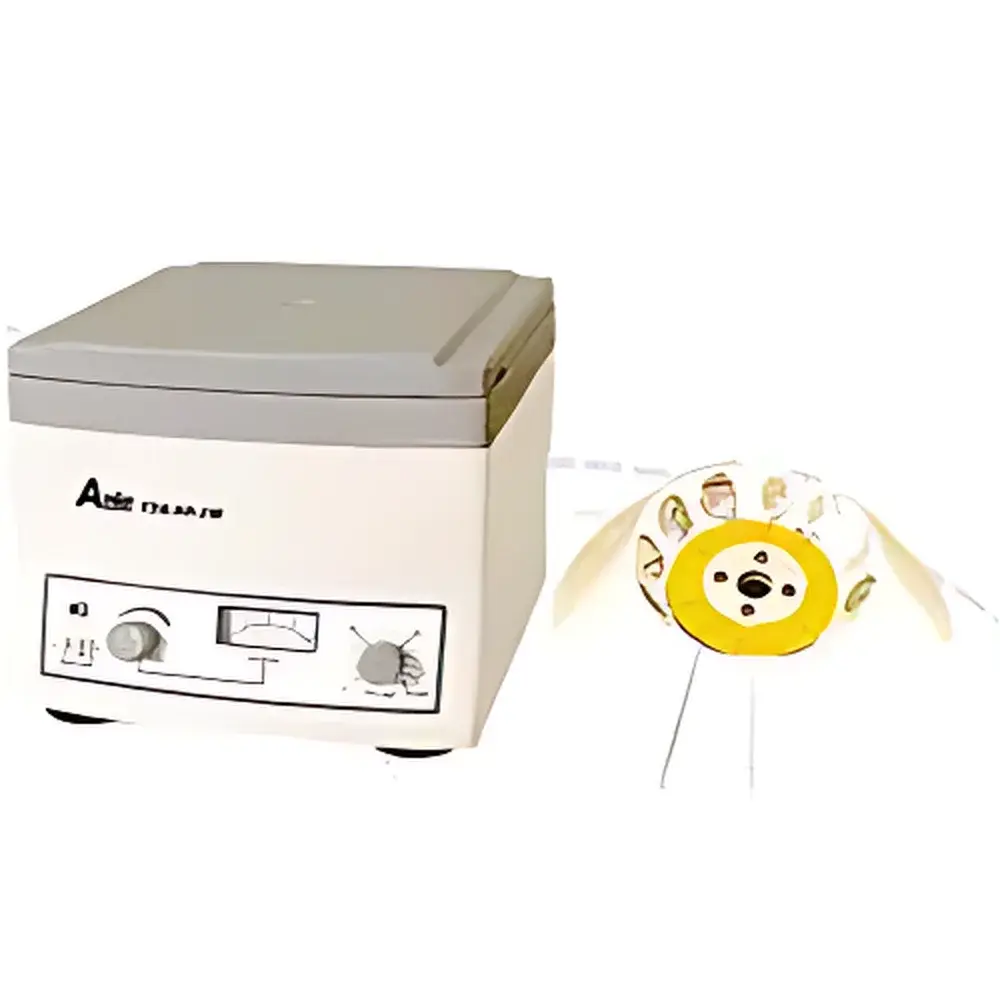
AnTing Feige TDL-80-2B Benchtop Low-Speed Centrifuge
| Brand | AnTing Feige |
|---|---|
| Origin | Shanghai, China |
| Model | TDL-80-2B |
| Instrument Type | Benchtop Centrifuge |
| Max. Speed | 4000 rpm |
| Max. RCF | 2325 ×g |
| Capacity | 12 × 20 mL (angular rotor) |
| Power Supply | 220 V, 50 Hz, 135 W |
| Dimensions (L×W×H) | 280 × 310 × 365 mm |
| Weight | 12 kg |
| Control System | Microprocessor-based digital display with touch panel |
| Motor Type | Brushless DC motor |
| Safety Features | Overspeed protection, imbalance detection, lid interlock |
| Compliance | Designed for GLP-compliant routine laboratory workflows |
Overview
The AnTing Feige TDL-80-2B is a microprocessor-controlled benchtop low-speed centrifuge engineered for reproducible sedimentation of biological suspensions in clinical, diagnostic, and research laboratories. Operating on the principle of radial acceleration-induced phase separation, it applies controlled centrifugal force to accelerate the settling of particles—such as blood cells, precipitated proteins, or cellular debris—based on their density, size, and shape relative to the surrounding medium. With a maximum rotational speed of 4000 rpm and a corresponding relative centrifugal force (RCF) of 2325 ×g, the TDL-80-2B delivers sufficient g-force for routine applications including serum/plasma separation, urine sediment analysis, and basic immunoprecipitation workflows—without compromising thermal stability or mechanical integrity. Its compact footprint (280 × 310 × 365 mm) and lightweight construction (12 kg) make it suitable for shared lab benches, mobile diagnostic units, and quality control stations where space and power efficiency are constrained.
Key Features
- Brushless DC motor ensuring extended service life, minimal maintenance, and consistent torque delivery across operational range
- Digital microprocessor control with real-time RPM/RCF dual-display and intuitive touch-panel interface
- Programmable operation with memory for up to 9 user-defined protocols, supporting repeatable method execution
- Automatic RCF calculation and direct RCF setting mode—eliminating manual conversion errors
- Integrated safety architecture: electronic overspeed cutoff, dynamic imbalance sensing, and mechanically interlocked lid switch
- High-strength polymer housing providing electromagnetic shielding, acoustic dampening (<65 dB(A) at 4000 rpm), and chemical resistance to common disinfectants
- Standard angular rotor configuration accommodating twelve 20 mL conical tubes (e.g., Falcon® 20 mL); compatible with optional 10 mL and 15 mL rotors for protocol flexibility
Sample Compatibility & Compliance
The TDL-80-2B supports standard polypropylene and polycarbonate centrifuge tubes (10–20 mL) used in clinical chemistry, hematology, and immunoassay workflows. It is routinely deployed for processing whole blood (EDTA, heparin, or serum separator tubes), urine supernatants, and clarified cell lysates. While not certified for biosafety level 3 (BSL-3) containment, its sealed rotor chamber and lid interlock meet ISO 13485-aligned design principles for in vitro diagnostic (IVD) equipment. The instrument operates within Class II electrical safety standards (IEC 61010-1) and supports audit-ready documentation when integrated into GLP or CAP-accredited environments—particularly where traceability of centrifugation parameters (time, speed, RCF) is required for method validation.
Software & Data Management
The TDL-80-2B operates as a standalone unit without external software dependency. All operational parameters—including run time, set speed, actual RCF, and elapsed duration—are displayed in real time and retained in non-volatile memory for the last 10 runs. Though lacking network connectivity or FDA 21 CFR Part 11-compliant electronic signatures, its deterministic control logic and hardware-enforced safety limits ensure data integrity for routine QC documentation. For laboratories requiring electronic record integration, analog output signals (0–5 V) can be interfaced with external data loggers via optional I/O module (sold separately), enabling timestamped parameter capture aligned with LIMS workflows.
Applications
- Routine serum and plasma separation from whole blood specimens prior to ELISA, electrophoresis, or clinical chemistry analysis
- Sediment concentration in urinalysis and microbiological culture preparation
- Clarification of crude tissue homogenates and bacterial cell pellets in molecular biology prep workflows
- Radioimmunoassay (RIA) sample processing where low-shear, low-heat conditions preserve antigen integrity
- Quality control testing of reagent stability, particulate content, and suspension uniformity in pharmaceutical manufacturing support labs
FAQ
What is the maximum tube capacity supported by the standard rotor?
The default angular rotor accepts twelve 20 mL conical centrifuge tubes (e.g., 16 × 100 mm format). Optional rotors for 10 mL and 15 mL tubes are available as accessories.
Does the TDL-80-2B support refrigeration?
No. This model is a non-refrigerated centrifuge intended for ambient-temperature applications only. Samples requiring thermal control must be pre-chilled prior to loading.
Is calibration traceable to national standards?
Speed calibration is performed using an NIST-traceable optical tachometer during factory verification. A certificate of conformance (CoC) is supplied with each unit; full metrological calibration services are available through authorized AnTing service centers.
Can this centrifuge be used for hazardous samples?
It is not rated for use with volatile organic solvents, radioactive isotopes above exempt quantities, or aerosol-generating biohazards. Use only with sealed tubes and appropriate secondary containment per institutional biosafety guidelines.
What maintenance intervals are recommended?
Routine cleaning of rotor chamber and lid seal is advised after each use. Full preventive maintenance—including bearing inspection and motor brushless controller diagnostics—is recommended every 12 months or after 1000 operating hours, whichever occurs first.



