
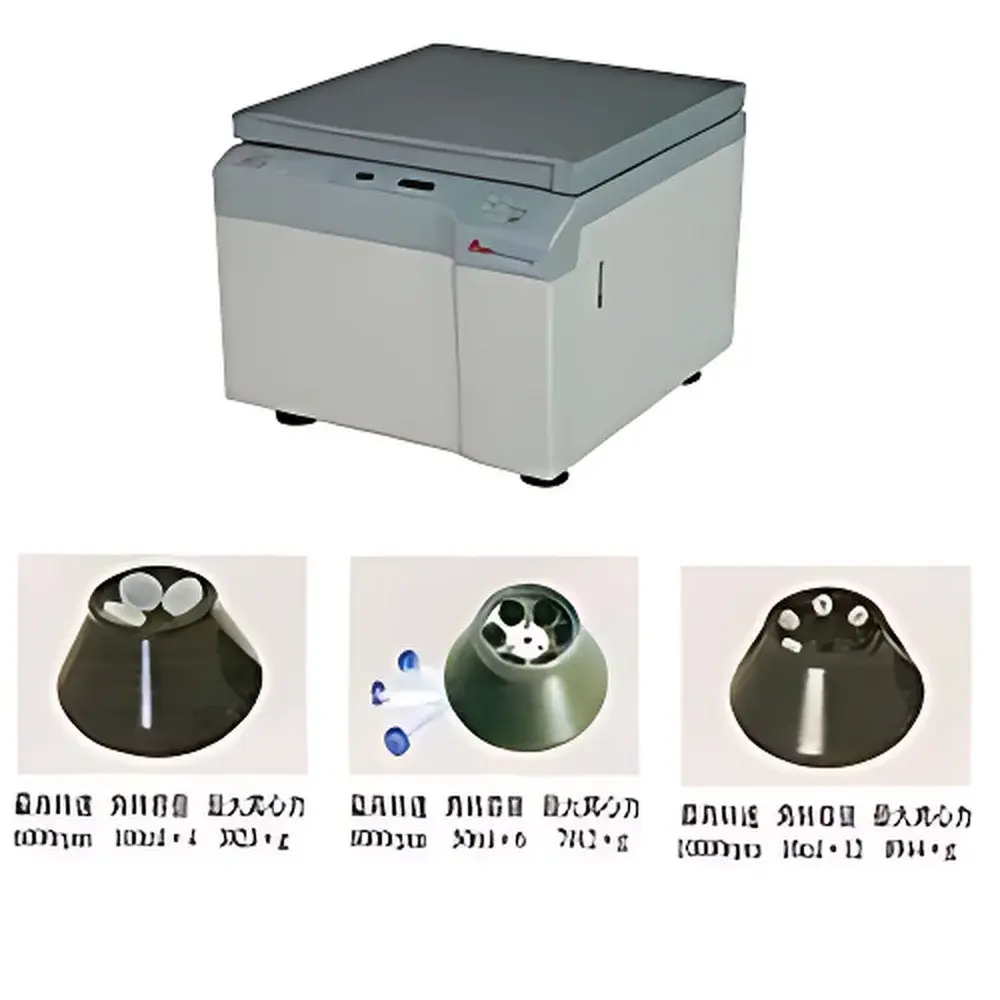
AnTing Feige TGL-10B Benchtop High-Speed Centrifuge
| Brand | AnTing Feige |
|---|---|
| Origin | Shanghai, China |
| Manufacturer Type | Authorized Distributor |
| Product Category | Domestic |
| Model | TGL-10B |
| Instrument Type | Benchtop Centrifuge |
| Speed Range | 10,000 rpm |
| Max RCF | 8,944 ×g |
| Max Capacity | 100 mL × 4 |
| Dimensions (L×W×H) | 500 × 540 × 570 mm |
| Noise Level | <70 dB(A) |
| Power Supply | 220 V, 50 Hz |
| Weight | 47 kg |
| Timer Range | 0–99 min |
| Rotor Configurations | Angle rotor No.1 (100 mL × 4 at 6,000 rpm), No.2 (50 mL × 6 at 8,000 rpm), No.3 (10 mL × 12 at 10,000 rpm) |
Overview
The AnTing Feige TGL-10B is a microprocessor-controlled benchtop high-speed centrifuge engineered for precision separation in routine and research-grade laboratory environments. It operates on the principle of sedimentation under controlled rotational acceleration, enabling differential separation of suspended particles based on size, density, and shape. With a maximum rotational speed of 10,000 rpm and a peak relative centrifugal force (RCF) of 8,944 ×g, the TGL-10B delivers consistent performance across a wide range of biological and biochemical applications—including cell pelleting, subcellular fractionation, nucleic acid purification, and protein precipitation. Its compact footprint (500 × 540 × 570 mm) and low operational noise (<70 dB[A]) make it suitable for shared lab spaces, biosafety cabinets, and quality control laboratories where spatial efficiency and acoustic comfort are critical design considerations.
Key Features
- AC variable-frequency motor drive ensures smooth acceleration/deceleration profiles, extended rotor lifespan, and reduced mechanical wear.
- Microprocessor-based digital control system with intuitive LED display for real-time monitoring of speed, RCF, time, and remaining runtime.
- Electronic safety door lock with automatic rotor recognition logic prevents operation unless the lid is fully engaged and balanced load conditions are verified.
- Reinforced stainless-steel chamber with optimized airflow design minimizes temperature rise during prolonged runs—critical for heat-sensitive samples such as enzymes or plasmid preparations.
- Three pre-calibrated angle rotors included: No.1 (100 mL × 4, rated up to 6,000 rpm / 3,823 ×g), No.2 (50 mL × 6, rated up to 8,000 rpm / 7,012 ×g), and No.3 (10 mL × 12, rated up to 10,000 rpm / 8,944 ×g).
- Programmable timer (0–99 minutes) with auto-stop and audible alert; supports both continuous and timed operation modes.
Sample Compatibility & Compliance
The TGL-10B accommodates standard conical-bottom centrifuge tubes (10–100 mL), including polypropylene, polycarbonate, and glass variants compatible with common aqueous and organic solvents. It supports ISO-certified rotor balancing protocols and meets general electrical safety requirements per GB 4793.1–2007 (equivalent to IEC 61010-1). While not certified for clinical diagnostics or GMP manufacturing environments, its reproducible speed/RCF output and traceable timer functionality support GLP-aligned documentation practices. For regulated workflows requiring audit trails, users may integrate external logging via RS-232 interface (optional accessory).
Software & Data Management
The TGL-10B operates without proprietary software—its embedded firmware provides full local control and parameter retention across power cycles. All run parameters (speed, time, RCF) are stored in non-volatile memory and recalled upon restart. Optional RS-232 serial output enables connection to third-party LIMS or lab notebook systems for automated data capture. No cloud dependency or license management is required; all configuration remains locally editable by authorized personnel. Firmware updates (if released) are distributed via USB flash drive following manufacturer-provided checksum verification procedures.
Applications
- Routine isolation of mammalian and microbial cells from culture supernatants.
- Pelleting of mitochondria, lysosomes, and other organelles in subcellular fractionation workflows.
- Clarification of crude lysates prior to chromatography or electrophoresis.
- Concentration and recovery of DNA, RNA, and viral particles from low-volume samples.
- Preparative centrifugation in agricultural biochemistry—e.g., extraction of plant metabolites or soil microbial consortia.
- QC testing of suspension stability in pharmaceutical suspensions and colloidal formulations.
FAQ
What is the maximum recommended run time for continuous operation?
The TGL-10B is rated for uninterrupted operation up to 99 minutes per cycle. For extended protocols, allow ≥15 minutes cooling interval between consecutive runs to maintain thermal stability.
Can this centrifuge be used with sealed tubes containing hazardous materials?
Yes—provided tubes are rated for the specified RCF and sealed according to ISO 15190:2020 containment guidelines. The rotor chamber is designed to contain minor tube rupture events, but biosafety level–appropriate PPE and secondary containment remain mandatory.
Is rotor calibration traceable to national standards?
Rotor geometry and mass distribution are factory-verified against reference instruments calibrated per CNAS-CL06:2022. Certificate of Conformance is supplied with each unit.
Does the instrument support user-defined rotor profiles?
No—rotor-specific speed limits and RCF values are hard-coded into firmware to prevent over-speeding. Only the three included angle rotors are recognized and enabled.
What maintenance schedule is recommended?
Visual inspection of rotor threads and chamber gasket every 100 hours of use; annual professional servicing includes bearing assessment, brake calibration, and electrical safety testing.



