
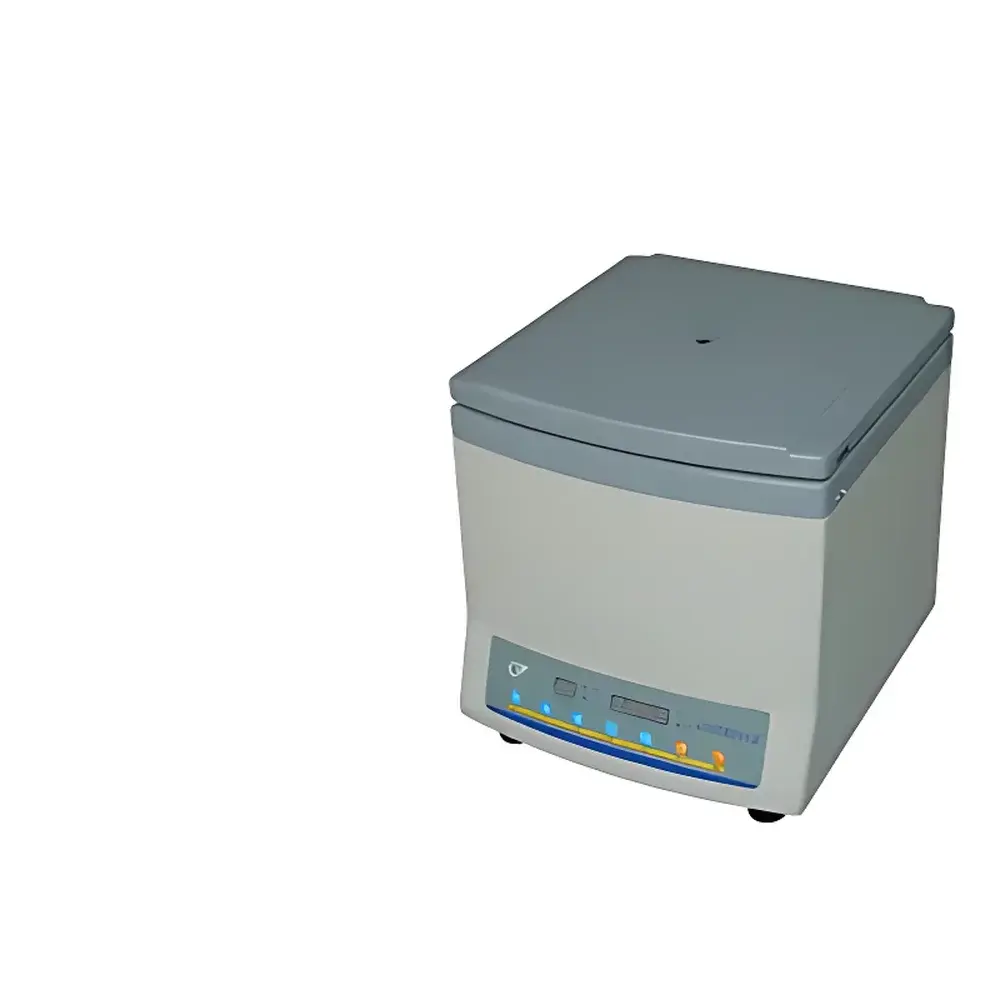
AnTing Feige TGL-16B High-Speed Benchtop Centrifuge
| Brand | AnTing Feige |
|---|---|
| Origin | Shanghai, China |
| Instrument Type | Benchtop Centrifuge |
| Maximum Speed | 16500 rpm |
| Maximum RCF | 18080 ×g |
| Capacity | 12 × 1.5 mL / 2 mL tubes (angle rotor) |
| Dimensions | 350 × 390 × 350 mm (L × W × H) |
| Power Supply | 220 V, 50 Hz, 250 W |
| Timer Range | 0–60 min |
| Noise Level | ≤70 dB(A) |
| Safety | Electronic lid lock, microprocessor control, automatic rotor identification (via preset parameters), over-speed and imbalance protection |
Overview
The AnTing Feige TGL-16B High-Speed Benchtop Centrifuge is a precision-engineered, microprocessor-controlled laboratory centrifuge designed for routine and research-grade separation tasks in life science laboratories. Operating on the principle of sedimentation under high gravitational force (RCF), it enables rapid pelleting of cellular components, subcellular organelles, nucleic acids, proteins, and precipitated reagents from small-volume samples. With a maximum rotational speed of 16,500 rpm and an achievable relative centrifugal force (RCF) of 18,080 ×g, the TGL-16B delivers consistent performance across reproducible spin protocols—critical for applications requiring tight control over g-force exposure time and thermal stability. Its compact footprint (350 × 390 × 350 mm), low-noise operation (≤70 dB[A]), and minimal cavity temperature rise during extended runs make it suitable for shared lab environments and laminar flow hoods where acoustic and thermal interference must be minimized.
Key Features
- Microprocessor-based digital control system with intuitive LED display for real-time monitoring of speed, time, and remaining run duration
- Electronic lid interlock mechanism compliant with IEC 61010-2-020 safety standards—prevents operation unless lid is fully closed and locked
- Brushless DC motor ensuring long service life, low maintenance, and stable torque delivery across speed range
- Angle rotor configuration optimized for 1.5 mL and 2 mL microcentrifuge tubes; compatible with optional 0.5 mL adapters for high-throughput sample processing
- Programmable timer (0–60 minutes) with auto-brake and auto-stop functions to prevent sample overheating or over-centrifugation
- Robust housing constructed from reinforced engineering plastic, providing structural integrity while minimizing vibration transmission
- Over-speed, imbalance, and overspeed cut-off safeguards integrated into firmware for fail-safe operation
Sample Compatibility & Compliance
The TGL-16B supports standard conical-bottom polypropylene microcentrifuge tubes (1.5 mL and 2 mL), as well as PCR strip-compatible formats when used with certified adapters. It is routinely deployed in workflows aligned with GLP-compliant quality control procedures in biopharmaceutical QC labs, academic molecular biology core facilities, and agricultural biotechnology research groups. While not certified to ISO/IEC 17025 or FDA 21 CFR Part 11 out-of-the-box, its repeatable RCF output, traceable timer function, and electronic audit trail (via internal event logging of start/stop times and error codes) support documentation requirements for internal SOP adherence. The unit meets CE marking requirements under the Low Voltage Directive (2014/35/EU) and Electromagnetic Compatibility Directive (2014/30/EU).
Software & Data Management
The TGL-16B operates via embedded firmware without external PC connectivity. All operational parameters—including speed (rpm), RCF (×g), time (min), and acceleration/deceleration profiles—are stored in non-volatile memory and recalled upon power-up. Though lacking USB or Ethernet interfaces, its deterministic behavior allows full integration into validated laboratory workflows through manual protocol recording and paper-based logbooks. For laboratories implementing electronic lab notebooks (ELNs), instrument usage data can be manually entered alongside batch numbers, operator IDs, and sample identifiers to satisfy basic traceability needs under ISO 15189 or CLIA guidelines.
Applications
- Routine pelleting of bacterial and yeast cells prior to lysis or genomic DNA extraction
- Clarification of lysates in protein purification pipelines (e.g., pre-spin before column loading)
- Separation of plasma from whole blood in clinical research settings (using appropriate tube types)
- Concentration of viral particles or exosomes from cell culture supernatants
- Removal of insoluble aggregates during antibody or recombinant protein formulation studies
- High-speed clarification of PCR reaction mixtures prior to capillary electrophoresis or sequencing library prep
- Preparative isolation of nuclei, mitochondria, or ribosomes in subcellular fractionation protocols
FAQ
What rotor configurations are supported by the TGL-16B?
The TGL-16B ships with a fixed-angle rotor accommodating twelve 1.5 mL or 2 mL tubes at maximum speed. Optional adapters for 0.5 mL tubes are available separately and maintain rated RCF when used within manufacturer-specified load limits.
Is the TGL-16B suitable for use with hazardous or infectious samples?
Yes—provided users employ sealed, biocontainment-certified tubes and follow BSL-2 containment practices. The centrifuge’s enclosed chamber and electronic lid lock reduce aerosol risk, though biosafety cabinets are recommended for initial tube loading/unloading when handling Category B agents.
Does the unit offer variable acceleration/deceleration rates?
No—the TGL-16B uses fixed ramp profiles optimized for microtube integrity and thermal management. Deceleration includes a soft-brake mode to minimize resuspension of sensitive pellets.
Can the TGL-16B be calibrated for regulatory compliance?
While no built-in calibration port exists, third-party metrology services can verify rotational speed (via tachometer) and timer accuracy per ISO 17025 methods. Users should retain calibration certificates for audit readiness in GMP or ISO 9001 environments.
What maintenance is required for long-term reliability?
Annual visual inspection of rotor integrity, cleaning of condensation vents, and verification of lid lock engagement are recommended. Lubrication is not required—the brushless motor design eliminates grease-based bearing maintenance.



