
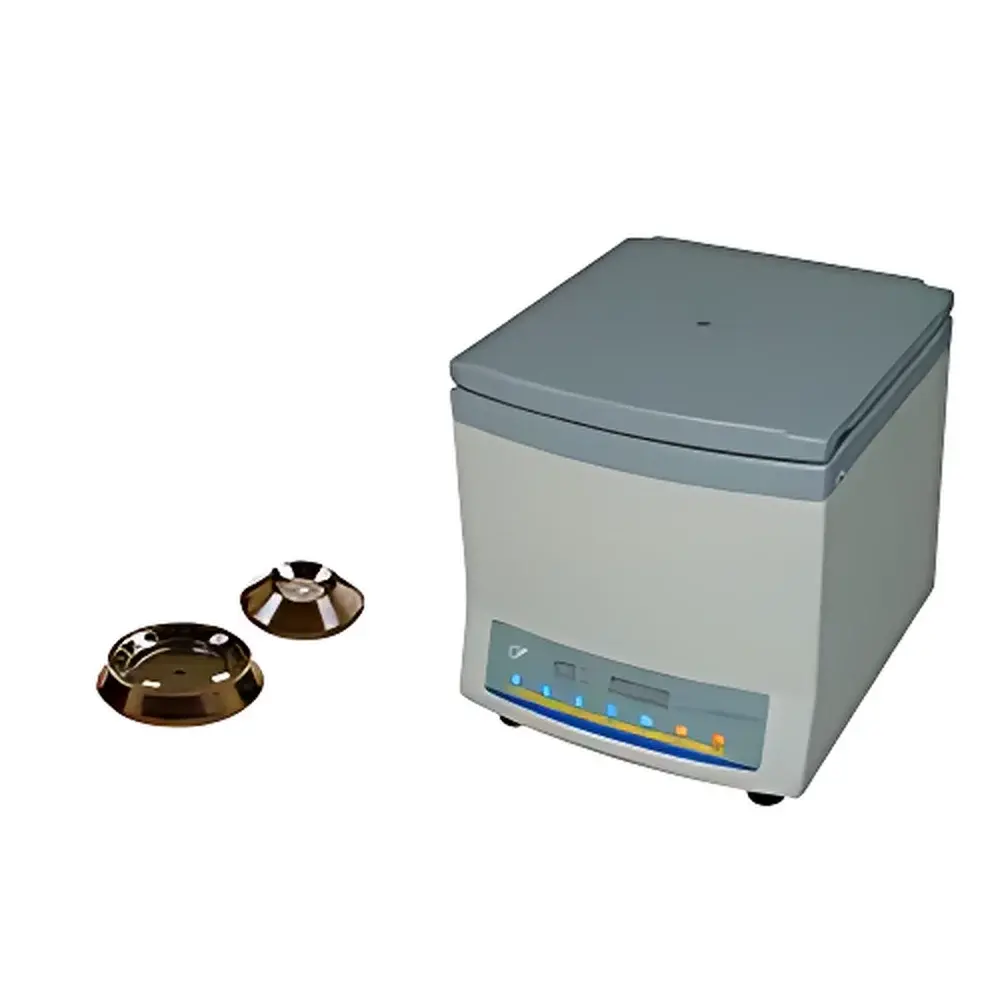
AnTing FeiGe TGL-16G High-Speed Benchtop Centrifuge
| Brand | AnTing FeiGe |
|---|---|
| Origin | Shanghai, China |
| Model | TGL-16G |
| Instrument Type | Benchtop Centrifuge |
| Speed Range | 0–16,000 rpm |
| Max RCF | 17,000 ×g |
| Rotor Configuration | Fixed-angle rotor |
| Capacity | 5 mL × 10 or 1.5 mL × 12 |
| Timer Range | 0–60 min |
| Power Supply | 220 V, 50 Hz, 250 W |
| Dimensions (L×W×H) | 330 × 300 × 300 mm |
| Weight | 15 kg |
| Compliance | CE-marked design principles, GLP-supportive operational architecture |
Overview
The AnTing FeiGe TGL-16G High-Speed Benchtop Centrifuge is an engineered solution for routine and research-grade separation tasks in life science laboratories. Designed around a fixed-angle rotor configuration, it operates on the principle of sedimentation centrifugation—utilizing radial acceleration to separate particles based on differences in density, size, and shape within a viscous medium. With a maximum rotational speed of 16,000 rpm and a corresponding relative centrifugal force (RCF) of 17,000 ×g, the TGL-16G delivers sufficient g-force for pelleting subcellular organelles, precipitating nucleic acids, concentrating viral particles, and isolating extracellular vesicles. Its compact footprint (330 × 300 × 300 mm) and lightweight construction (15 kg) make it suitable for shared lab environments, biosafety cabinets, and mobile analytical workstations where space and ergonomics are constrained.
Key Features
- Microprocessor-controlled speed and time regulation with digital display for repeatable parameter recall
- Electronically interlocked safety lid with automatic rotor recognition logic to prevent operation without proper closure
- High-strength polymer housing engineered for mechanical stability and acoustic dampening—typical noise level ≤ 65 dB(A) at full speed
- Thermally optimized chamber design minimizing temperature rise during extended runs (ΔT < 8 °C after 30 min at 16,000 rpm)
- Brushless DC motor delivering high torque at low power consumption (250 W nominal), supporting long-term reliability under daily use
- Programmable timer with 1-minute resolution and auto-brake function for controlled deceleration
Sample Compatibility & Compliance
The TGL-16G accommodates standard microcentrifuge tubes (1.5 mL and 5 mL) in its fixed-angle rotor, enabling direct compatibility with common consumables used in molecular biology workflows—including DNase/RNase-free polypropylene tubes and PCR-compatible formats. It supports protocols aligned with ISO 20347:2019 (laboratory equipment performance verification) and incorporates fail-safes consistent with IEC 61010-1 safety requirements for electrical laboratory apparatus. While not certified for clinical diagnostics under FDA 21 CFR Part 820, its operational repeatability and audit-ready parameter logging support GLP-compliant documentation when integrated into validated lab SOPs. The rotor geometry ensures uniform sedimentation patterns critical for reproducible nucleic acid recovery and protein pellet integrity.
Software & Data Management
The TGL-16G operates via embedded firmware without external PC dependency; however, all run parameters—including speed, time, and RCF—are retained in non-volatile memory for up to 10 recent cycles. Optional RS-232 serial interface (available upon request) enables integration with LIMS or custom LabVIEW-based monitoring systems for centralized device fleet management. Event logs capture door status, over-speed alerts, and thermal warnings—supporting traceability in regulated environments. Though lacking native 21 CFR Part 11 electronic signature capability, the unit’s deterministic behavior and immutable runtime records facilitate third-party validation for GMP-aligned QC labs conducting method transfer studies.
Applications
- Routine isolation of plasmid DNA, genomic DNA, and total RNA from bacterial, mammalian, and plant lysates
- Clarification of cell lysates prior to SDS-PAGE or Western blot analysis
- Preparative centrifugation of exosomes and microvesicles (≥100 nm diameter) using standardized 1.5 mL tube protocols
- Separation of antibody-antigen complexes in ELISA development workflows
- Concentration of dilute protein solutions (e.g., column eluates) without denaturation risk at moderate g-forces
- Field-deployable sample stabilization in agricultural extension labs performing soil microbiome extraction
FAQ
What is the maximum recommended run time at full speed (16,000 rpm)?
Continuous operation at maximum speed is rated for up to 30 minutes per cycle, assuming ambient temperature ≤ 25 °C and adequate ventilation around the unit.
Can the TGL-16G accommodate PCR strip tubes or 0.2 mL tubes?
No—the fixed-angle rotor is configured exclusively for 1.5 mL and 5 mL conical tubes; adapters for smaller formats are not supplied or validated.
Is rotor balancing required before each run?
Yes. Symmetrical mass distribution across opposing positions is mandatory; imbalance detection triggers immediate shutdown to prevent bearing wear or vibration-induced damage.
Does the unit support refrigeration or temperature control?
No. The TGL-16G is a non-refrigerated model; users requiring thermal management should consider complementary cold-room operation or post-run ice-bath handling.
How often should maintenance calibration be performed?
Annual verification of speed accuracy (±2% tolerance) and timer fidelity (±1 sec/min) is recommended using NIST-traceable tachometry and stopwatch standards.



