
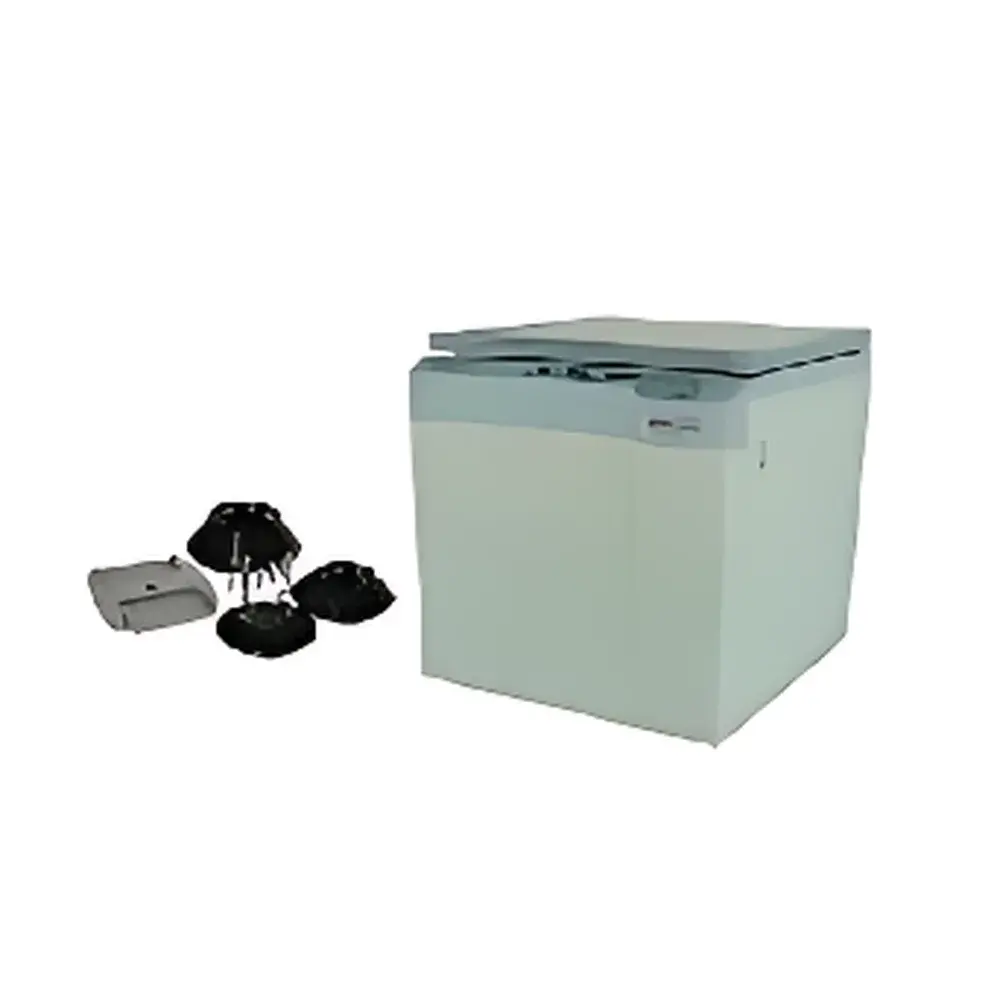
AnTing Feige TGL-16GR High-Speed Refrigerated Benchtop Centrifuge
| Brand | AnTing Feige (Centifuge) |
|---|---|
| Origin | Shanghai, China |
| Manufacturer Type | Authorized Distributor |
| Product Category | Domestic |
| Model | TGL-16GR |
| Instrument Type | Benchtop Centrifuge |
| Speed Range | 10,000–30,000 rpm (High-Speed Class) |
| Function | Refrigerated Centrifuge |
| Configuration | Swing-Bucket & Fixed-Angle Rotor Compatible |
| Separation Grade | Biomolecular Applications |
| Max Capacity | 10 mL × 12 |
| Max Speed | 16,000 rpm |
| Max RCF | 15,455 ×g |
| Dimensions (L×W×H) | 500 mm × 540 mm × 780 mm |
| Weight | 72 kg |
| Temperature Range | −5 °C to +30 °C |
| Temp. Accuracy | ±2 °C |
| Timer Range | 0–99 min |
| Noise Level | <72 dB(A) |
| Power Supply | 220 V, 50 Hz, 1.5 kW |
Overview
The AnTing Feige TGL-16GR is a high-performance benchtop refrigerated centrifuge engineered for precision biomolecular separation in academic, clinical, and industrial laboratory environments. It operates on the principle of sedimentation under controlled centrifugal force, enabling rapid and reproducible isolation of subcellular components—including cellular organelles, viruses, nucleic acids, proteins, and plasma fractions—based on differences in density, size, and shape. Its integrated refrigeration system—featuring a high-efficiency Tecumseh (France) compressor—maintains sample integrity during prolonged high-speed runs by actively suppressing thermal drift. The brushless frequency-controlled motor delivers smooth acceleration/deceleration profiles and ensures long-term operational stability with minimal mechanical wear. A microprocessor-based control system manages real-time monitoring of speed, temperature, time, and rotor identification, while an electronic safety interlock automatically engages the lid lock during operation, complying with IEC 61010-2-020 requirements for centrifuge safety.
Key Features
- Refrigerated operation from −5 °C to +30 °C with ±2 °C temperature accuracy across the full speed range
- Maximum rotational speed of 16,000 rpm and relative centrifugal force (RCF) up to 15,455 ×g
- Four pre-calibrated rotor configurations: No.1 fixed-angle rotor (0.5/2 mL × 12, 16,000 rpm), No.2 fixed-angle rotor (1.5/2 mL × 24, 12,000 rpm), No.3 fixed-angle rotor (10 mL × 12, 10,000 rpm), and No.4 swing-bucket rotor for 96-well microplates (80 wells, 6,000 rpm)
- Low-noise design (<72 dB[A]) achieved through balanced rotor dynamics, vibration-damping chassis, and acoustic insulation
- Intelligent rotor recognition and automatic RCF/speed conversion based on selected rotor geometry and tube dimensions
- Programmable timer (0–99 minutes) with auto-stop and deceleration ramp control (soft-brake function)
- Robust cast-aluminum housing and stainless-steel chamber for corrosion resistance and easy decontamination
Sample Compatibility & Compliance
The TGL-16GR supports routine handling of sensitive biological samples requiring cold preservation—such as whole blood, PBMCs, serum, lysates, viral supernatants, and purified RNA/DNA preparations. Its rotor configurations accommodate standard microcentrifuge tubes (0.5–2 mL), conical tubes (10 mL), and standardized enzyme-linked immunosorbent assay (ELISA) or cell culture plates. All rotors are certified to ISO 15197:2013 and validated per manufacturer-defined load balancing tolerances. The instrument meets CE marking requirements under Directive 2014/30/EU (EMC) and 2014/35/EU (LVD), and its temperature control architecture aligns with GLP-compliant workflows where thermal consistency is critical for assay reproducibility. While not inherently 21 CFR Part 11 compliant out-of-the-box, audit trails and user access logs can be implemented via external LIMS integration.
Software & Data Management
The TGL-16GR features an embedded LCD interface with intuitive navigation keys and real-time parameter display (speed, RCF, temperature, elapsed time, remaining time). Though it does not include proprietary PC software or cloud connectivity, all run parameters—including rotor ID, speed setpoint, temperature setpoint, and duration—are stored in non-volatile memory for the last 100 cycles and retrievable via front-panel recall. For laboratories operating under regulated quality systems (e.g., ISO/IEC 17025, CAP, or CLIA), manual recordkeeping of run logs—including operator ID, sample identifiers, and deviation notes—is supported through standardized SOP templates. Optional external data loggers may be interfaced via RS-232 port for continuous environmental monitoring during validation protocols.
Applications
- Preparative isolation of mitochondria, nuclei, and membrane vesicles from tissue homogenates
- Clarification of bacterial and mammalian cell lysates prior to chromatographic analysis
- Concentration and purification of extracellular vesicles (exosomes) and viral particles
- Routine plasma/serum separation for clinical chemistry and immunoassay workflows
- High-yield recovery of plasmid DNA and total RNA from alkaline lysis preparations
- Processing of ELISA plates for antibody binding kinetics and antigen capture assays
FAQ
What is the maximum allowable imbalance tolerance for the TGL-16GR?
The instrument permits a maximum mass imbalance of ±0.5 g per tube position when using matched tubes and proper loading symmetry; exceeding this may trigger automatic shutdown.
Can the TGL-16GR operate without refrigeration?
Yes—the temperature setpoint can be adjusted to ambient mode (+30 °C), though continuous uncooled operation at max speed is not recommended for heat-sensitive samples.
Is rotor autoclaving supported?
Fixed-angle aluminum rotors are compatible with dry-heat sterilization at ≤121 °C for 2 hours; swing-bucket rotors and polymer adapters must not be autoclaved and should be cleaned with 70% ethanol or mild detergent.
Does the unit support rotor calibration certificates?
Factory calibration reports are provided for each rotor, including moment of inertia values and RCF verification at three speed points (6,000 / 12,000 / 16,000 rpm); third-party calibration services are available upon request.
What maintenance intervals are recommended?
Compressor oil inspection every 24 months, condenser coil cleaning quarterly, and bearing lubrication per 5,000 operating hours—full service logs are retained in the instrument’s internal memory.
Related Products



