
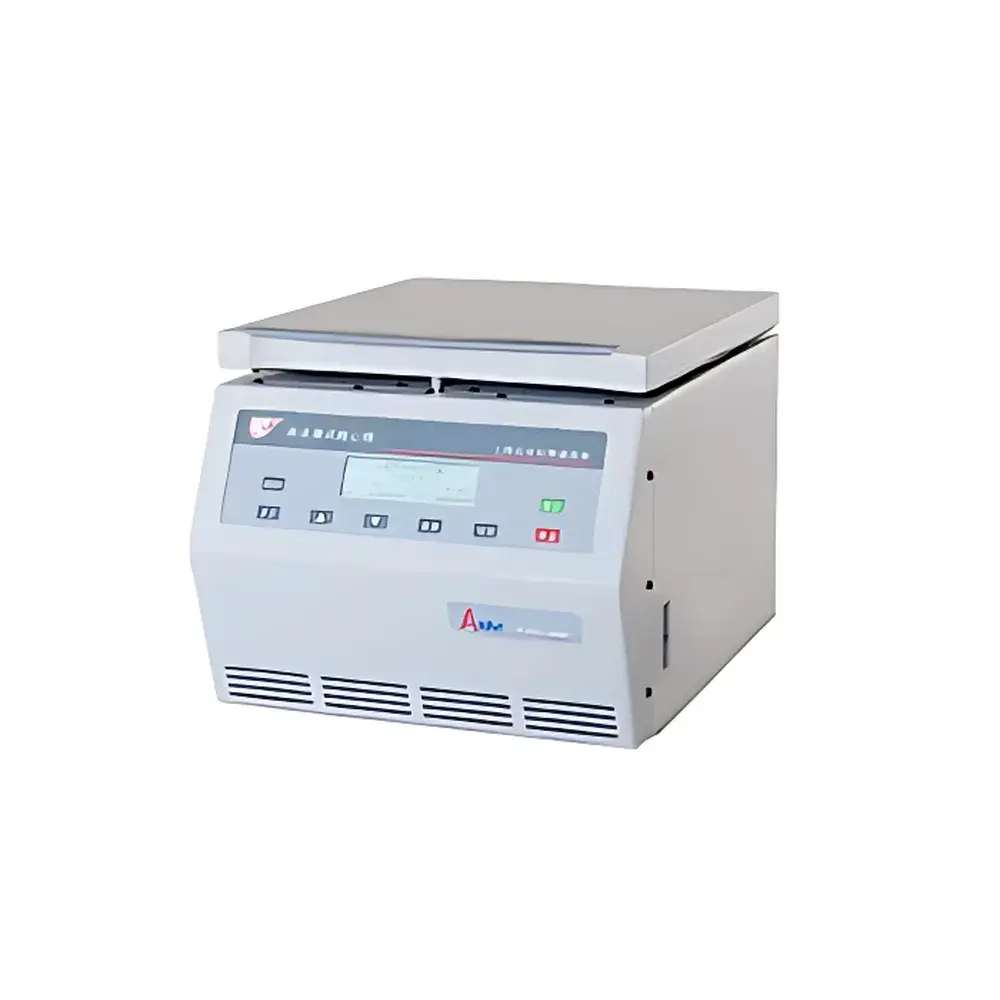
AnTing FeiGe TGL-18C Benchtop High-Speed Centrifuge
| Brand | AnTing FeiGe |
|---|---|
| Origin | Shanghai, China |
| Model | TGL-18C |
| Max Speed | 18000 rpm |
| Max RCF | 21000 ×g |
| Max Capacity | 5 mL × 10 |
| Rotor Type | Fixed-Angle |
| Dimensions | 490 mm × 356 mm × 315 mm |
| Drive System | Inverter-Controlled Brushless Motor |
| Speed Range | 300–18000 rpm |
| Rotor Configurations | 1.5 mL × 12, 7 mL × 8 |
| Safety | Electronic Lid Lock, Rotor Recognition (via mechanical coding), Over-Speed & Imbalance Protection |
Overview
The AnTing FeiGe TGL-18C Benchtop High-Speed Centrifuge is an engineered solution for rapid, reproducible separation of biological macromolecules and subcellular components in non-refrigerated laboratory environments. Operating on the principle of sedimentation under controlled centrifugal force—governed by the Svedberg equation—the instrument delivers precise RCF (Relative Centrifugal Force) up to 21,000 ×g at its maximum rotational speed of 18,000 rpm. Designed for routine and research-grade applications where thermal stability and operational fidelity are critical, the TGL-18C employs a brushless inverter motor with closed-loop speed regulation, ensuring minimal drift (< ±50 rpm at setpoint) and high torque consistency across the full 300–18,000 rpm range. Its compact footprint and low-noise operation (≤65 dB(A) at 18,000 rpm) make it suitable for shared core facilities, teaching labs, and QC/QA environments requiring reliable benchtop centrifugation without cryogenic constraints.
Key Features
- Brushless inverter motor with digital speed feedback control for stable, repeatable rotor acceleration and deceleration profiles
- Electronically interlocked safety lid with mechanical rotor detection—prevents operation unless rotor is correctly seated and lid fully engaged
- High-strength polymer housing engineered for structural rigidity and vibration damping; surface-treated for chemical resistance and ease of decontamination
- Intuitive LED display interface with real-time monitoring of speed (rpm), RCF (×g), time remaining, and error codes
- Programmable run parameters including acceleration/deceleration ramp rates (soft stop option available), timed runs (1 s–99 min 59 s), and memory for up to 10 user-defined protocols
- Thermal management system minimizes cavity temperature rise (< 8 °C above ambient after 30 min at max speed), preserving heat-sensitive analytes such as enzymes and RNA
Sample Compatibility & Compliance
The TGL-18C accommodates standard microcentrifuge tubes (1.5 mL and 2.0 mL) and conical tubes (5–7 mL) using factory-calibrated fixed-angle rotors. It supports common biosafety Level 1 and Level 2 workflows involving whole blood, cell lysates, bacterial pellets, viral supernatants, and purified nucleic acid or protein fractions. While not certified for IVD or GMP manufacturing use, the unit complies with general-purpose electrical safety standards (IEC 61010-1) and electromagnetic compatibility (IEC 61326-1). Its design facilitates cleaning validation per ISO 14644-1 cleanroom practices and aligns with GLP documentation requirements when paired with external audit-trail-capable lab information systems. Rotor configurations are mechanically coded to prevent mismatched use—a prerequisite for maintaining validated centrifugation conditions in regulated settings.
Software & Data Management
The TGL-18C operates via embedded firmware with no external PC dependency. All operational data—including start/stop timestamps, final speed achieved, total runtime, and fault logs—are retained in non-volatile memory for retrieval via front-panel navigation. While the device does not support USB export or network connectivity, its parameter logging meets minimum traceability criteria for internal SOP adherence and method verification. For laboratories operating under FDA 21 CFR Part 11 or EU Annex 11 guidelines, integration with third-party electronic lab notebooks (ELNs) or LIMS platforms is achievable through manual entry or barcode-scanned protocol initiation, provided procedural controls govern data transcription integrity.
Applications
- Isolation of mitochondria, nuclei, and plasma membranes from mammalian tissue homogenates
- Pelleting of exosomes and virus particles from cell culture supernatants
- Clarification of bacterial lysates prior to affinity chromatography or SDS-PAGE analysis
- Routine preparation of genomic DNA and plasmid preps using silica-membrane spin columns
- Concentration of dilute protein solutions (e.g., antibody eluates, recombinant expression supernatants)
- Separation of phase-separated organic/aqueous extracts in environmental or pharmaceutical sample prep
FAQ
What is the maximum RCF achievable with the standard 1.5 mL rotor?
The TGL-18C achieves 21,000 ×g at 18,000 rpm with the 12-position 1.5 mL fixed-angle rotor (radius = 8.5 cm).
Does the centrifuge support rotor auto-recognition?
Yes—mechanical coding on each rotor ensures only compatible rotors engage the drive spindle, preventing unsafe overspeed conditions.
Can this unit be used for clinical diagnostics under CLIA or CAP requirements?
It may be employed in pre-analytical specimen processing (e.g., serum separation) but lacks CE-IVD marking and is not validated for diagnostic reporting per ISO 15189.
Is calibration documentation provided with the instrument?
Factory calibration certificates for speed and timer accuracy are included; users should perform periodic verification per ISO/IEC 17025 or internal QA procedures.
What maintenance is required for long-term reliability?
Annual inspection of rotor threads, lid latch mechanism, and motor brushes (though brushless design eliminates brush wear); rotor lifetime tracking based on cumulative run hours and max-speed cycles is recommended.



