
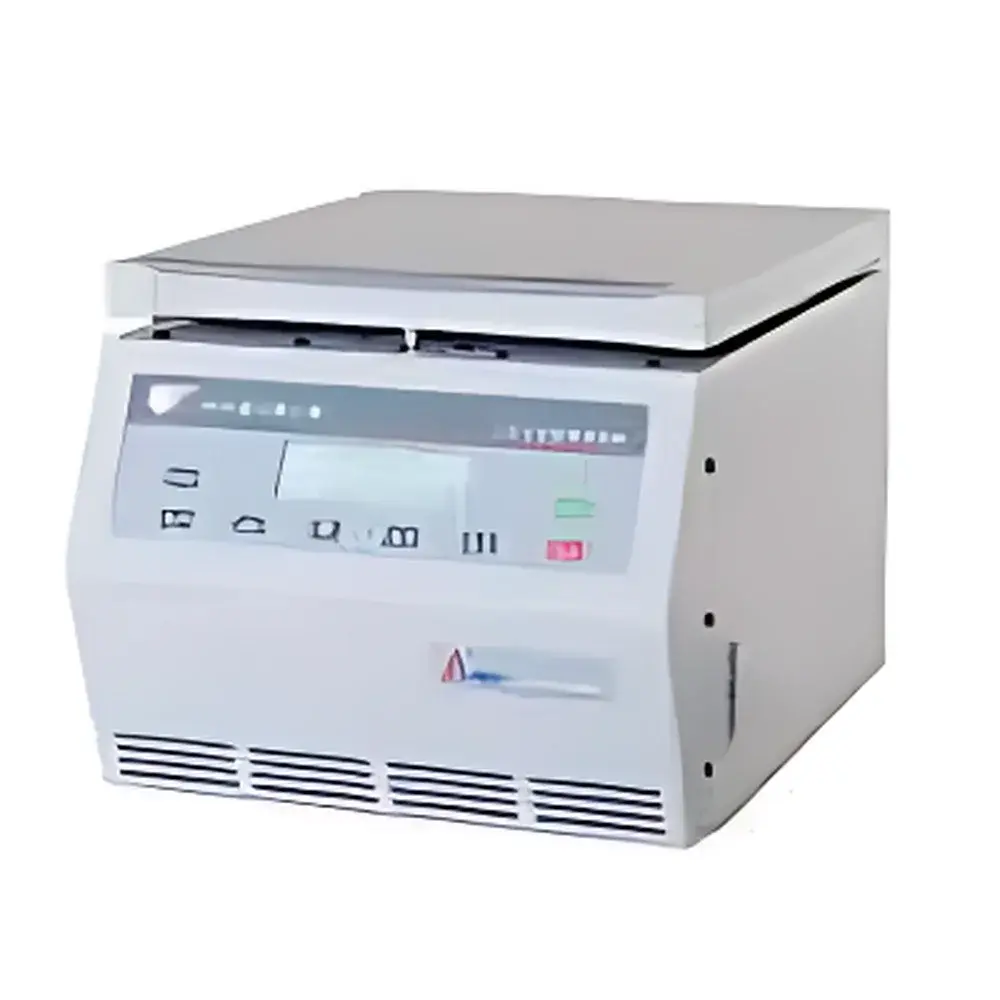
AnTing Feige TGL-18C High-Speed Benchtop Centrifuge
| Brand | AnTing Feige (Centifuge) |
|---|---|
| Origin | Shanghai, China |
| Manufacturer Type | Authorized Distributor |
| Product Category | Domestic |
| Model | TGL-18C |
| Instrument Type | Benchtop Centrifuge |
| Speed Range | 100–18,000 rpm |
| Max RCF | 21,000 × g |
| Max Capacity | 10 × 5 mL |
| Refrigeration | Yes (Active Cooling) |
| Timer Range | 0–99 min |
| Power Supply | 220 V, 50 Hz |
| Power Consumption | 250 W |
| Temperature Rise During Operation | <6 °C |
| Speed Accuracy | ±50 rpm |
| Dimensions (W×D×H) | 350 × 450 × 310 mm |
| Net Weight | 22 kg |
| Rotor Type | Fixed-Angle (e.g., 12 × 1.5 mL or 8 × 7 mL) |
| Construction | 316 Stainless Steel Chamber |
| Drive System | Brushless Inverter Motor |
| Safety | Electronic Lid Lock, Auto-Balancing Dampers, Patented Hinge Mechanism |
Overview
The AnTing Feige TGL-18C High-Speed Benchtop Centrifuge is an engineered solution for laboratories requiring reliable, refrigerated high-speed separation of biological samples at benchtop scale. Designed around the principles of rotor dynamics and forced convection cooling, the TGL-18C delivers precise sedimentation forces up to 21,000 × g—sufficient for pelleting subcellular organelles including mitochondria, lysosomes, nuclei, and plasma membranes, as well as for nucleic acid and protein purification workflows. Its integrated refrigeration system maintains sample integrity during extended runs by limiting temperature rise to less than 6 °C under full-load operation—a critical parameter for thermolabile biomolecules. The unit complies with IEC 61010-1 safety standards for laboratory electrical equipment and incorporates mechanical and electronic safeguards aligned with ISO/IEC 17025 operational best practices.
Key Features
- Brushless inverter motor with digital speed control ensures stable rotational performance across the full range (100–18,000 rpm), minimizing torque fluctuations and enhancing reproducibility between runs.
- Electronically interlocked lid mechanism prevents operation unless fully closed and secured—meeting basic functional safety requirements for Class II biosafety environments.
- Optimized airflow path and internal heat-dissipation architecture enable rapid thermal stabilization and consistent chamber temperature control without external chillers.
- Large backlit LCD display simultaneously shows real-time values for speed (rpm), relative centrifugal force (× g), elapsed time, and remaining runtime—supporting GLP-compliant documentation protocols.
- 316 stainless steel rotor chamber resists corrosion from common solvents and biological buffers; all wetted surfaces are non-porous and compatible with standard laboratory decontamination agents.
- Patented self-damping suspension system automatically compensates for minor imbalances during acceleration and deceleration, reducing vibration transmission to the work surface.
- Fixed-angle rotor configuration supports common microcentrifuge tube formats (e.g., 1.5 mL, 5 mL, 7 mL), facilitating direct compatibility with downstream assay platforms and storage systems.
Sample Compatibility & Compliance
The TGL-18C is routinely deployed in applications involving whole blood, cell suspensions, tissue homogenates, viral lysates, and chromatographic fractions. It meets the physical separation requirements outlined in ASTM E2923-22 (Standard Guide for Centrifugation Methods in Biotechnology) and supports workflows referenced in USP Analytical Instrument Qualification. While not certified for GMP manufacturing environments, its construction, traceable calibration points, and audit-ready operational logs align with internal QC/QA validation frameworks. The unit does not include 21 CFR Part 11-compliant electronic signature capability; however, manual record-keeping of run parameters satisfies basic GLP documentation needs.
Software & Data Management
The TGL-18C operates via embedded firmware with no external PC dependency. All operational parameters—including speed setpoint, time duration, and start/stop commands—are entered directly on the front-panel interface. Runtime data (actual rpm, achieved × g, cycle completion status) are retained in volatile memory for immediate verification but are not exportable or archived digitally. For laboratories requiring traceable data capture, integration with third-party lab information management systems (LIMS) is achievable only through manual transcription or optional RS-232 serial logging (hardware-dependent; contact technical support for interface compatibility details).
Applications
- Isolation of cellular organelles (mitochondria, lysosomes, nuclei) from mammalian and plant tissue extracts.
- Clarification of bacterial and yeast lysates prior to affinity chromatography or SDS-PAGE analysis.
- Concentration and desalting of DNA/RNA samples in molecular biology workflows.
- Preparative separation of exosomes and extracellular vesicles from serum or conditioned media.
- Routine clinical processing of serum, plasma, and cerebrospinal fluid specimens for diagnostic assays.
- Pharmaceutical formulation development involving nanoparticle dispersion stability assessment.
FAQ
What is the maximum relative centrifugal force (RCF) this centrifuge can generate?
The TGL-18C achieves a maximum RCF of 21,000 × g when operating at 18,000 rpm with the standard fixed-angle rotor.
Does the instrument support rotor auto-recognition or dynamic imbalance detection?
No—the TGL-18C does not feature rotor identification sensors or real-time imbalance analytics; users must manually verify rotor compatibility and load symmetry before initiation.
Can the centrifuge be used for continuous operation over multiple cycles without cooldown intervals?
Yes, provided ambient temperature remains below 30 °C and total daily runtime does not exceed 6 hours; extended use may affect long-term bearing life and thermal regulation consistency.
Is the 316 stainless steel chamber validated for autoclave compatibility?
No—the chamber is not designed for steam sterilization; cleaning is limited to wipe-down with ethanol, isopropanol, or diluted sodium hypochlorite solutions.
What regulatory certifications does the device carry?
It bears CE marking per Directive 2014/30/EU (EMC) and 2014/35/EU (LVD); no FDA 510(k) or ISO 13485 certification is held.



