
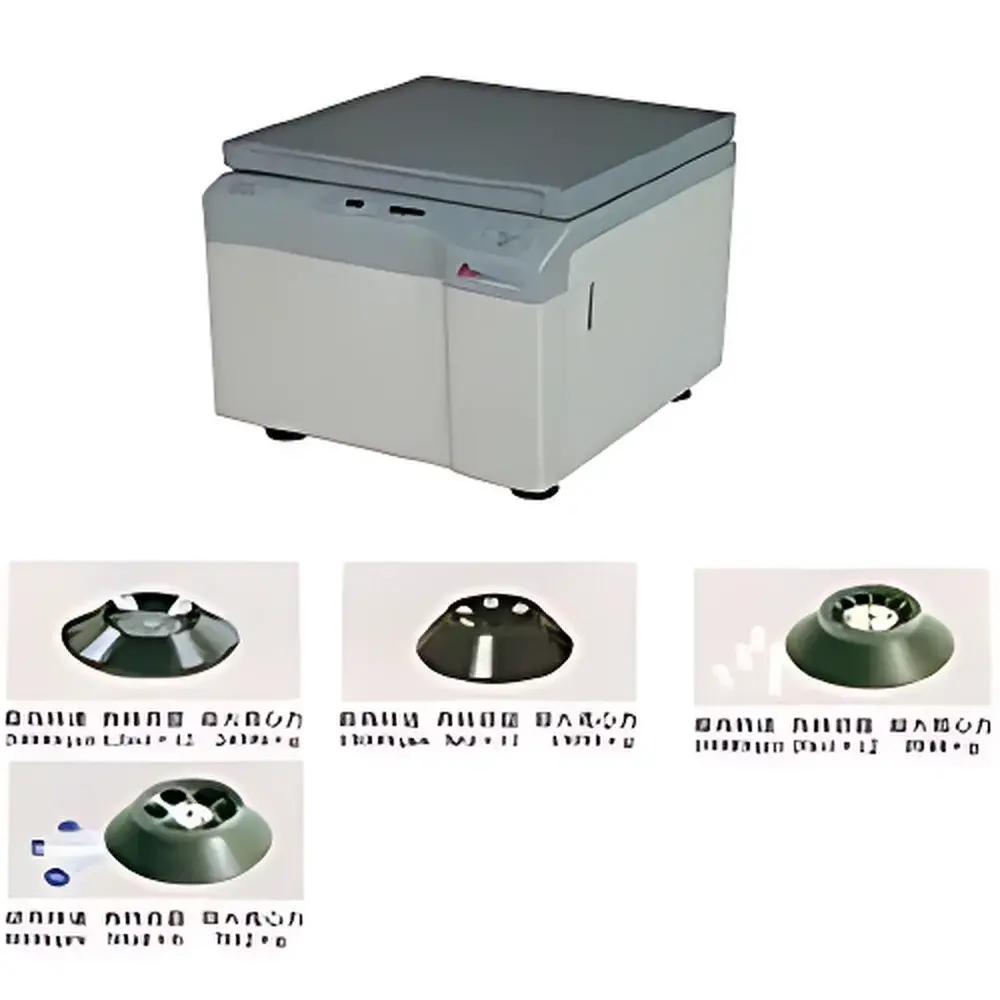
AnTing FeiGe TGL-20B High-Speed Benchtop Centrifuge
| Brand | AnTing FeiGe |
|---|---|
| Origin | Shanghai, China |
| Model | TGL-20B |
| Type | Benchtop Centrifuge |
| Max Speed | 20000 rpm |
| Max RCF | 24596 ×g |
| Max Capacity | 50 mL × 6 |
| Rotor Configurations | Angle rotors (1.5 mL × 12 @ 20000 rpm |
| Timer Range | 0–99 min |
| Noise Level | <70 dB(A) |
| Dimensions (L×W×H) | 500 × 540 × 570 mm |
| Weight | 47 kg |
| Power Supply | 220 V, 50 Hz |
Overview
The AnTing FeiGe TGL-20B High-Speed Benchtop Centrifuge is an engineered solution for routine and research-grade separation tasks in life science laboratories. Designed around a brushless AC frequency-controlled motor, the system delivers precise rotational control, high torque at low speeds, and stable operation across its full speed range — up to 20,000 rpm with a maximum relative centrifugal force (RCF) of 24,596 ×g. Its compact footprint (500 × 540 × 570 mm) and benchtop form factor make it suitable for shared lab spaces, biosafety cabinets, and controlled environment rooms where floor space is constrained. The centrifuge operates on standard 220 V / 50 Hz mains power and incorporates thermal management features that minimize cavity temperature rise during extended runs — a critical consideration for heat-sensitive biomolecules such as plasmid DNA, ribonucleoprotein complexes, and purified enzymes.
Key Features
- Brushless AC frequency-controlled motor ensures long service life, minimal maintenance, and consistent speed accuracy ±100 rpm across all operating ranges.
- Microprocessor-based digital control panel with intuitive LED display provides real-time monitoring of speed (rpm), RCF, time remaining, and rotor identification status.
- Integrated electronic door lock mechanism prevents accidental lid opening during operation and automatically halts rotation if lid integrity is compromised — compliant with IEC 61010-2-020 safety requirements for centrifuges.
- Four pre-calibrated angle rotor configurations support broad sample volume flexibility: 1.5 mL × 12 (20,000 rpm), 5 mL × 12 (15,000 rpm), 10 mL × 12 (10,000 rpm), and 50 mL × 6 (8,000 rpm), enabling protocol-specific optimization without manual recalibration.
- Acoustic damping housing and balanced rotor assembly reduce operational noise to <70 dB(A), meeting ISO 7779 and ISO 3744 standards for laboratory equipment sound emission.
- Auto-braking and soft-start functions minimize mechanical stress on samples and extend rotor longevity, particularly during repeated high-speed cycles.
Sample Compatibility & Compliance
The TGL-20B accommodates standard polypropylene, polycarbonate, and stainless-steel centrifuge tubes within its specified rotor geometries. It supports common biological workflows involving cell pelletization, subcellular fractionation, nucleic acid precipitation, and protein concentration — particularly effective for isolating genomic DNA, mitochondrial fractions, and viral particles. While not certified for clinical diagnostics under FDA 21 CFR Part 820 or ISO 13485, the instrument meets general-purpose laboratory safety and electromagnetic compatibility (EMC) requirements per IEC 61326-1 and electrical safety standards per IEC 61010-1. Documentation includes traceable calibration records for rotor inertia and RCF calculation algorithms, supporting GLP-compliant recordkeeping when integrated into validated lab environments.
Software & Data Management
The TGL-20B operates via embedded firmware without external PC dependency. All run parameters — including speed, time, acceleration/deceleration profiles, and rotor ID — are stored in non-volatile memory for up to 100 program presets. While no proprietary software suite is provided, the device supports manual data logging through timestamped LED readouts and operator-recorded run logs. For labs requiring audit trails, integration with LIMS or ELN systems can be achieved via optional RS-232 or USB-to-serial adapters (not included), enabling export of runtime metadata for regulatory review under ISO/IEC 17025 or CAP-accredited workflows.
Applications
- Isolation of bacterial and mammalian cell pellets from culture supernatants (e.g., E. coli harvesting at 12,000 rpm, 15 min).
- Purification of plasmid DNA using alkaline lysis followed by isopropanol precipitation and pelleting at 20,000 rpm.
- Preparative separation of microsomal and mitochondrial fractions from tissue homogenates using differential centrifugation protocols.
- Routine clarification of serum, plasma, or fermentation broths prior to HPLC or ELISA analysis.
- Concentration of dilute protein solutions (e.g., antibody eluates) using 50 mL conical tubes at 8,000 rpm.
- Support for teaching laboratories in biochemistry and molecular biology courses requiring reproducible, entry-level high-speed separation capability.
FAQ
What is the maximum RCF achievable with the TGL-20B, and at what rotor configuration?
The maximum RCF of 24,596 ×g is achieved using the 1.5 mL × 12 angle rotor at 20,000 rpm.
Does the TGL-20B support refrigerated operation?
No — the TGL-20B is a non-refrigerated benchtop centrifuge. Ambient temperature control of the lab environment is recommended for thermolabile samples.
Are rotor balancing requirements specified in the manual?
Yes — symmetrical loading is mandatory; maximum allowable imbalance is ≤1.0 g per tube pair, consistent with ISO 15887 guidelines for angle rotor use.
Can third-party rotors be used with this centrifuge?
Only manufacturer-certified AnTing FeiGe rotors are validated for mechanical and safety compliance; use of unapproved rotors voids warranty and violates IEC 61010-2-020 operational limits.
Is the timer programmable in seconds or only minutes?
The timer is adjustable in 1-minute increments across the 0–99 minute range; sub-minute precision is not supported.



