
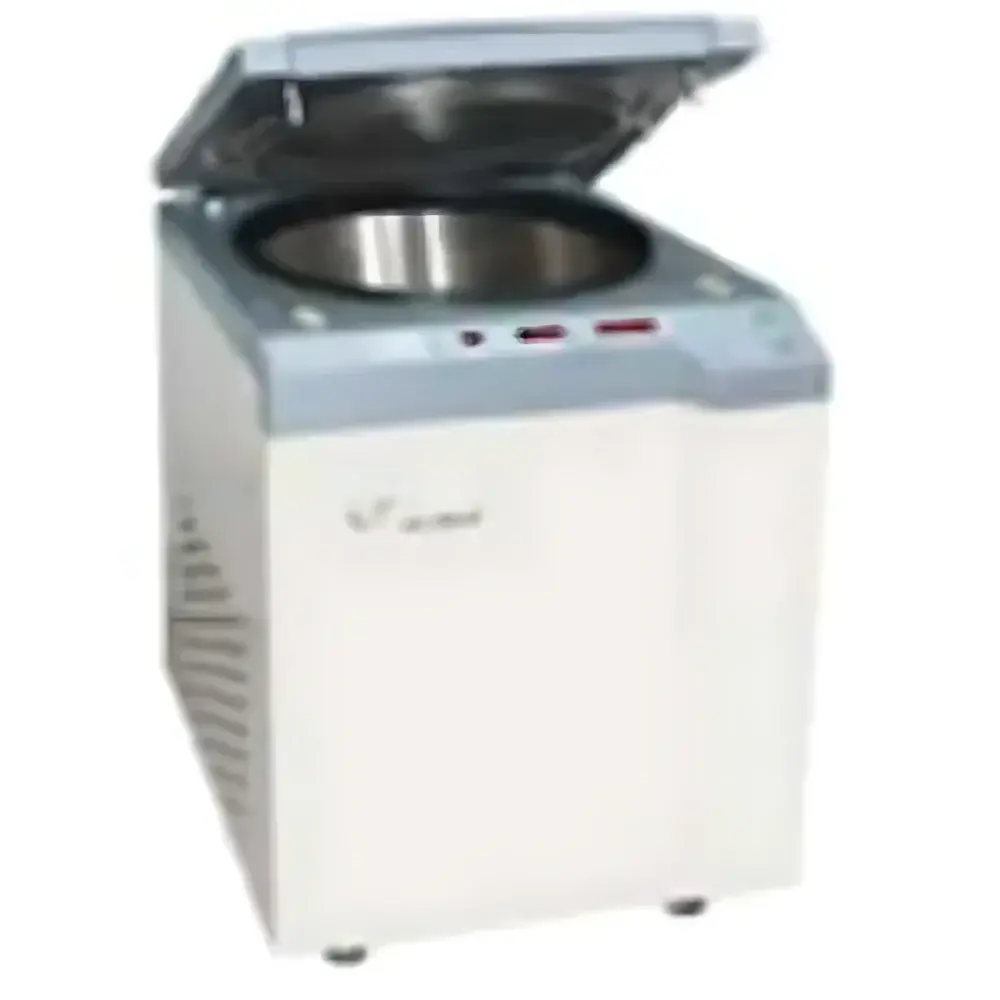
AnTing GL-20B High-Speed Refrigerated Centrifuge
| Brand | AnTing |
|---|---|
| Origin | Shanghai, China |
| Model | GL-20B |
| Type | Benchtop Refrigerated Centrifuge |
| Speed Range | Up to 20,000 rpm |
| Max RCF | 43,825 × g |
| Max Capacity | 6 × 500 mL |
| Temperature Range | −20 °C to +30 °C |
| Temp. Accuracy | ±2 °C |
| Timer Range | 0–99 min |
| Power Supply | 220 V, 50 Hz |
| Total Power | 3 kW |
| Dimensions (L×W×H) | 790 × 665 × 950 mm |
| Weight | 277 kg |
Overview
The AnTing GL-20B High-Speed Refrigerated Centrifuge is an engineered benchtop solution designed for demanding separation tasks in analytical laboratories, biopharmaceutical QC environments, and academic research settings. It operates on the principle of sedimentation under controlled centrifugal force, enabling rapid phase separation of heterogeneous mixtures—including cell suspensions, protein precipitates, subcellular organelles, and nucleic acid complexes—based on differences in particle density, size, and shape. Its integrated refrigeration system maintains precise temperature control between −20 °C and +30 °C during operation, minimizing thermal denaturation of thermolabile biomolecules and ensuring reproducible pelleting efficiency across repeated runs. With a maximum rotational speed of 20,000 rpm and a corresponding maximum relative centrifugal force (RCF) of 43,825 × g, the GL-20B supports high-resolution separations typically required for mitochondrial isolation, viral pellet concentration, and large-volume plasma fractionation.
Key Features
- Robust stainless-steel rotor chamber and reinforced polymer housing ensure structural integrity at sustained high speeds while contributing to low operational noise and vibration.
- Microprocessor-controlled temperature regulation with ±2 °C accuracy over the full operating range (−20 °C to +30 °C), validated using traceable NIST-calibrated sensors.
- Electronic safety interlock system with automatic door lock engagement—prevents rotor acceleration unless the lid is fully closed and sealed.
- Intuitive digital interface with real-time display of speed (rpm), RCF, elapsed time, remaining time, and chamber temperature.
- Programmable timer (0–99 minutes) with auto-brake and hold functions; optional soft-brake mode reduces resuspension risk for delicate pellets.
- High-capacity configuration supporting six 500 mL centrifuge bottles (e.g., polypropylene or polycarbonate), compatible with standard ISO 13485-certified consumables.
Sample Compatibility & Compliance
The GL-20B accommodates a broad spectrum of sample formats, including conical-bottom tubes (15–50 mL), swing-out buckets for blood collection tubes, and fixed-angle rotors for microcentrifuge tubes (up to 2 mL). Its mechanical design conforms to IEC 61010-1:2010 safety standards for laboratory electrical equipment. While not certified for GMP manufacturing use out-of-the-box, the instrument meets foundational requirements for GLP-compliant workflows when operated within documented SOPs—including audit-ready run logs (via optional RS-232/USB data export), routine calibration verification per ISO/IEC 17025 guidance, and adherence to ASTM D4057 for sampling protocol consistency.
Software & Data Management
The GL-20B features embedded firmware with non-volatile memory capable of storing up to 20 user-defined protocols. Data logging includes timestamped records of run parameters (speed, temperature, duration, RCF), error codes, and motor status. Optional connectivity modules enable serial (RS-232) or USB-to-host transmission for integration into LIMS or ELN platforms. All exported files are plain-text CSV format, facilitating traceability and alignment with FDA 21 CFR Part 11 requirements when paired with institutional electronic signature policies and access controls.
Applications
- Preparative isolation of mammalian cell nuclei and mitochondria from tissue homogenates.
- Clinical-scale processing of whole blood into packed red cells, platelet-rich plasma, and buffy coat fractions.
- Concentration and purification of bacteriophage lysates and extracellular vesicles (EVs) prior to TEM or nanoparticle tracking analysis (NTA).
- Routine clarification of fermentation broths and monoclonal antibody harvest streams in process development labs.
- Stabilization of enzyme-containing supernatants prior to kinetic assay or SDS-PAGE analysis.
FAQ
What is the recommended maintenance schedule for the GL-20B?
Routine inspection of rotor threads, O-rings, and refrigerant lines is advised every 200 operating hours; full rotor balancing and bearing assessment should be performed annually by authorized service personnel.
Can the GL-20B accommodate carbon fiber rotors?
No—the GL-20B is validated exclusively for use with its supplied aluminum alloy swing-bucket and fixed-angle rotors; third-party or composite rotors void warranty and compromise safety certification.
Is remote monitoring supported natively?
Remote start/stop and parameter adjustment require external hardware integration via the RS-232 port; no built-in Ethernet or Wi-Fi module is included.
How does the temperature control system perform during extended high-speed runs?
The dual-stage compressor and insulated chamber maintain setpoint stability within ±2 °C even during continuous 99-minute runs at 20,000 rpm, as verified per ISO 13485 Annex C thermal mapping protocols.
Are rotor lifetime logs tracked automatically?
Rotor usage (total run time and max speed history) must be manually recorded; the device does not embed RFID or EEPROM-based rotor ID tracking.



