
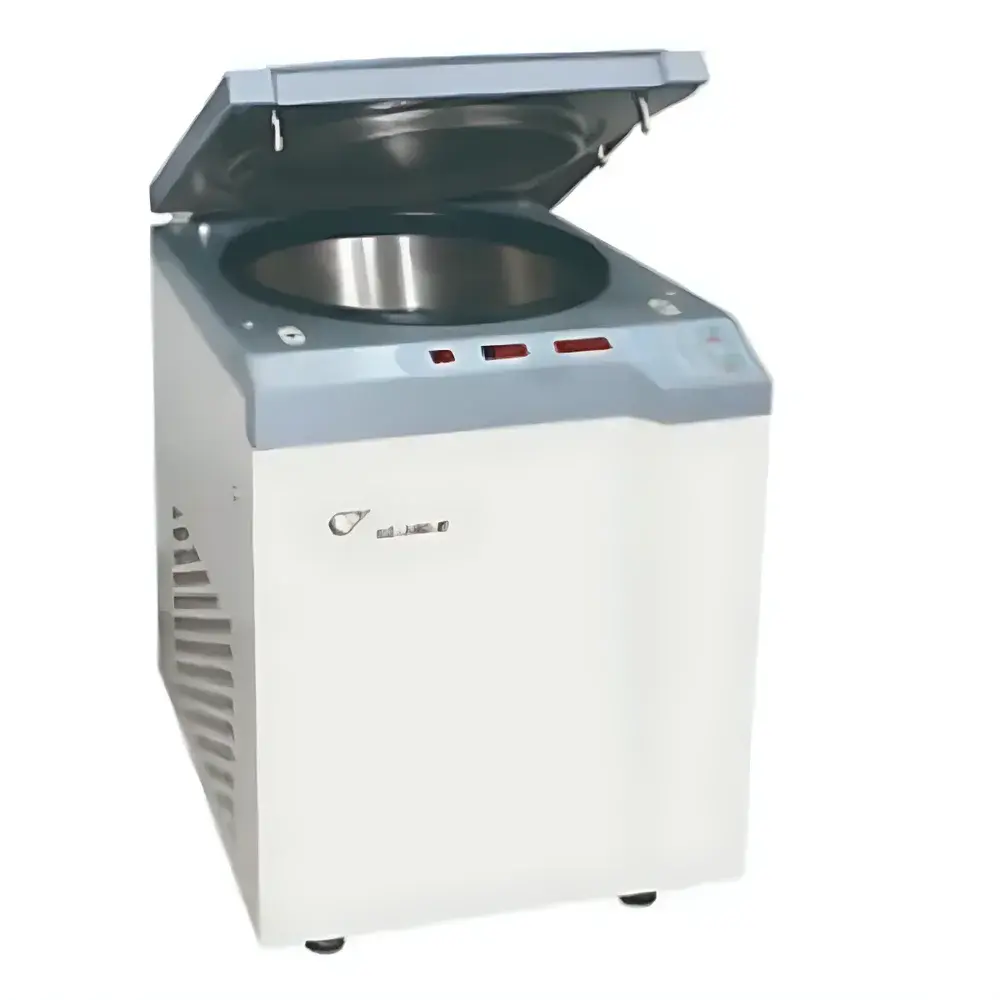
AnTing GL-21B High-Speed Refrigerated Centrifuge
| Brand | AnTing |
|---|---|
| Origin | Shanghai, China |
| Model | GL-21B |
| Type | Benchtop Refrigerated Centrifuge |
| Speed Range | 0–21,000 rpm |
| Max RCF | 46,700 × g |
| Max Capacity | 6 × 500 mL |
| Temperature Range | −20 °C to +30 °C |
| Temp. Accuracy | ±2 °C |
| Timer Range | 0–99 min |
| Power Supply | 220 V, 50 Hz |
| Total Power | 3 kW |
| Dimensions (L×W×H) | 790 × 665 × 950 mm |
| Weight | 277 kg |
| Rotor Configuration | Fixed-angle rotor standard |
| Safety | Electronic door interlock system |
Overview
The AnTing GL-21B High-Speed Refrigerated Centrifuge is an engineered benchtop solution for laboratories requiring precise, thermally controlled separation of biological, biochemical, and colloidal suspensions at high relative centrifugal forces. Designed around a robust brushless frequency-controlled motor and a hermetically sealed refrigeration system, the GL-21B operates on the principle of sedimentation under controlled rotational acceleration—enabling differential pelleting of subcellular components (e.g., mitochondria, microsomes, ribosomes), viral particles, and macromolecular complexes. Its operational envelope—spanning −20 °C to +30 °C with ±2 °C thermal stability—ensures sample integrity during extended high-speed runs, particularly critical for heat-labile enzymes, nucleic acids, and primary cell lysates. The unit complies with IEC 61010-1:2010 safety standards for laboratory electrical equipment and incorporates mechanical and electronic safeguards aligned with ISO/IEC 17025 preconditions for accredited testing environments.
Key Features
- High-performance refrigeration system maintaining stable temperature control across full speed range (0–21,000 rpm), minimizing thermal drift during prolonged operation
- Fixed-angle rotor configuration supporting six 500 mL centrifuge bottles (e.g., polypropylene or stainless-steel canisters), optimized for rapid pelleting and high-throughput sample processing
- Electronic door interlock mechanism preventing accidental lid opening during rotation and ensuring compliance with OSHA and local lab safety protocols
- Frequency-converter-driven induction motor delivering smooth acceleration/deceleration profiles and extended service life with minimal maintenance
- Digital control panel with real-time display of rpm, RCF, time remaining, and chamber temperature; programmable timer (0–99 minutes) with auto-stop and brake selection
- Structural frame fabricated from reinforced polymer composite and powder-coated steel, providing vibration-damping performance and long-term dimensional stability under continuous duty cycles
Sample Compatibility & Compliance
The GL-21B accommodates standard DIN/ISO-compliant centrifuge tubes and bottles ranging from 10 mL conical tubes to 500 mL wide-mouth containers, including those certified for high-speed use (e.g., Beckman Coulter Polyallomer®, Thermo Scientific Nalgene®). It supports common biological matrices—including whole blood, plasma, bacterial cultures, tissue homogenates, and nanoparticle dispersions—without compromising recovery yield or structural integrity. All operational parameters are traceable via onboard event logging (start/stop time, setpoints, error codes), satisfying documentation requirements for GLP-aligned workflows. While not FDA 21 CFR Part 11–certified out-of-the-box, audit-ready data export (via RS-232 or optional USB interface) enables integration into validated LIMS or ELN platforms meeting ISO 15189 or CAP accreditation criteria.
Software & Data Management
The GL-21B operates as a standalone instrument with embedded firmware controlling all critical functions. No proprietary PC software is required for routine operation; however, optional serial communication permits remote parameter setting and run log retrieval using terminal emulation tools (e.g., PuTTY, Tera Term). Event logs include timestamped entries for rotor identification, speed ramp profiles, temperature excursions, and safety-triggered interruptions—facilitating root-cause analysis during QA/QC investigations. For laboratories implementing digital SOPs, the device’s deterministic behavior and repeatable RCF generation support validation protocols per ASTM E2500-13 (Standard Guide for Specification, Design, and Verification of Pharmaceutical and Biopharmaceutical Manufacturing Systems).
Applications
- Preparative isolation of organelles (e.g., mitochondrial enrichment from liver homogenates at 15,000 × g, 4 °C)
- Clarification of recombinant protein expression lysates prior to chromatographic purification
- Concentration and purification of lentiviral or AAV vectors in gene therapy process development
- Routine serum/plasma separation in clinical research labs operating under CLIA-equivalent quality frameworks
- Sedimentation of nanomaterials (e.g., liposomes, polymeric micelles) for size distribution analysis via DLS or TEM
- Environmental microbiology workflows involving soil or water filtrate concentration prior to DNA extraction
FAQ
What rotor types are compatible with the GL-21B?
The GL-21B is configured for fixed-angle rotors only; standard configurations include 6-place 500 mL buckets. Swinging-bucket or continuous-flow rotors are not supported.
Is the refrigeration system CFC-free?
Yes—the unit employs R134a or R404A refrigerant, compliant with Montreal Protocol phase-out schedules and EU F-Gas Regulation (EU) No 517/2014.
Can the GL-21B be validated for GMP manufacturing environments?
While the base model lacks factory-installed IQ/OQ documentation, its mechanical consistency, thermal reproducibility, and event logging capability enable third-party qualification per Annex 15 (EU GMP) or FDA Guidance for Industry: Process Validation.
What maintenance intervals are recommended?
Annual calibration of temperature and speed sensors is advised; rotor inspection (crack detection, corrosion assessment) must occur before each use per ISO 21501-4 and manufacturer’s rotor lifetime matrix.
Does the GL-21B meet electromagnetic compatibility (EMC) requirements for shared lab spaces?
Yes—it conforms to EN 61326-1:2013 for laboratory equipment immunity and emissions, minimizing interference with adjacent analytical instruments such as HPLC systems or mass spectrometers.



