
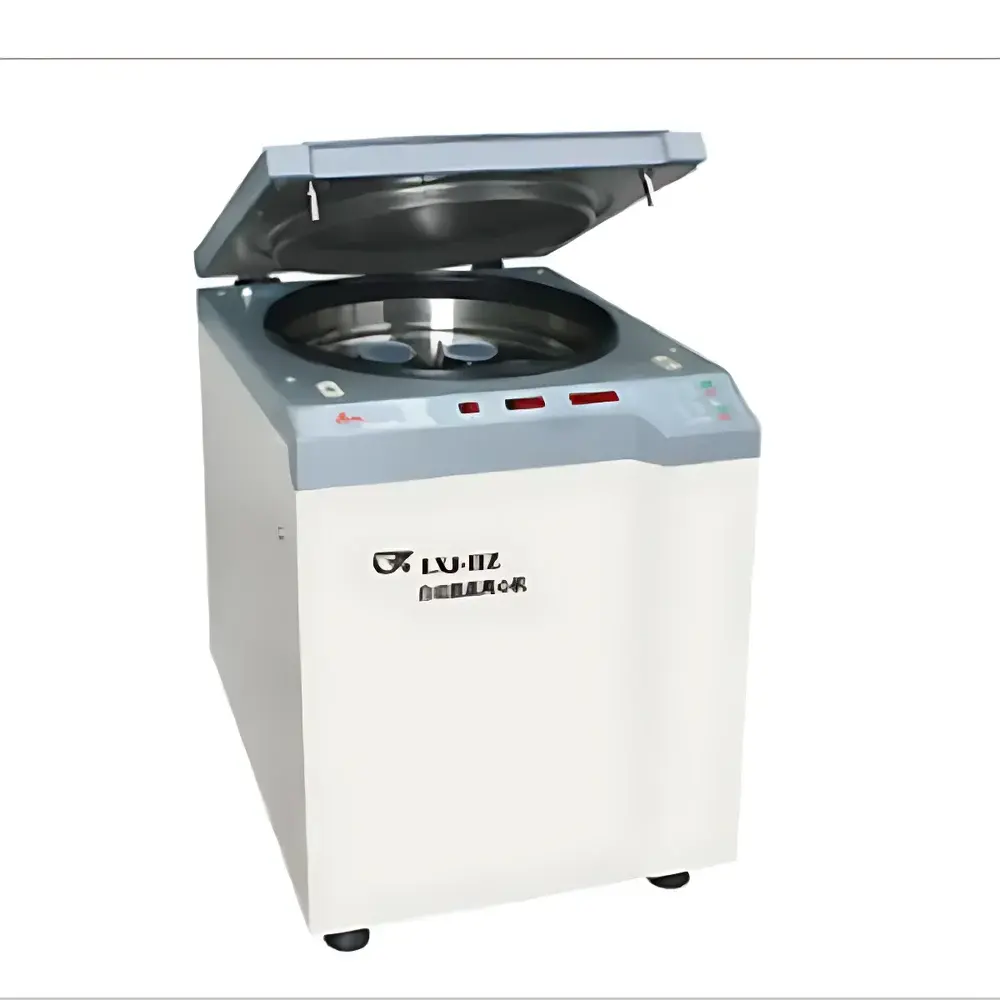
AnTing LXJ-IIB Automatic Cap-Removal Benchtop Centrifuge
| Brand | AnTing |
|---|---|
| Origin | Shanghai, China |
| Model | LXJ-IIB |
| Type | Benchtop Refrigerated Centrifuge |
| Speed Range | 0–3600 rpm |
| Max RCF | 3040 ×g |
| Rotor Type | Swing-Bucket Horizontal Rotor |
| Max Capacity | 120 × 5 mL Vacuum Blood Tubes |
| Temperature Control | Refrigerated (operating range: 4–25 °C) |
| Timer Range | 0–99 min |
| Power Supply | 220 V, 50 Hz, 750 W |
| Dimensions (L×W×H) | 550 mm × 700 mm × 770 mm |
| Net Weight | 144 kg |
| Drive System | Brushless Frequency-Controlled Motor |
| Safety Features | Electronic Door Interlock, Automatic Lid Lock During Operation |
| Noise Level | ≤65 dB(A) |
| Compliance | Designed for GLP-compliant clinical laboratories |
Overview
The AnTing LXJ-IIB Automatic Cap-Removal Benchtop Centrifuge is an integrated separation system engineered specifically for high-throughput clinical specimen processing in hospital laboratories, blood banks, and diagnostic centers. Unlike conventional centrifuges requiring manual cap removal prior to or after centrifugation, the LXJ-IIB performs cap detachment—via synchronized mechanical actuation—immediately following rotor deceleration and before lid unlocking. This fully automated sequence eliminates operator intervention between centrifugation and post-run handling, reducing biosafety risks, minimizing cross-contamination potential, and ensuring consistent tube orientation for downstream automation (e.g., auto-loaders for hematology analyzers or LIS-integrated tube sorters). The instrument operates on a brushless frequency-controlled motor, delivering stable rotational control across its 0–3600 rpm range and achieving a maximum relative centrifugal force of 3040 ×g. Its refrigerated design maintains sample temperature between 4 °C and 25 °C during operation, preserving labile analytes such as coagulation factors, hormones, and cellular RNA in whole blood specimens.
Key Features
- Integrated automatic cap-removal mechanism synchronized with rotor stop sequence—ensures 100% cap detachment success rate for standard 5 mL vacuum blood collection tubes (including BD Vacutainer®, Greiner Bio-One, and Sarstedt formats)
- Brushless DC motor with vector control enables precise speed regulation, low thermal drift, and extended service life (>20,000 h MTBF)
- Electronic door interlock system prevents lid opening during rotation and enforces mandatory rotor stop before release—compliant with IEC 61010-2-020 safety standards for centrifuges
- Refrigeration module with PID-controlled compressor maintains chamber temperature within ±1.5 °C accuracy across full speed range
- Low-noise acoustic enclosure (<65 dB[A] at 1 m distance) suitable for open-plan laboratory environments
- Dual-mode timer (minutes only; 0–99 min) with auto-stop and audible end-of-run alert
- Stainless-steel swing-bucket rotor chamber with corrosion-resistant aluminum rotor bodies—validated for 120 × 5 mL tube capacity at 3600 rpm
Sample Compatibility & Compliance
The LXJ-IIB is validated for use with all major brands of evacuated blood collection tubes (EDTA, heparin, serum separator, citrate, and fluoride-oxalate), accommodating nominal diameters from 12.5 mm to 16 mm and lengths up to 100 mm. Tube compatibility extends to plastic and glass variants meeting ISO 6710:2017 specifications. The centrifuge’s operational parameters align with CLSI GP45-A4 (Clinical Laboratory Standards Institute) guidelines for serum and plasma separation, and its temperature stability supports adherence to CAP (College of American Pathologists) checklist requirements for specimen integrity. While not FDA-cleared as a medical device, its mechanical and electrical architecture conforms to GB/T 19001–2016 (ISO 9001:2015) quality management systems, and documentation supports internal GLP audits in contract research and clinical trial labs.
Software & Data Management
The LXJ-IIB operates via embedded firmware without external PC dependency. All run parameters—including speed, time, temperature setpoint, and rotor identification—are stored in non-volatile memory with timestamped logs (last 100 cycles). Audit-trail functionality records operator ID (via optional RFID badge reader integration), start/stop timestamps, and any safety event (e.g., imbalance detection, door interlock breach). Data export is supported via USB 2.0 port in CSV format for integration into LIMS or QMS platforms. Firmware updates are performed offline using signed binary files, maintaining data integrity per ISO/IEC 17025:2017 clause 7.7.2.
Applications
- Routine serum/plasma separation from venous blood specimens in clinical chemistry and immunoassay workflows
- Pre-analytical processing for coagulation testing (PT, APTT, fibrinogen) where rapid, temperature-controlled separation minimizes platelet activation
- Blood bank operations including buffy coat isolation and red cell washing protocols
- Biobanking of peripheral blood mononuclear cells (PBMCs) when coupled with density gradient media (e.g., Ficoll-Paque™)
- High-volume outpatient lab settings requiring walk-away automation between centrifugation and tube sorting stages
FAQ
Does the LXJ-IIB support rotor calibration verification?
Yes—rotor identification is encoded in RFID tags mounted on each swing bucket assembly; calibration data (k-factor, Rmax, Rmin) is factory-programmed and accessible via service mode.
Can the unit be integrated into a track-based total lab automation (TLA) system?
It features dry-contact I/O ports (start/stop, ready, error) and Modbus RTU over RS-485 for OEM-level integration with middleware controllers.
Is routine maintenance required beyond cleaning and rotor inspection?
Annual verification of refrigeration performance, door lock torque, and imbalance sensor threshold is recommended per manufacturer’s PM schedule (documented in EN 61000-6-3 EMC compliance report).
What vacuum tube types have been validated for 100% cap removal reliability?
BD Vacutainer® SST II Advance, Greiner Bio-One VitroCLOT®, and Sarstedt Monovette® Serum Clot Activator—tested across 5,000+ cycles per tube type under ISO 8573-1 Class 4 compressed air conditions.
Does the centrifuge meet electromagnetic compatibility (EMC) requirements for hospital environments?
Yes—certified to IEC 61326-1:2013 (industrial, scientific, and medical equipment) and tested for immunity against RF fields (80 MHz–2.7 GHz, 3 V/m) and electrostatic discharge (±8 kV contact).



