
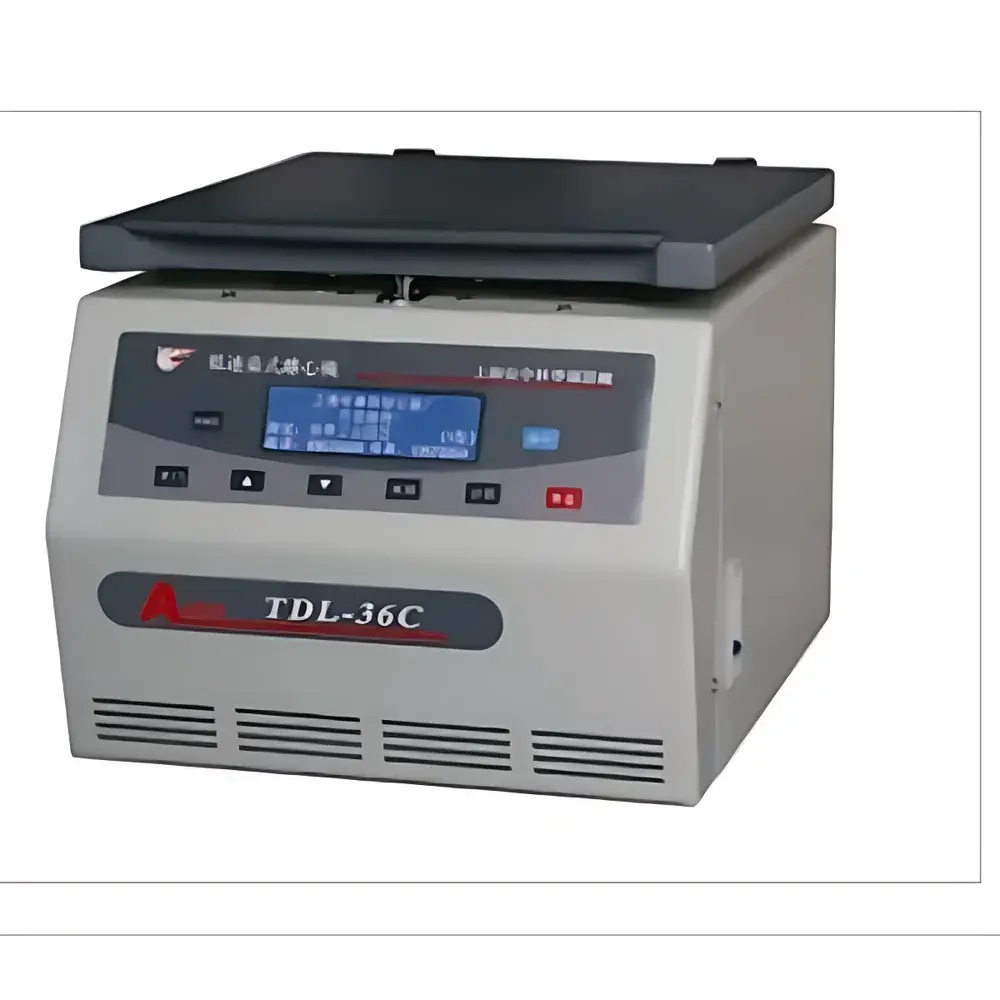
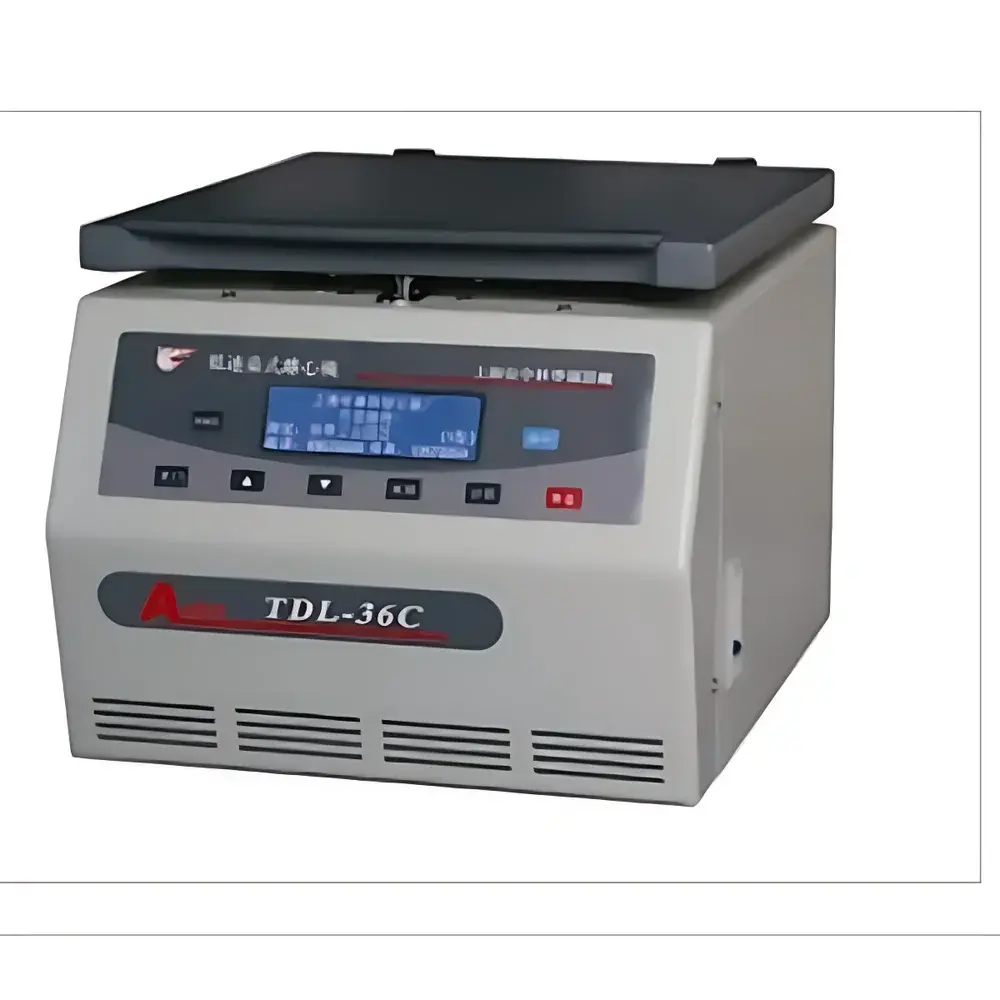
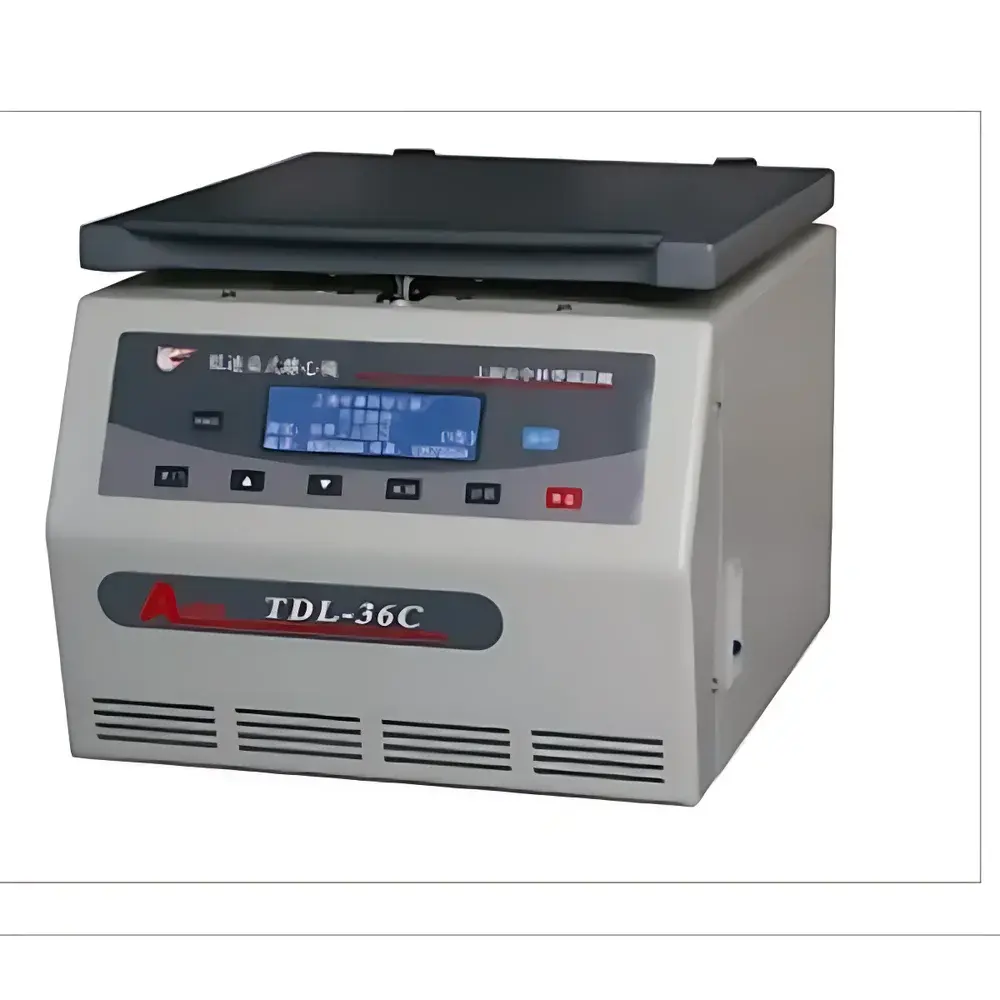
AnTing TDL-36C Benchtop Low-Speed High-Capacity Centrifuge
| Brand | AnTing |
|---|---|
| Origin | Shanghai, China |
| Model | TDL-36C |
| Instrument Type | Benchtop Centrifuge |
| Speed Range | 0–3600 rpm |
| Max RCF | 3100 × g |
| Rotor Configuration | Horizontal Swing-Out Rotor |
| Max Capacity | 4 × 1000 mL |
| Timer Range | 0–99 min |
| Power Supply | 220 V, 50 Hz, 750 W |
| Dimensions (L×W×H) | 715 × 550 × 435 mm |
| Weight | 90 kg |
| Safety | Electronic Lid Lock |
| Construction | Reinforced Polymer Housing |
| Compliance | Designed for GLP-compliant routine separation workflows |
Overview
The AnTing TDL-36C is a robust benchtop low-speed centrifuge engineered for high-volume liquid-phase separation in academic laboratories, quality control environments, and industrial R&D settings. Operating on the principle of sedimentation under controlled gravitational force (RCF), the TDL-36C delivers reproducible separation of suspensions, cell cultures, serum, whole blood, and coarse particulates—without inducing thermal or mechanical stress associated with high-speed operation. Its fixed-angle swing-out rotor design ensures uniform sample distribution during acceleration and deceleration, minimizing tube deformation and enhancing run-to-run consistency. With a maximum RCF of 3100 × g and a top rotational speed of 3600 rpm, the instrument occupies a critical niche between preparative and clinical centrifugation—offering sufficient force for pelleting erythrocytes, yeast, or precipitated polymers while maintaining compatibility with standard polypropylene and glass centrifuge tubes up to 1000 mL.
Key Features
- High-capacity horizontal rotor accommodating four 1000 mL bottles or equivalent configurations (e.g., eight 500 mL tubes or sixteen 250 mL tubes), enabling batch processing without intermediate transfers.
- Electronically interlocked safety lid that prevents operation unless fully closed and latched—meeting IEC 61010-1 requirements for laboratory equipment safety.
- Precision-machined polymer housing with vibration-damping base and balanced drive system, ensuring operational stability at full load and minimizing floor transmission.
- Digital timer with 1-minute resolution and auto-stop functionality; supports both timed runs and continuous operation mode via manual override.
- Brushed DC motor with thermal overload protection and soft-start/soft-brake algorithms to reduce mechanical wear and extend service life beyond 10,000 operating hours.
- Integrated calibration port for optional third-party RCF verification using traceable tachometers or optical sensors—supporting internal audit readiness.
Sample Compatibility & Compliance
The TDL-36C is validated for use with common laboratory containers including conical-bottom polypropylene bottles (ISO 8573-1 compliant), borosilicate glass centrifuge jars, and sealed stainless-steel canisters rated for ≤3100 × g. It does not support fixed-angle rotors or ultracentrifuge tubes. While not certified to ISO 13485 or FDA 21 CFR Part 11 out-of-the-box, its electronic logging capability (via optional RS-232 interface) allows integration into validated data acquisition systems supporting 21 CFR Part 11 Annex 11 compliance when paired with qualified software. The unit conforms to electromagnetic compatibility standards per EN 61326-1 and meets Class II electrical safety classification under IEC 61010-1.
Software & Data Management
The TDL-36C operates as a standalone instrument with no embedded microprocessor-based data storage. All operational parameters—including set speed, elapsed time, and final RCF—are displayed via LED interface but are not timestamped or exportable without external instrumentation. For regulated environments requiring audit trails, users may connect the centrifuge’s analog tachometer output (0–10 V DC proportional to rpm) to a validated SCADA or LIMS system. Optional firmware upgrades (available through authorized AnTing service centers) provide basic USB data logging for speed/time profiles, compatible with CSV export for post-run analysis in Excel or MATLAB.
Applications
- Routine plasma and serum separation from whole blood in clinical support labs.
- Clarification of fermentation broths and microbial cell harvests in bioprocessing pilot lines.
- Sedimentation of activated sludge or wastewater effluents in environmental testing facilities.
- Preparative isolation of plant tissue homogenates, starch granules, or latex particles prior to downstream chromatography.
- Stabilization and phase separation of emulsions, suspensions, and colloidal dispersions in materials science research.
FAQ
What is the maximum recommended fill volume per 1000 mL bottle?
For optimal balance and rotor longevity, AnTing recommends filling each 1000 mL container to no more than 90% capacity (i.e., ≤900 mL) when operating at ≥3000 rpm.
Can the TDL-36C accommodate rotor adapters for smaller tubes?
Yes—horizontal rotor adapter sleeves (sold separately) support 50 mL, 15 mL, and 5 mL conical tubes; however, maximum RCF must be recalculated based on effective radius reduction.
Is maintenance documentation available in English?
Full bilingual (Chinese/English) service manuals, spare parts diagrams, and calibration procedures are provided upon registration of the serial number via AnTing’s global technical support portal.
Does this model meet CE marking requirements for EU shipment?
Units manufactured after Q3 2022 include CE marking per Machinery Directive 2006/42/EC and EMC Directive 2014/30/EU; earlier units require retrofit certification by an EU-notified body.
How often should the rotor be inspected for fatigue cracks?
AnTing mandates visual and dye-penetrant inspection of the aluminum alloy rotor every 1,500 runs or annually—whichever occurs first—as specified in the Maintenance Schedule (Rev. 4.2).



