
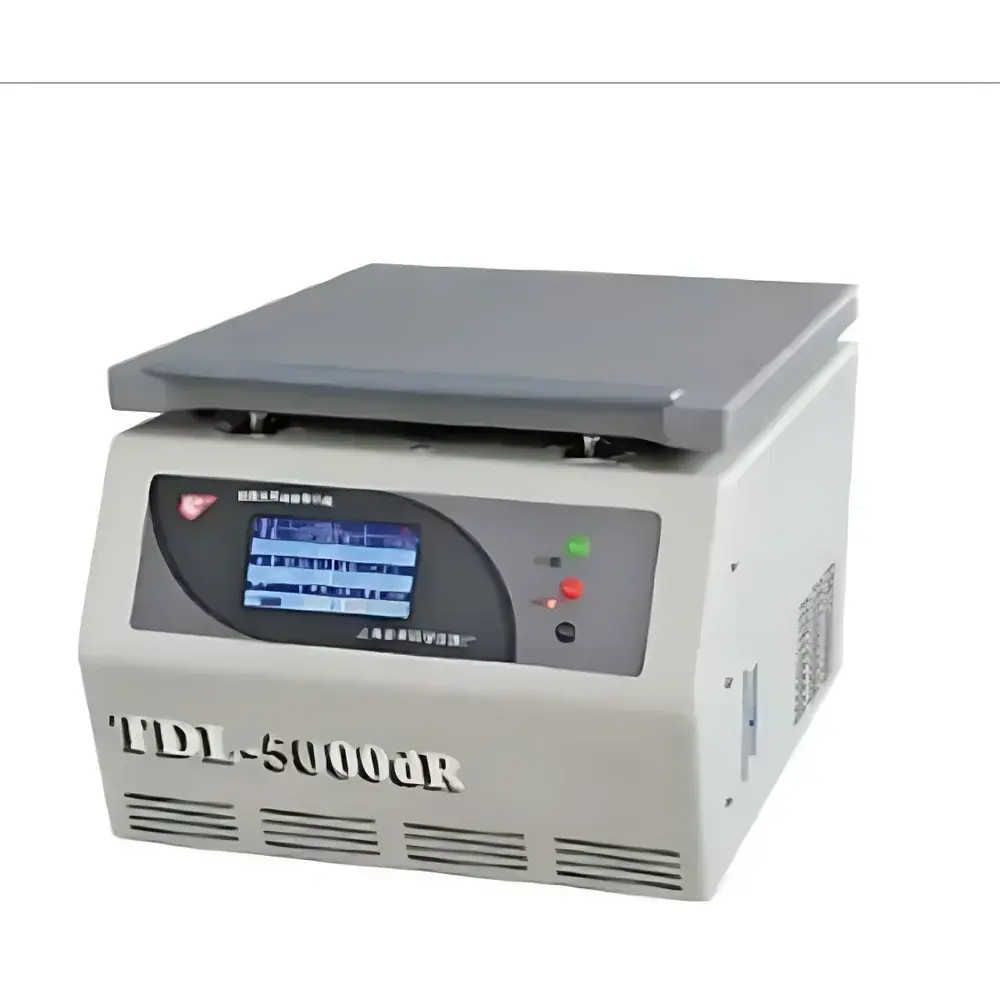
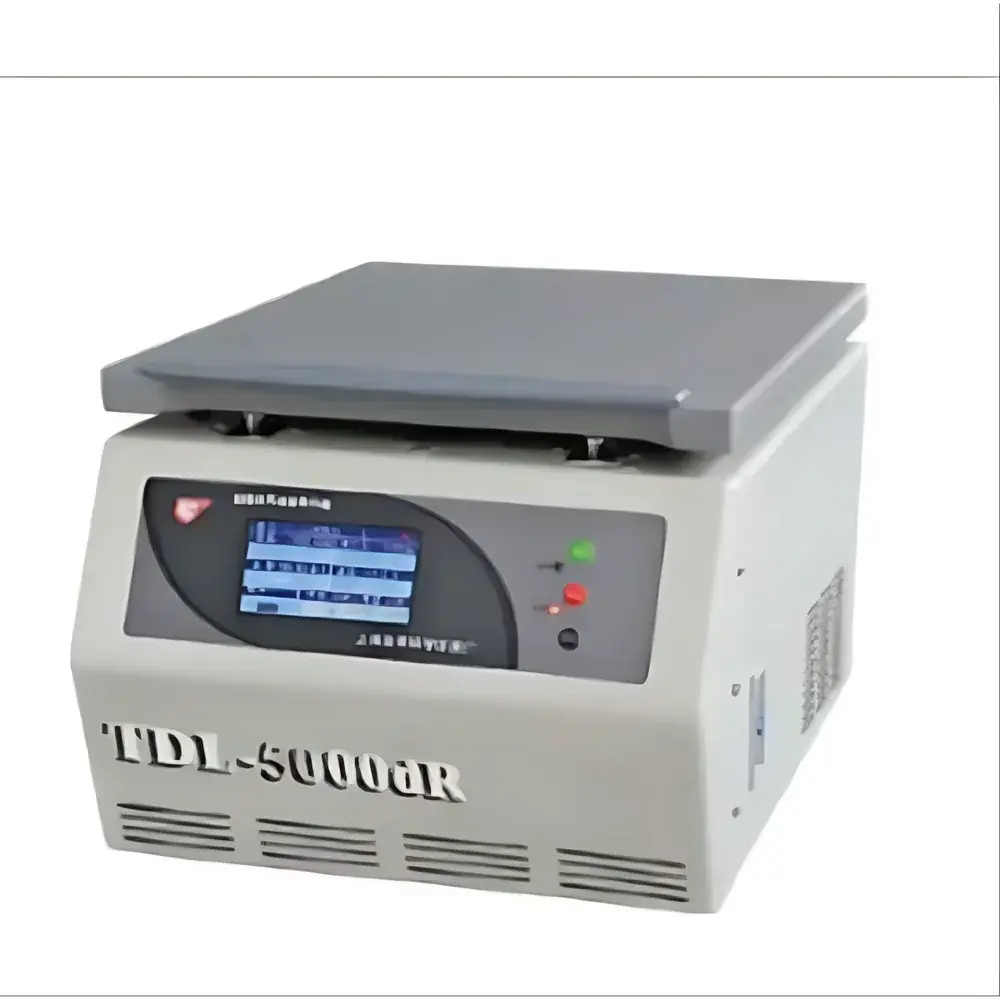
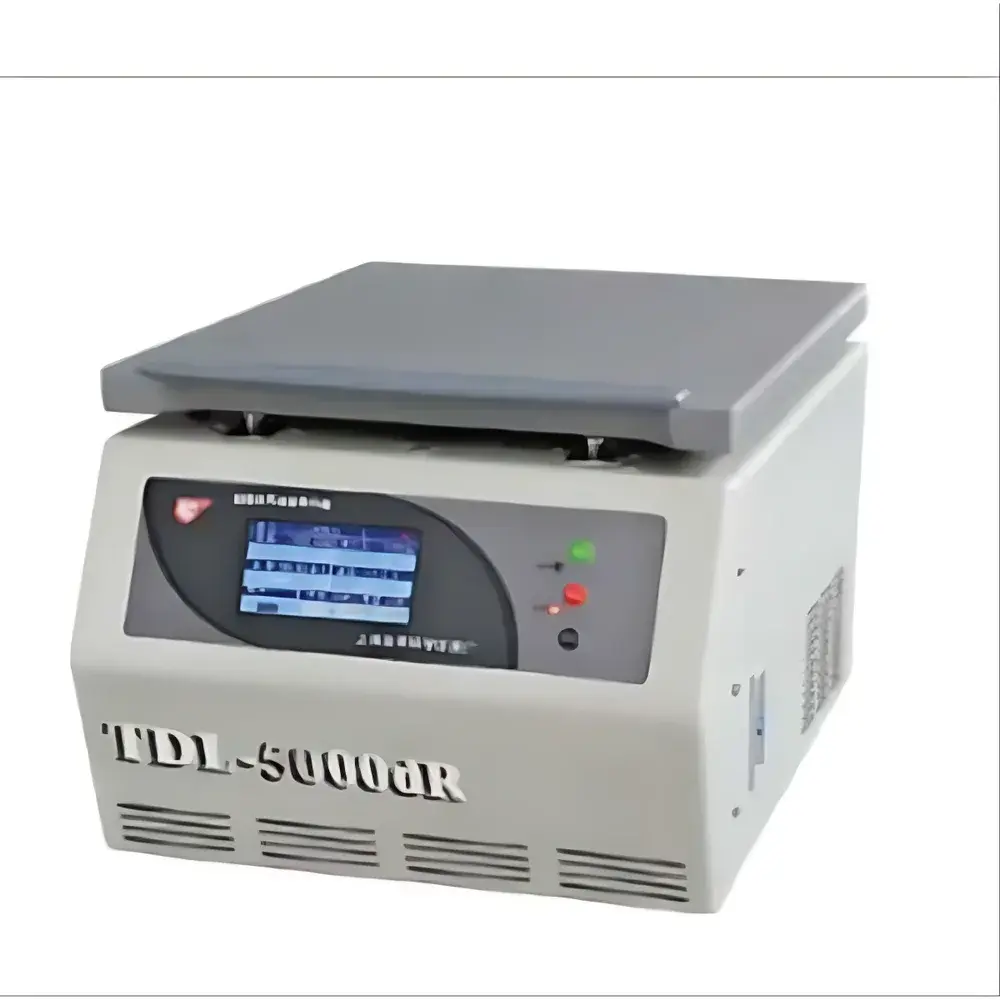
AnTing TDL5000dR Benchtop Low-Speed Refrigerated Centrifuge
| Brand | AnTing |
|---|---|
| Origin | Shanghai, China |
| Model | TDL5000dR |
| Type | Benchtop Refrigerated Centrifuge |
| Speed Range | 0–5000 rpm |
| Max RCF | 4500 × g |
| Max Capacity | 250 mL × 4 (angle rotor) / 100 mL × 4 (horizontal rotor) |
| Temperature Range | –20 °C to +30 °C |
| Temp. Accuracy | ±2 °C |
| Timer Range | 0–99 min |
| Power Supply | 220 V, 50 Hz, 1500 W |
| Dimensions (L×W×H) | 720 × 540 × 415 mm |
| Weight | 125 kg |
| Control System | Variable-frequency motor with capacitive touch screen interface |
| Safety | Electronic door lock, imbalance detection, auto lid lock, over-temperature & over-speed protection |
Overview
The AnTing TDL5000dR is a benchtop low-speed refrigerated centrifuge engineered for routine separation tasks in clinical laboratories, biotechnology QC environments, and academic research settings where temperature-sensitive samples—such as whole blood, cell suspensions, serum, plasma, and tissue homogenates—require gentle yet reproducible sedimentation. Operating on the principle of sedimentation under controlled gravitational force (RCF), the instrument utilizes a brushless variable-frequency motor to deliver precise speed regulation across its 0–5000 rpm range, enabling consistent acceleration/deceleration profiles and minimizing sample disturbance during spin-down. Its integrated refrigeration system maintains chamber temperatures between –20 °C and +30 °C with ±2 °C stability, critical for preserving enzyme activity, preventing protein denaturation, and inhibiting microbial growth during extended runs. The unit’s robust cast-aluminum housing and vibration-damping base ensure operational stability even at maximum load, while its compact footprint (720 × 540 × 415 mm) allows seamless integration into standard laboratory cabinetry.
Key Features
- Variable-frequency drive motor ensures smooth start-up, accurate speed control (±10 rpm), and extended service life without carbon brushes or mechanical wear.
- Capacitive touch-screen interface with intuitive icon-based navigation supports multi-step program storage (up to 99 protocols), real-time parameter display, and password-protected user access levels.
- Comprehensive safety architecture includes electronic door interlock, automatic rotor recognition (via embedded ID chip in optional rotors), dynamic imbalance detection, overspeed cutoff, and dual thermal sensors for compressor and chamber monitoring.
- Refrigeration system employs environmentally compliant R134a refrigerant and optimized airflow design to achieve rapid cooldown (<15 min from 25 °C to –10 °C) and stable thermal performance under continuous operation.
- Structural integrity reinforced by high-strength polymer composite components and precision-machined stainless-steel rotor chambers, meeting ISO 13485-aligned manufacturing standards for medical device support equipment.
Sample Compatibility & Compliance
The TDL5000dR accommodates a wide range of sample containers—including polypropylene conical tubes (5–250 mL), PCR strips, microtiter plates (96-well and 192-well formats), and custom adapters—through five interchangeable rotor configurations. Horizontal rotors (No. 1–2) support high-capacity pelleting of clinical specimens; the angle rotor (No. 3) enables faster pelleting of smaller-volume samples with higher RCF efficiency; the microplate carrier (No. 4) ensures uniform separation across all wells without edge effects; and the fixed-angle rotor (No. 5) delivers optimal resolution for small-volume biological assays. All rotors are certified to IEC 61010-2-020 (Safety Requirements for Centrifuges) and validated for use under GLP-compliant workflows. The system supports audit-ready documentation when paired with optional data logging modules compliant with FDA 21 CFR Part 11 requirements.
Software & Data Management
While the TDL5000dR operates autonomously via its onboard controller, it supports optional USB data export for protocol transfer and run log retrieval (timestamped speed, temperature, time, RCF, and fault codes). The touch interface logs the last 100 run records with operator ID tagging (when enabled), facilitating traceability in regulated environments. Firmware updates are performed via secure USB key, ensuring version control and cybersecurity alignment with ISO/IEC 27001-informed lab IT policies. No cloud connectivity or proprietary software installation is required—data remains local and under full institutional control.
Applications
- Clinical diagnostics: Separation of serum/plasma from whole blood (e.g., CBC prep, coagulation testing)
- Cell culture labs: Harvesting adherent or suspension cells at low shear stress (≤4500 × g)
- Pharmaceutical QA/QC: Clarification of vaccine suspensions, antibody formulations, and excipient blends
- Food & beverage testing: Fat extraction from milk, yeast sedimentation in fermentation monitoring
- Environmental analysis: Concentration of suspended solids or microorganisms from water samples per ASTM D5907
- Academic teaching: Demonstrating sedimentation kinetics, density gradient principles, and centrifugal force calculations
FAQ
What is the maximum allowable ambient temperature for continuous operation?
The unit is rated for ambient conditions up to 32 °C; above this, cooling efficiency decreases and duty cycle must be reduced per manufacturer guidelines.
Can the TDL5000dR be validated for GMP environments?
Yes—when equipped with optional IQ/OQ documentation packages and calibrated using NIST-traceable tachometers and thermistors, it meets baseline requirements for equipment qualification under EU Annex 15 and USP .
Is rotor balancing required before each run?
Yes—manual balance within ±0.5 g per tube position is mandatory; the system does not compensate for gross imbalance and will halt if detected.
Does the centrifuge support remote monitoring or network integration?
No native Ethernet or Wi-Fi capability exists; however, third-party RS-232-to-USB adapters may enable basic serial command interrogation for integration into facility-wide lab automation systems.
What maintenance intervals are recommended?
Compressor oil inspection every 24 months; refrigerant pressure check annually; rotor cavity cleaning after each use; full preventive maintenance (bearing assessment, seal integrity, calibration verification) every 18 months by authorized service personnel.



