
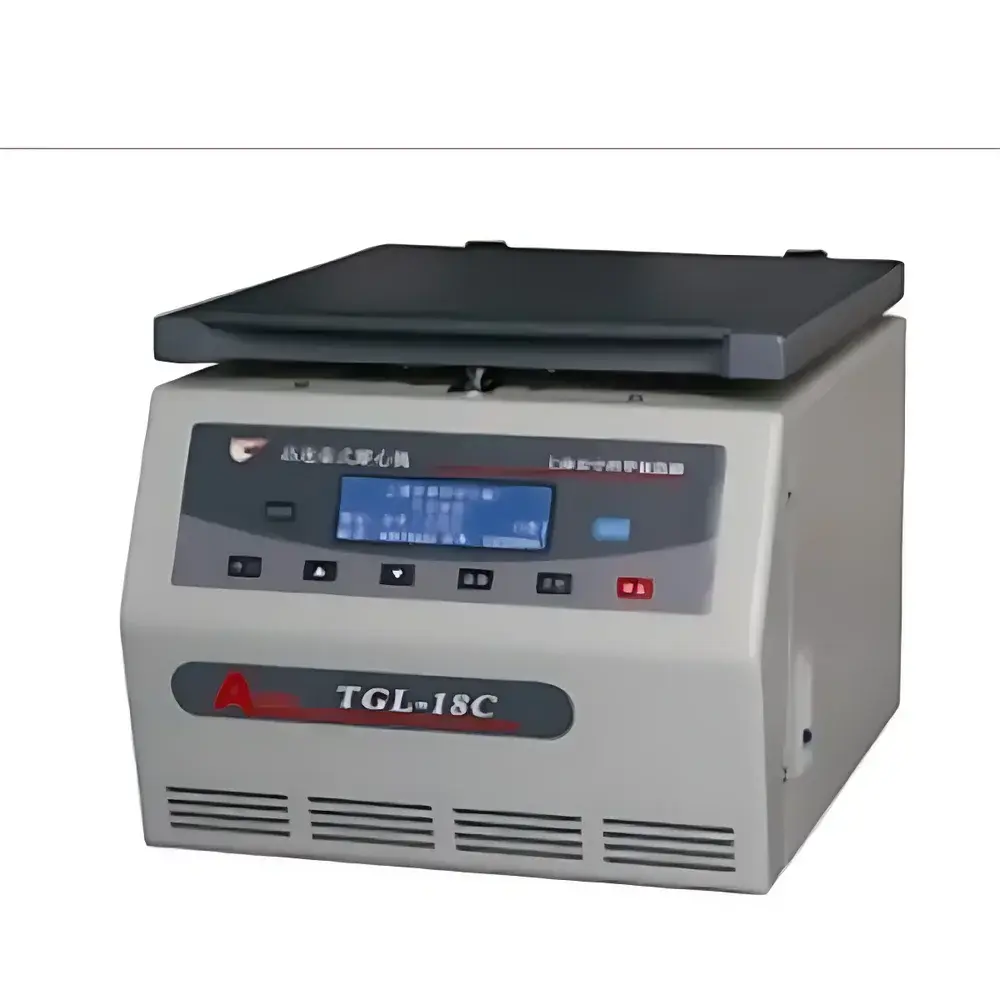
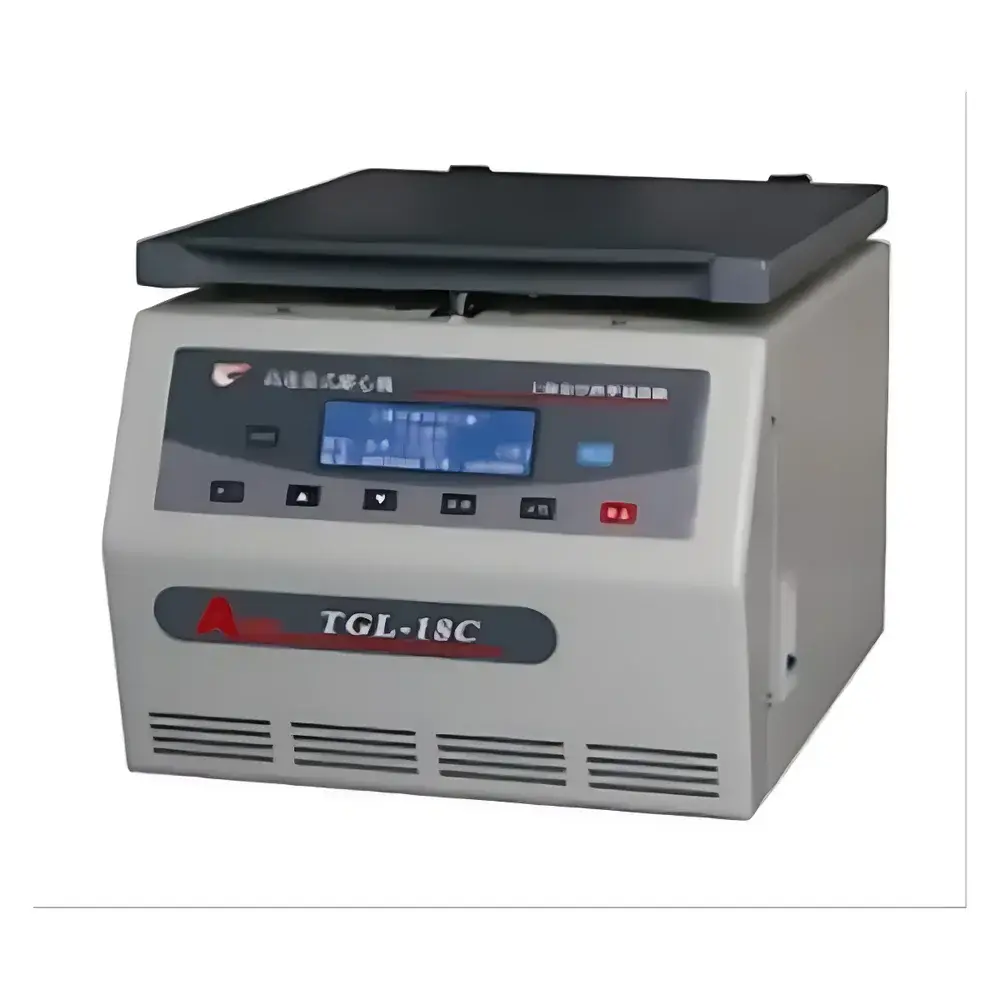
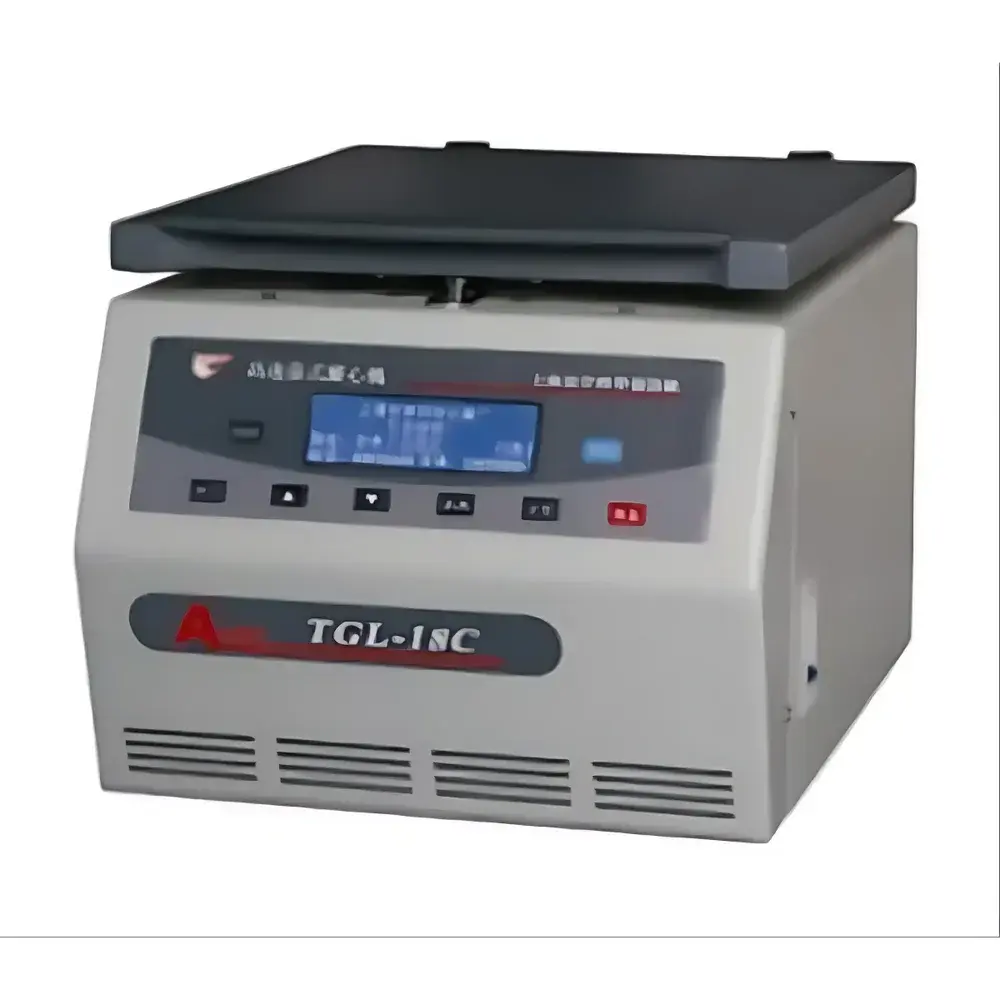
AnTing TGL-18C High-Speed Benchtop Centrifuge
| Brand | AnTing |
|---|---|
| Origin | Shanghai, China |
| Model | TGL-18C |
| Instrument Type | Benchtop Centrifuge |
| Speed Range | 0–18,000 rpm |
| Max RCF | 23,000 × g (calculated at rotor radius) |
| Max Capacity | 50 mL × 6 (angle rotor) |
| Rotor Configurations | 1.5 mL × 12, 7 mL × 8, 5 mL × 10, 1.5 mL × 24 |
| Timer Range | 0–99 min |
| Power Supply | 220 V, 50 Hz, 250 VA |
| Dimensions (L×W×H) | 550 × 350 × 320 mm |
| Weight | 43 kg |
| Construction | Reinforced polymer housing with precision-machined rotor chamber |
| Safety | Electronic lid interlock, automatic rotor recognition (mechanical), imbalance detection |
Overview
The AnTing TGL-18C High-Speed Benchtop Centrifuge is an engineered solution for routine and research-grade separation tasks in life science, clinical diagnostics, and quality control laboratories. Designed around a brushless DC motor drive system with microprocessor-based speed and time control, the TGL-18C delivers stable rotational performance across its full operating range of 0–18,000 rpm. Its centrifugal force output reaches up to 23,000 × g (RCF), calculated at the maximum radius of the standard 50 mL angle rotor — enabling efficient pelleting of subcellular particles, bacteria, and precipitated macromolecules. The unit operates on standard 220 V / 50 Hz mains power and integrates mechanical safety features including an electronic lid lock that prevents operation unless the rotor chamber is fully sealed, along with dynamic imbalance sensing to halt rotation under asymmetric load conditions. Its compact footprint (550 × 350 × 320 mm) and 43 kg mass ensure stable placement on standard laboratory benches without requiring anchoring or vibration isolation.
Key Features
- Brushless DC motor with variable-frequency drive for precise speed regulation and extended service life
- Microprocessor-controlled timing system with 1-minute resolution and auto-stop functionality
- Reinforced polymer chassis offering corrosion resistance, electromagnetic compatibility (EMC), and acoustic dampening
- Electronic lid interlock compliant with IEC 61010-1 safety standards for laboratory electrical equipment
- Three pre-calibrated angle rotors included: 1.5 mL × 12, 7 mL × 8, and 5 mL × 10; optional 1.5 mL × 24 rotor available for high-throughput microcentrifuge applications
- Real-time RPM/RCF display with dual-unit readout and memory recall for last-used parameters
- No external refrigeration — optimized thermal management maintains ambient rotor temperature during extended runs (≤30 min at max speed)
Sample Compatibility & Compliance
The TGL-18C accommodates standard conical-bottom polypropylene and polycarbonate tubes (1.5–50 mL), including certified low-binding and sterile options. It supports common centrifugation protocols for nucleic acid extraction, protein purification, cell harvesting, and serum/plasma separation. While not a refrigerated unit, its thermal profile remains within ISO 13485-defined operational limits for non-critical sample integrity when used per manufacturer-recommended run durations. The device conforms to GB/T 13823.12–2018 (Chinese national standard for centrifuge safety and performance) and carries CE marking under the Low Voltage Directive (2014/35/EU) and EMC Directive (2014/30/EU). Documentation includes factory calibration certificates traceable to NIM (National Institute of Metrology, China), and all rotors are individually serialized for GLP-compliant instrument logbook entries.
Software & Data Management
The TGL-18C operates as a standalone instrument with no proprietary software dependency. All operational parameters — speed, time, acceleration/deceleration profiles (fixed ramp rates), and RCF calculation — are set via front-panel membrane keys and confirmed on a dual-line LCD display. For laboratories implementing 21 CFR Part 11 compliance, optional RS-232 serial output (with third-party data logger integration) enables timestamped parameter logging and audit trail generation. No onboard storage or network connectivity is provided, aligning with ISO/IEC 17025 requirements for minimal firmware intervention in accredited testing environments.
Applications
- Preparative isolation of mitochondria, lysosomes, and microsomes from tissue homogenates
- Clarification of bacterial culture supernatants prior to chromatography or ELISA analysis
- Concentration of viral particles and exosomes using PEG-based precipitation workflows
- Routine phase separation in solvent extraction protocols (e.g., phenol-chloroform DNA isolation)
- Quality assurance centrifugation for pharmaceutical suspensions and colloidal formulations
- Training and method development in academic teaching labs where reproducibility and safety are prioritized over ultra-high-speed capability
FAQ
Is the TGL-18C suitable for biosafety level 2 (BSL-2) applications?
Yes — when used with sealed rotors and capped tubes, it meets containment requirements for centrifuging low-risk biological agents. A biosafety cabinet is recommended for tube loading/unloading.
Does the unit support programmable acceleration and deceleration ramps?
No — it uses fixed-rate braking (standard deceleration) and soft-start acceleration to minimize mechanical stress and sample resuspension.
Can third-party rotors be installed?
Only AnTing-certified rotors are validated for mechanical integrity and RCF accuracy at rated speeds; use of non-OEM rotors voids warranty and compromises safety certification.
What maintenance is required for long-term reliability?
Biannual inspection of lid seal integrity, rotor threads, and motor cooling vents is advised. Rotors must be cleaned with neutral pH detergent and air-dried after each use to prevent corrosion.
Is rotor imbalance compensation automatic?
The system detects gross imbalance (>5 g mass difference between opposing positions) and halts rotation within 0.8 seconds; manual balancing remains essential for optimal bearing longevity and noise reduction.



