
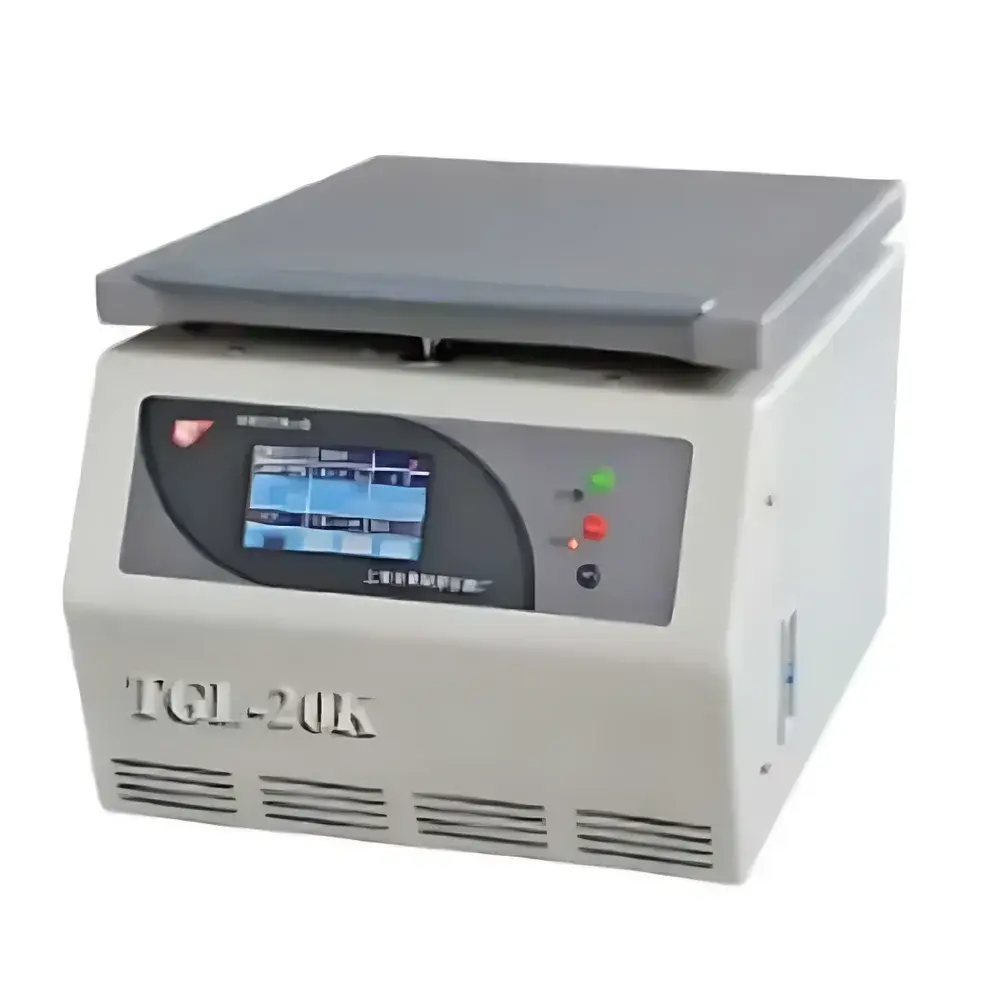
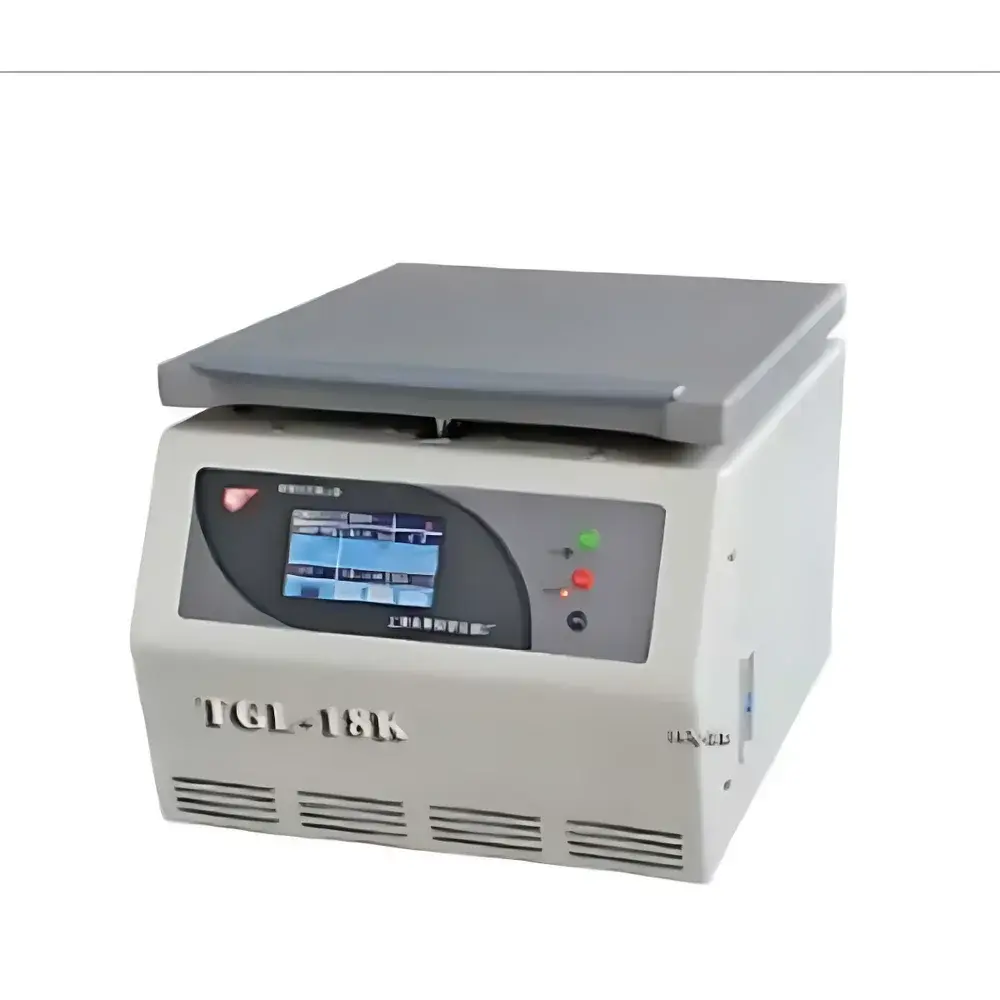
AnTing TGL-20K High-Speed Refrigerated Benchtop Centrifuge
| Brand | AnTing |
|---|---|
| Origin | Shanghai, China |
| Model | TGL-20K |
| Instrument Type | Benchtop Centrifuge |
| Category | High-Speed Refrigerated Centrifuge (10,000–30,000 rpm) |
| Max Speed | 20,000 rpm |
| Max RCF | 28,000 × g |
| Max Capacity | 50 mL × 6 |
| Rotor Configuration | Fixed-Angle Rotors |
| Dimensions (L×W×H) | 620 mm × 420 mm × 385 mm |
| Power Supply | 220 V, 50 Hz, 400 W |
| Weight | 57 kg |
| Control System | Frequency-Controlled Motor with Touchscreen Interface |
| Safety | Electronic Lid Lock |
| Cooling | Integrated Refrigeration System |
Overview
The AnTing TGL-20K is a high-speed refrigerated benchtop centrifuge engineered for precision separation of biological, chemical, and pharmaceutical samples under controlled thermal conditions. It operates on the principle of sedimentation acceleration via rotational force—generating up to 28,000 × g at its maximum speed of 20,000 rpm—to enable rapid pelleting of subcellular particles, macromolecules, and suspended solids. Designed for consistent performance in quality control laboratories, academic research facilities, and small-scale production environments, the TGL-20K integrates a brushless frequency-controlled motor, real-time temperature regulation (typically −20 °C to +40 °C), and a rigid cast-alloy chassis with reinforced polymer housing to minimize vibration and ensure long-term mechanical stability. Its compact footprint (620 × 420 × 385 mm) and 57 kg mass provide optimal balance between operational rigidity and benchtop space efficiency.
Key Features
- Refrigerated operation with independent cooling system maintaining setpoint accuracy within ±2 °C across the full operating range (−20 °C to +40 °C)
- Microprocessor-controlled touchscreen interface supporting programmable run profiles—including speed, time, temperature, acceleration/deceleration ramps, and automatic rotor identification
- Five pre-calibrated fixed-angle rotors included: Rotor #1 (1.5/2 mL × 12), Rotor #2 (5 mL × 12), Rotor #3 (1.5/2 mL × 18), Rotor #4 (50 mL × 6), and Rotor #5 (10 mL × 12), each certified for maximum RCF at specified speeds
- Electronic lid interlock with dual-sensor verification ensuring immediate motor shutdown upon lid opening during operation
- Low-noise design (<65 dB(A) at 20,000 rpm) achieved through dynamic balancing, acoustic insulation, and optimized airflow management
- Energy-efficient 400 W power consumption with auto-standby mode and overtemperature/overcurrent/imbalance fault detection
Sample Compatibility & Compliance
The TGL-20K accommodates standard polypropylene, polycarbonate, and stainless-steel centrifuge tubes (1.5–50 mL), including conical-bottom microcentrifuge tubes and thin-walled PCR strips. Its rotor configurations support common protocols in molecular biology (e.g., plasmid DNA isolation, RNA precipitation), clinical diagnostics (serum/plasma separation), and materials science (nanoparticle dispersion clarification). The unit complies with IEC 61010-1:2010 for laboratory electrical equipment safety and meets EN 61326-1:2013 electromagnetic compatibility requirements. While not FDA 21 CFR Part 11–certified out-of-the-box, its audit-trail-capable touchscreen firmware supports GLP/GMP-aligned documentation when integrated into validated lab information management systems (LIMS).
Software & Data Management
The embedded control software records timestamped run logs—including speed, RCF, temperature, duration, rotor ID, and error codes—for local retrieval via USB export. No proprietary desktop application is required; data exports as CSV files compatible with Excel, LabArchives, or electronic lab notebook (ELN) platforms. Firmware updates are performed via USB flash drive, with version history and checksum validation to ensure integrity. Optional RS-232 or Ethernet connectivity (via third-party interface module) enables remote monitoring and integration into centralized instrument networks adhering to ASTM E1384 or ISO/IEC 17025 traceability frameworks.
Applications
- Clarification of bacterial lysates prior to chromatographic purification
- Isolation of exosomes and extracellular vesicles from cell culture supernatants
- Separation of red blood cells from whole blood in hematology workflows
- Concentration of viral vectors for gene therapy process development
- Density gradient centrifugation using sucrose or iodixanol media (with compatible rotors)
- Routine QC testing of colloidal suspensions and emulsions in formulation labs
FAQ
What is the minimum and maximum operating temperature range?
The refrigeration system maintains temperatures from −20 °C to +40 °C, with typical stabilization time of ≤15 minutes from ambient to −20 °C.
Can the TGL-20K accommodate swing-bucket rotors?
No—the TGL-20K is configured exclusively for fixed-angle rotors; swing-bucket compatibility is not supported by its mechanical design or rotor interface.
Is rotor calibration traceable to national standards?
Each rotor is supplied with a factory-verified RCF vs. speed curve; users may perform periodic verification using NIST-traceable tachometers and thermistors per ISO 15195 guidelines.
Does the centrifuge support timed ramping profiles?
Yes—acceleration and deceleration rates are independently programmable in 100 rpm/s increments, enabling gentle pelleting of fragile organelles or viscous samples.
What maintenance intervals are recommended?
Routine cleaning of the chamber and rotor seats is advised after each use; full preventive maintenance—including bearing inspection and refrigerant pressure check—is recommended every 12 months or 1,000 operating hours, whichever occurs first.



