
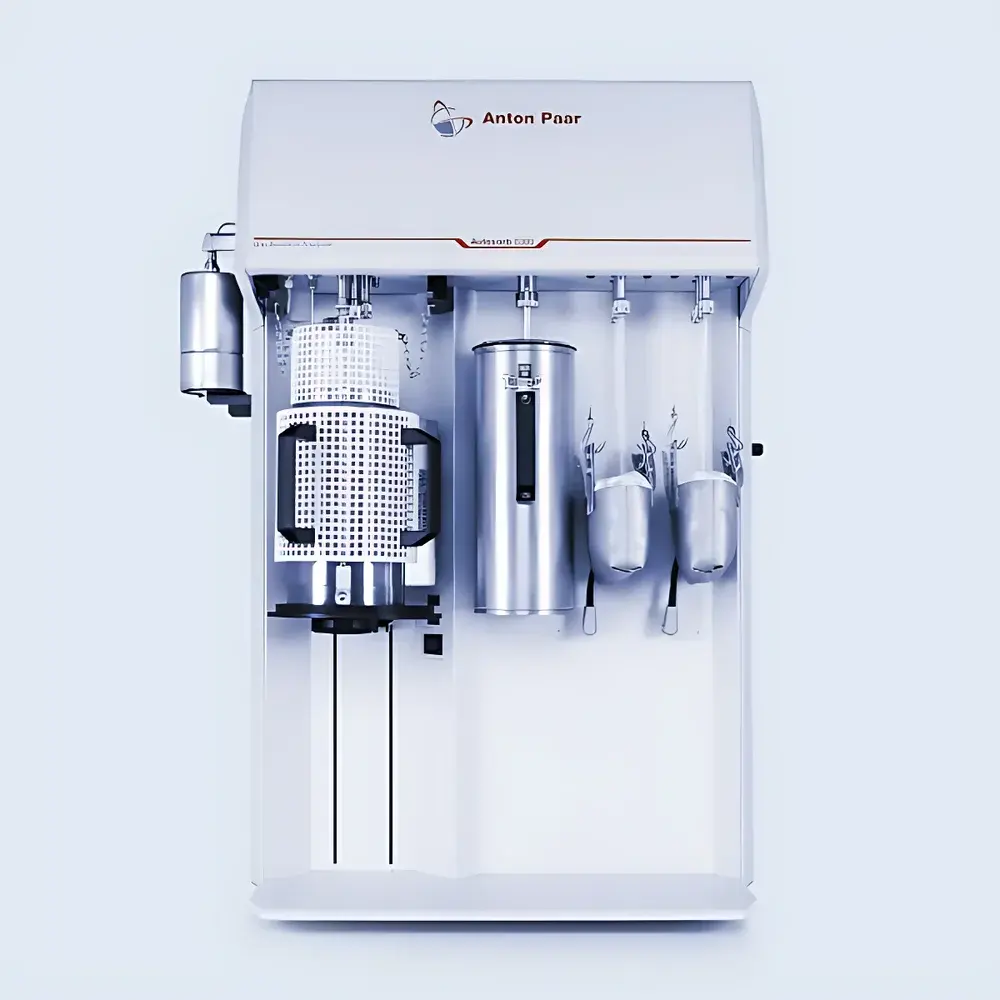
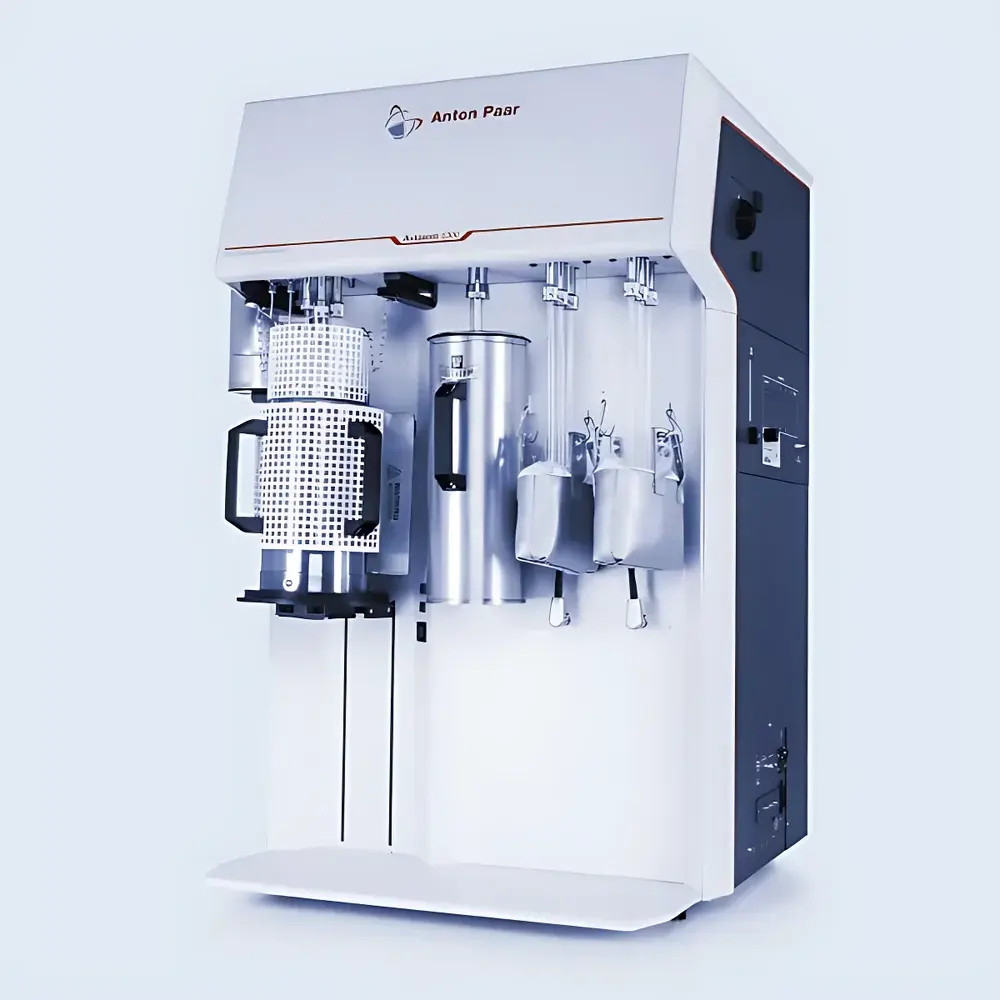
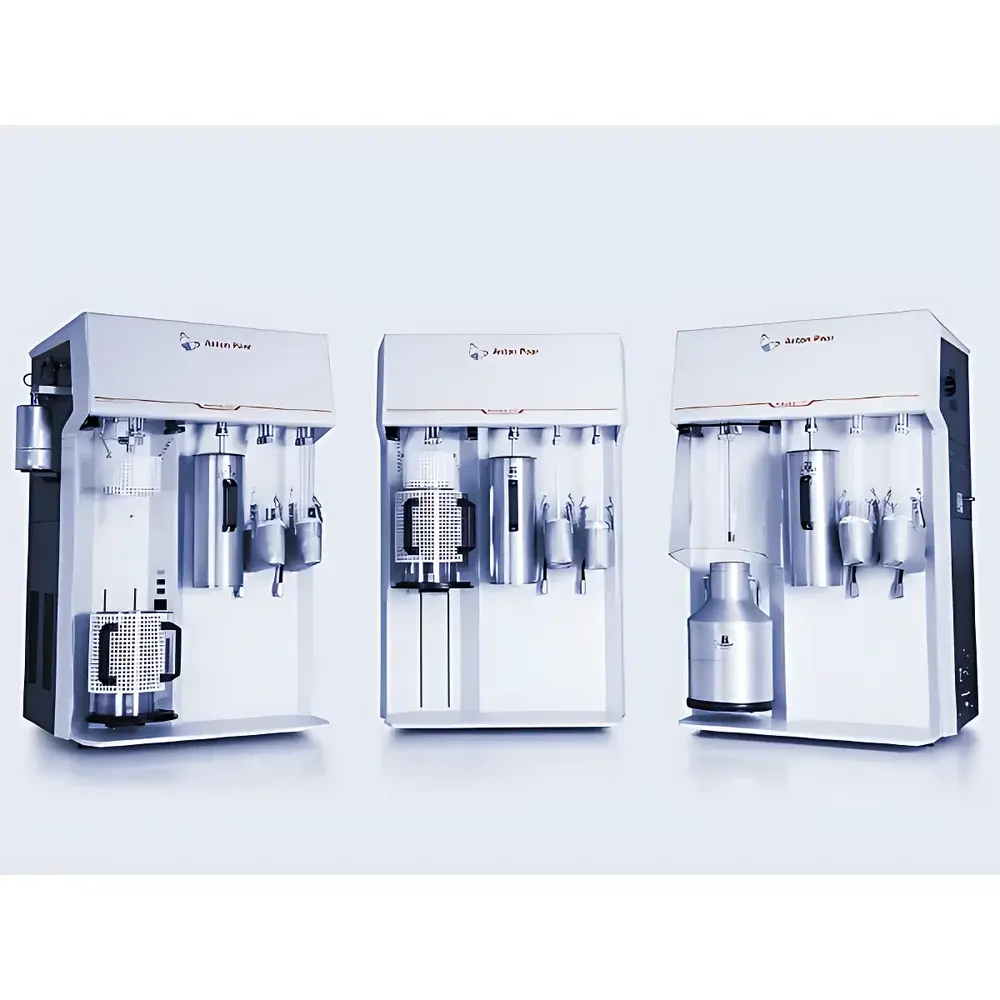
Anton Paar Autosorb 6300 Automated Chemisorption Analyzer
| Brand | Anton Paar |
|---|---|
| Origin | USA |
| Manufacturer Type | Original Equipment Manufacturer (OEM) |
| Instrument Type | Chemisorption Analyzer |
| Model | Autosorb 6300 |
| Gas Inlet Ports | 6 |
| Maximum Heating Temperature | 1100 °C |
| Isothermal Stability | ±1 °C |
| Ramp Rate | 1–50 °C/min |
| Pressure Range | 2×10⁻⁵ to 1100 Torr (2.6×10⁻⁸ to 0.997 p/p₀ for N₂ at 77 K) |
| Analytical Modes | TPR, TPO, TPD, Pulse Titration |
| Detection | Integrated TCD, Optional Mass Spectrometer |
| Vapor Source | Built-in |
| Dewar Duration | >90 h (LN₂) |
| Degassing Stations | 6 PID-controlled, up to 450 °C |
| TruZone Active Liquid-Level Control | Yes |
| PowderProtect Anti-Dust System | Yes |
| Stainless Steel Manifold with Pneumatic Valves | Yes |
| Vacuum Integrity Improvement | 38% vs. legacy designs |
| BET Surface Area Detection Limit | 0.01 m²/g (N₂, 77 K) |
| Pore Size Range | 0.35 nm – 500 nm |
| Metal Dispersion Detection Limit | 0.003 m² (H₂ on Pt, 313 K) |
Overview
The Anton Paar Autosorb 6300 is a high-precision, fully automated gas sorption analyzer engineered for comprehensive catalyst and porous material characterization. It integrates dual-mode operation—vacuum volumetric physisorption and dynamic/flow-based chemisorption—within a single platform, enabling rigorous surface area, pore structure, and active site quantification under rigorously controlled thermodynamic and kinetic conditions. The instrument operates on the principle of precise pressure–volume–temperature (PVT) measurements in ultra-high vacuum environments, supported by real-time thermal management and active liquid-level stabilization via TruZone technology. Its stainless steel monolithic manifold, coupled with high-integrity pneumatic valves, achieves a base vacuum performance enhanced by 38% over prior-generation systems—critical for achieving reproducible sub-10⁻⁸ p/p₀ measurements required for micropore analysis and low-surface-area materials. Designed for compliance with ASTM D3663 (BET surface area), ISO 9277 (gas adsorption), and USP (catalyst characterization), the Autosorb 6300 serves as a reference-grade platform in academic catalysis labs, industrial R&D centers, and regulatory-compliant QC environments.
Key Features
- Triple independent analysis stations: Simultaneous, fully autonomous physisorption experiments at three distinct temperatures and/or gases—enabling parallel BET, t-plot, and NLDFT analyses without cross-contamination or scheduling conflict.
- Modular high-temperature furnace: Rapid-swappable 1100 °C heating module with programmable ramp rates (1–50 °C/min) and ±1 °C isothermal stability—optimized for TPR, TPO, TPD, and static chemisorption isotherms.
- Six PID-controlled degassing stations: Dual-zone heating (RT–450 °C) with integrated cold trap and programmable multi-step profiles—ensuring complete removal of physisorbed species prior to chemisorption measurement.
- TruZone active liquid-level control: Maintains constant cryogenic bath geometry during extended LN₂ runs (>90 h), eliminating cold zone volume drift and ensuring <0.5% repeatability in low-p/p₀ (<10⁻⁷) data acquisition.
- Enhanced chemical compatibility: Standard support for H₂, CO, NH₃, C₃H₆O, C₅H₅N, CH₄, C₂H₆, C₆H₆, and other reactive/non-reactive gases; optional mass spectrometer integration for evolved gas analysis (EGA) during TPD/TPO.
- PowderProtect anti-dust system: Prevents sample dispersion during evacuation and gas dosing—preserving integrity of fragile catalysts and nanomaterials.
Sample Compatibility & Compliance
The Autosorb 6300 accommodates powders, pellets, extrudates, and monoliths ranging from 1000 m² total surface area. Its chemically inert stainless-steel flow path and corrosion-resistant seals permit routine use with acidic (NH₃), basic (pyridine), and reducing (H₂) probe molecules. All analytical protocols adhere to internationally recognized standards: ASTM D4641 (pore size distribution), ISO 15901-2 (NLDFT modeling), and ISO 18852 (metal dispersion via H₂ pulse titration). For regulated environments, Kaomi software supports 21 CFR Part 11-compliant audit trails, electronic signatures, and role-based access control—fully aligned with GLP and GMP documentation requirements.
Software & Data Management
Kaomi software provides unified control of up to four Autosorb instruments from a single workstation. It includes DoseWizard™—a library of pre-validated, standards-compliant method templates (ASTM, DIN, ISO)—and advanced scripting for custom isotherm acquisition, TPD deconvolution, and Langmuir–Freundlich fitting. Data processing incorporates NLDFT/QSDFT kernel libraries validated against IUPAC reference materials, alongside BJH, HK, SF, and MP models for meso-/macropore analysis. Reporting modules generate compliant PDF summaries with traceable metadata, raw isotherm overlays, error propagation estimates, and fractal dimension (FHH/NK) outputs. All datasets are stored in vendor-neutral HDF5 format with embedded calibration history and environmental logs.
Applications
- Catalyst development: Quantifying metal dispersion, active surface area, and reducibility (via H₂-TPR) of Pt/Al₂O₃, Ni/MgO, Co-Mo sulfides, and single-atom catalysts.
- Battery materials: Characterizing specific surface area and pore accessibility of cathode precursors (e.g., NMC, LFP) and solid electrolytes (LLZO, LATP).
- Carbon capture: Evaluating CO₂ adsorption capacity, isosteric heat of adsorption (Qst), and cyclic stability of MOFs and amine-grafted silicas.
- Pharmaceutical excipients: Measuring surface energetics and moisture uptake kinetics of microcrystalline cellulose and spray-dried lactose using Kr (87 K) physisorption.
- Environmental catalysis: Assessing NOₓ storage capacity (NSR) of BaO/CeO₂-ZrO₂ and SO₂ poisoning resistance via in situ TPO.
FAQ
What distinguishes the Autosorb 6300 from legacy chemisorption analyzers?
Its triple-station architecture, TruZone liquid-level stabilization, and monolithic stainless manifold collectively enable <0.5% BET repeatability and reliable sub-10⁻⁸ p/p₀ data—unattainable with conventional float-level or glass-manifold systems.
Can the Autosorb 6300 perform both physisorption and chemisorption on the same sample without transfer?
Yes. The instrument supports sequential degas–physisorption–chemisorption workflows within a single sample tube, minimizing handling errors and atmospheric contamination.
Is mass spectrometry integration required for TPD peak assignment?
No. While optional MS enhances speciation, built-in TCD detection with multi-gas calibration enables robust TPD/TPR deconvolution using standard reference libraries (e.g., H₂, CO, CO₂, H₂O).
How does the PowderProtect system improve measurement fidelity?
It suppresses particle entrainment during rapid pressure transients—preventing false signals from suspended fines and preserving sample mass integrity across multi-cycle analyses.
What validation materials are recommended for routine performance verification?
BAM Reference Material P115 (silica gel) for BET surface area; NIST SRM 1900 (graphitized carbon black) for micropore analysis; and certified Pt/Al₂O₃ standards for H₂ pulse titration reproducibility assessment.



