
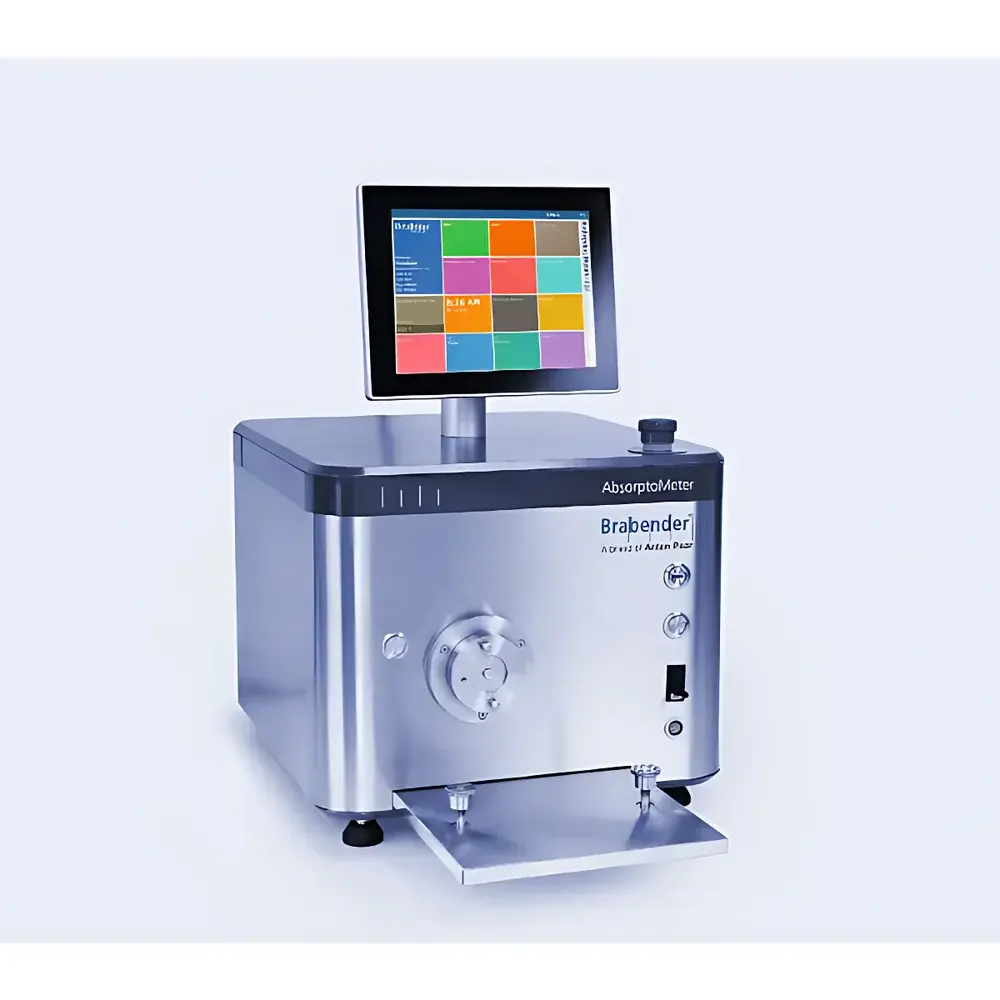
Anton Paar Brabender AbsorptoMeter Carbon Black Oil Absorption Tester
| Brand | Anton Paar Brabender |
|---|---|
| Origin | Germany |
| Model | AbsorptoMeter |
| Standards Compliance | ASTM D2414, ASTM D3493, ASTM D6854 |
| Measurement Principle | Automated Titration-Based Oil Absorption (OAN) |
| Construction | Stainless Steel Housing |
| Software | Integrated PC-Based Control with Audit Trail & Data Export |
| Sample Handling | Dedicated Mixing Discs for Carbon Black & Silica |
| Viscosity Range | Up to 1,000,000 mPa·s |
| Solvent Compatibility | NMP, Paraffin Oil, and Other Standard Oils |
| Automation Level | Fully Automated Titration, Dosing, Mixing, Endpoint Detection |
Overview
The Anton Paar Brabender AbsorptoMeter is a fully automated, precision-engineered instrument designed for the quantitative determination of oil absorption number (OAN) in carbon black, silica, and other fine particulate fillers used extensively in rubber and polymer compounding. Based on the standardized titration principle—where a defined volume of non-volatile oil is incrementally added to a fixed mass of dry powder under controlled shear—the AbsorptoMeter detects the critical endpoint at which the powder transitions from a dry, free-flowing state to a cohesive, paste-like mass. This physical transition reflects the material’s surface area, structure, and porosity, directly correlating with reinforcement efficiency in elastomeric systems. Unlike manual spatula-based methods prone to operator variability and subjective endpoint interpretation, the AbsorptoMeter employs motorized dosing, real-time torque monitoring, and algorithmic endpoint recognition to deliver high reproducibility (RSD < 2% per ASTM inter-laboratory studies) and traceable measurement records.
Key Features
- Fully automated oil titration with programmable dosing rates and adaptive endpoint detection via torque-shear profiling
- Stainless steel construction (AISI 316) for chemical resistance, mechanical robustness, and compliance with ISO 17025 laboratory environmental requirements
- Dedicated mixing discs engineered for carbon black (high-structure grades) and fumed silica (low-density agglomerates), minimizing cross-contamination and wear
- High-torque mixing system capable of handling viscosities up to 1,000,000 mPa·s—ensuring reliable performance with highly structured or solvent-swollen samples
- Integrated compatibility with aggressive solvents including N-methyl-2-pyrrolidone (NMP), paraffinic oils, and phthalate esters without seal degradation
- Modular design supporting future calibration verification kits and optional accessories such as inert-atmosphere sample loading modules
Sample Compatibility & Compliance
The AbsorptoMeter is validated for routine use with ASTM D2414 (carbon black), ASTM D3493 (silica), and ASTM D6854 (modified carbon black grades). Its hardware and software architecture are aligned with GLP and GMP documentation requirements, featuring time-stamped audit trails, user-access controls, and electronic signature support compliant with FDA 21 CFR Part 11 when deployed with validated IT infrastructure. All measurement sequences—including blank runs, reference standard calibrations, and sample replicates—are logged with metadata (operator ID, timestamp, ambient temperature/humidity, reagent lot number) to support ISO/IEC 17025 accreditation. The instrument accommodates sample masses from 2.0 g to 5.0 g, with resolution down to 0.001 g via integrated analytical balance interface (optional external balance supported).
Software & Data Management
The AbsorptoMeter Control Software provides a Windows-based interface for method creation, sequence scheduling, real-time torque curve visualization, and statistical evaluation of replicate measurements. Each test generates a complete digital dossier containing raw torque vs. time data, derivative curves, calculated OAN values (g oil/100 g sample), and pass/fail flags against predefined specification limits. Data export is supported in CSV, PDF, and XML formats—with direct integration into LIMS platforms via ODBC or RESTful API. Version-controlled method templates ensure consistent execution across shifts and sites, while change logs record all parameter modifications with user attribution and timestamps—critical for internal audits and regulatory inspections.
Applications
Primary applications include quality control of carbon black batches in tire tread compounds, evaluation of silica dispersion efficiency in green tire formulations, R&D screening of surface-modified fillers, and technical service support for compounders optimizing filler-oil interactions. Secondary use cases extend to pigment characterization in coatings, pharmaceutical excipient testing (e.g., fumed silica flow aids), and academic research on nanoparticle wetting behavior. The instrument’s adaptability to diverse oil types and mixing kinetics makes it suitable for developing novel filler systems where conventional OAN protocols require method adaptation.
FAQ
What standards does the AbsorptoMeter support?
ASTM D2414, ASTM D3493, and ASTM D6854 are natively supported; custom methods can be configured for ISO 3452-2, DIN 53601, or internal specifications.
Is calibration traceable to national standards?
Yes—certified reference materials (CRM) for carbon black and silica are available through Anton Paar’s calibration services, with NIST-traceable certificates issued upon request.
Can the AbsorptoMeter operate unattended overnight?
Yes—scheduled sequences with auto-start, error recovery logic, and email notifications enable lights-out operation for batch testing.
How is maintenance performed?
Routine cleaning requires only isopropanol wipe-down of the mixing chamber; annual preventive maintenance includes torque sensor recalibration and drive belt inspection—both documented in the built-in service log.
Does the software support multi-user environments?
Yes—role-based access control (RBAC) allows administrator, operator, and reviewer permissions with configurable password policies and session timeout settings.




