
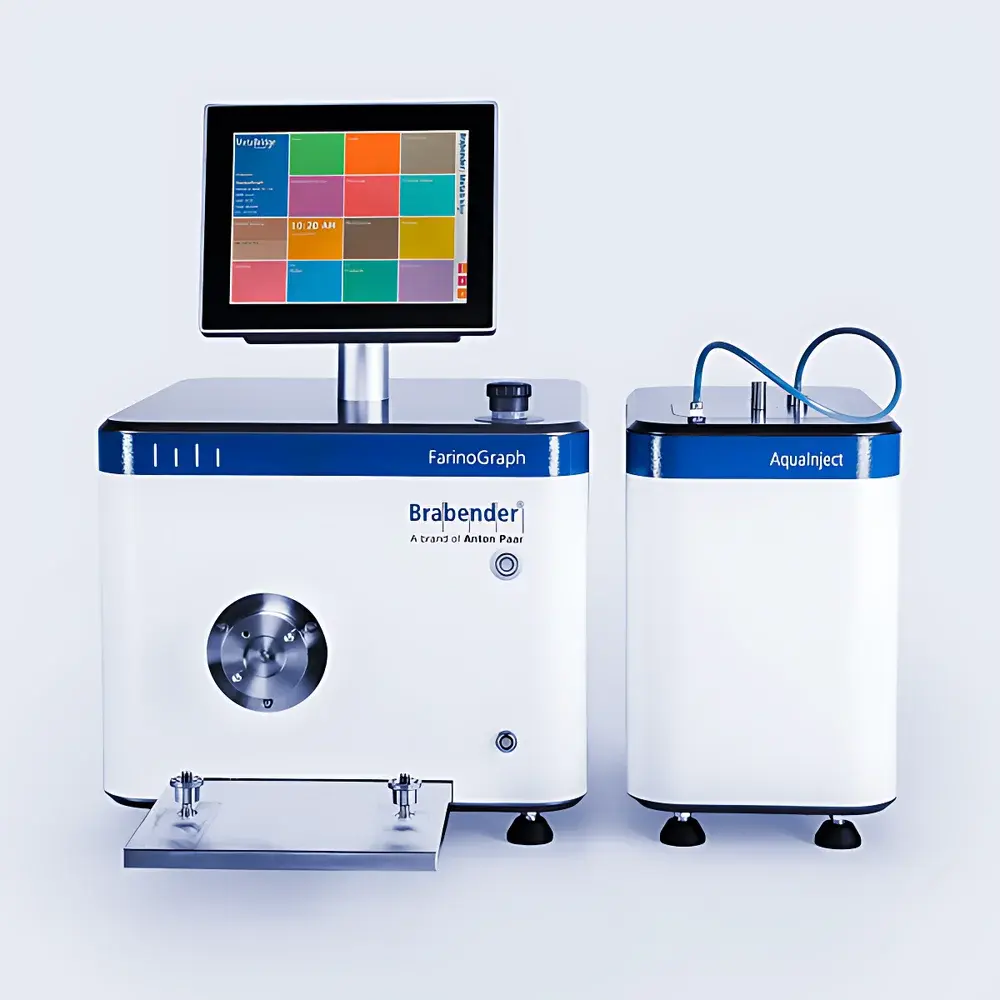
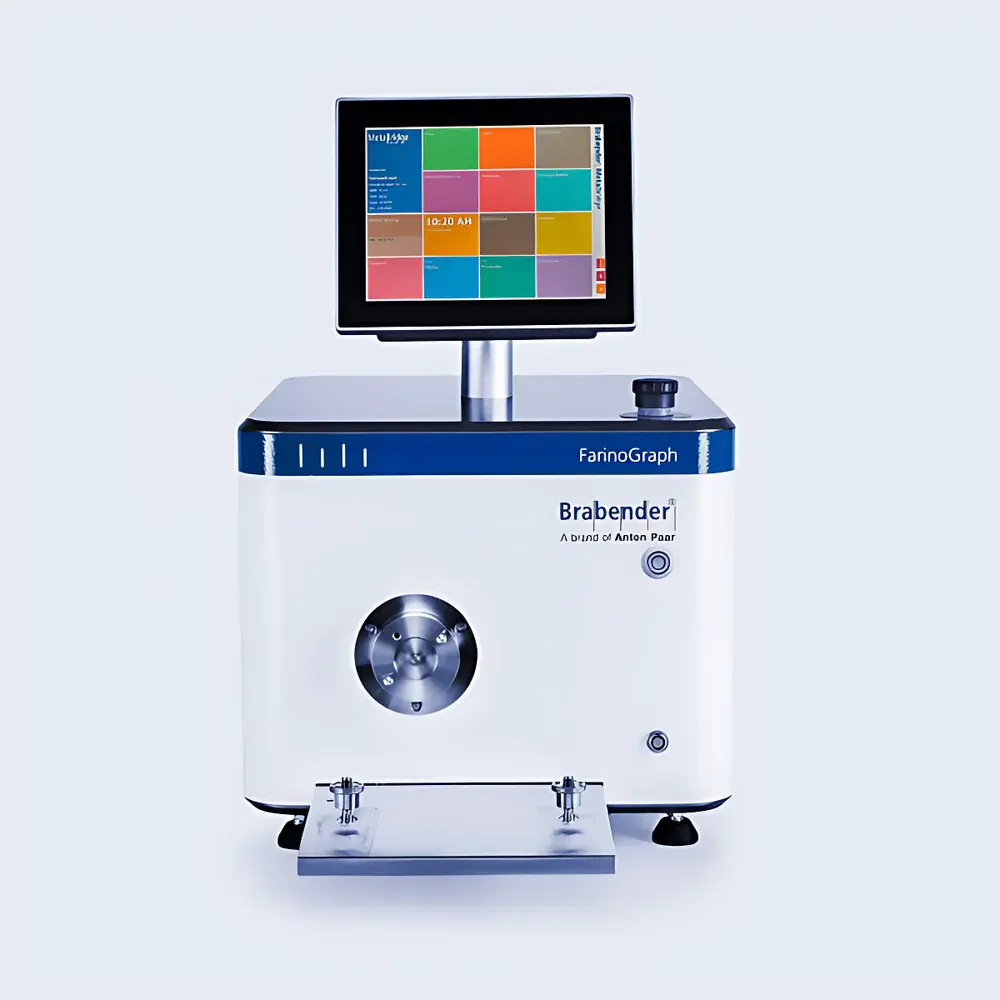
Anton Paar Brabender FarinoGraph Electronic Flour Quality Analyzer
| Brand | Anton Paar Brabender |
|---|---|
| Origin | Germany |
| Model | FarinoGraph |
| Compliance | ICC, AACCI, ISO 5530-1, ISO 21415 |
| Measurement Unit | Brabender Unit (BU) / Farinograph Unit (FU) |
| Stirring Capacity | 10 g to 300 g |
| Water Dosage | Automated via AquaInject module |
| Data Management | MetaBridge web-based software |
| Connectivity | LIMS/ERP integration supported |
Overview
The Anton Paar Brabender FarinoGraph Electronic Flour Quality Analyzer is a precision instrument engineered for standardized rheological assessment of wheat flour and dough systems. Operating on the principle of controlled mechanical mixing under constant torque and temperature conditions, the FarinoGraph measures resistance to deformation during hydration and kneading—quantified in Brabender Units (BU)—to generate the farinogram: a time-dependent viscosity curve that defines key functional parameters including water absorption, dough development time, stability, softening degree, and Farinograph Quality Number (FQN). Developed over six decades ago and continuously refined to meet evolving industry demands, this instrument remains the globally recognized reference for flour quality evaluation across milling, baking R&D, breeding programs, and regulatory compliance laboratories. Its adherence to ICC Standard No. 115, AACCI Method 54-21, and ISO 5530-1 ensures methodological consistency and data comparability across international supply chains.
Key Features
- Automated water titration via the AquaInject module, enabling precise, reproducible hydration control with adjustable dosing profiles and real-time feedback.
- Modular stirring system supporting sample masses from 10 g (breeding-scale micro-mixing) to 300 g (industrial process simulation), with interchangeable mixer heads optimized for specific applications.
- Integrated temperature control (typically 30 °C ± 0.2 °C) compliant with standardized testing protocols to ensure thermally stable rheological response.
- High-resolution torque transduction with dynamic range calibrated to detect subtle changes in dough viscoelastic behavior throughout the entire mixing cycle.
- Robust mechanical architecture designed for continuous operation in QC environments, with maintenance intervals aligned to ISO 9001-certified laboratory workflows.
Sample Compatibility & Compliance
The FarinoGraph accommodates a broad spectrum of cereal-based materials—including hard and soft wheat flours, rye, spelt, durum semolina, and composite blends—as well as flour fortified with enzymes, oxidants, or hydrocolloids. All measurements conform to internationally harmonized standards: ICC 115 (Determination of water absorption and dough properties), AACCI 54-21 (Farinograph method), ISO 5530-1 (Cereals and cereal products — Determination of rheological properties using the farinograph), and ISO 21415 (Cereals — Determination of gluten index). The instrument supports GLP-compliant data integrity through audit-trail-enabled software logging, electronic signatures (per FDA 21 CFR Part 11 requirements when configured with appropriate IT infrastructure), and traceable calibration against certified reference materials.
Software & Data Management
MetaBridge—the browser-based software platform—serves as the central hub for instrument control, real-time visualization, and advanced data interpretation. It operates independently of operating systems and permits remote access from laptops, tablets, or smartphones via secure HTTPS connections. Core capabilities include automated farinogram evaluation (e.g., DDT, stability, FQN), AI-assisted curve prediction to reduce measurement duration by up to 50%, customizable evaluation point definitions via EvaluationEditor plugin, and correlation analysis across historical datasets using the Correlation Plugin. Data export formats include CSV, PDF, and XML, facilitating seamless integration with LIMS, ERP, and statistical process control (SPC) platforms. All raw and processed data are stored with immutable timestamps, user authentication logs, and version-controlled method templates.
Applications
The FarinoGraph delivers actionable insights across multiple domains: millers use it to optimize grinding parameters and blend formulations; bakers rely on it to predict dough handling behavior and adjust fermentation schedules; plant breeders apply it to screen germplasm for end-use quality traits; and regulatory bodies reference its outputs for certification and labeling compliance. When combined with complementary Brabender instruments—the ExtensoGraph (for extensional rheology) and Amylograph-E (for starch pasting and α-amylase activity)—it forms the tri-phase system for comprehensive flour-to-bread process simulation. This integrated approach enables predictive modeling of final product performance, including loaf volume, crumb structure, and shelf-life stability.
FAQ
What standards does the FarinoGraph comply with?
It meets ICC 115, AACCI 54-21, ISO 5530-1, and ISO 21415, ensuring global interoperability of flour quality data.
Can the FarinoGraph be used for non-wheat cereals?
Yes—it supports rye, spelt, barley, oats, and composite flours, though method adaptations may be required per standard specifications.
Is MetaBridge compatible with existing laboratory IT infrastructure?
MetaBridge operates as a web application requiring only a modern browser and network connectivity; no local installation is needed, and it supports SSO, LDAP, and TLS 1.2+ encryption.
How does the AquaInject module improve measurement reproducibility?
It eliminates manual pipetting error by delivering water in programmable increments with ±0.1 mL accuracy and real-time flow monitoring.
Can farinogram data be exported for statistical analysis?
Yes—CSV and XML exports preserve all raw torque/time points, metadata, and evaluation parameters for downstream multivariate analysis or SPC charting.




