
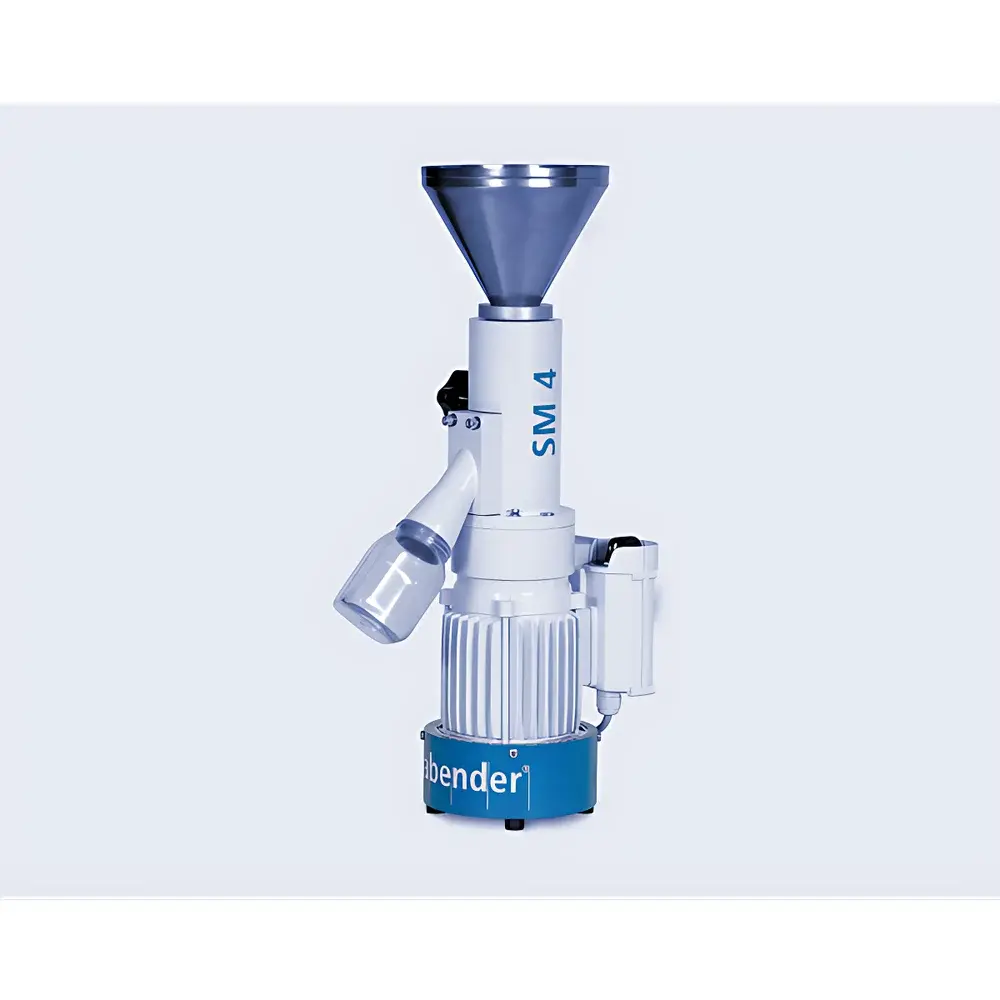
Anton Paar Brabender SM 4 Laboratory Mill
| Brand | Anton Paar Brabender |
|---|---|
| Origin | Germany |
| Manufacturer | Anton Paar TorqueTec GmbH (formerly Brabender GmbH) |
| Model | SM 4 |
| Grinding Principle | Adjustable-gap roller mill with dual counter-rotating corrugated rollers |
| Max. Feed Capacity | 200 g per batch |
| Adjustable Gap Range | 0.1–3.0 mm (micrometer-adjustable) |
| Motor Power | 0.75 kW |
| Speed | 250 rpm (fixed) |
| Construction | Stainless steel housing, food-grade contact materials |
| Compliance | ISO 6540, ISO 712, ISO 20483, AOAC 991.20, AACC 22–10 |
Overview
The Anton Paar Brabender SM 4 Laboratory Mill is a precision-engineered roller mill designed specifically for the reproducible, low-heat comminution of cereal grains and oilseeds in analytical laboratories. Based on the classic Corrugated Roller Mill principle—where two counter-rotating, grooved stainless-steel rollers apply controlled shear and compression—the SM 4 minimizes thermal degradation and moisture loss during grinding. This is critical for maintaining sample integrity prior to quantitative analysis of moisture, protein (e.g., Kjeldahl or Dumas), fat (e.g., Soxhlet or NMR), starch, or fiber content. Unlike high-speed impact mills or blade grinders, the SM 4’s mechanical design ensures consistent particle size distribution without localized overheating, preserving native enzyme activity and volatile compound profiles where required. Its integration into the Anton Paar ecosystem following the 2023 acquisition of Brabender enhances global service coverage, calibration traceability, and long-term technical support under ISO/IEC 17025-aligned service protocols.
Key Features
- Micrometer-adjustable grinding gap (0.1–3.0 mm), enabling precise control over particle fineness and repeatability across batches.
- Dual counter-rotating corrugated rollers with hardened stainless-steel surfaces, engineered for uniform stress distribution and minimal wear.
- Low-speed operation (250 rpm) and optimized roller geometry limit frictional heating—typical temperature rise ≤ 2.5 °C during standard wheat grinding (200 g, 1.2 mm gap).
- Stainless-steel feed hopper, grinding chamber, and collection tray comply with FDA 21 CFR Part 117 (Current Good Manufacturing Practice) for food contact surfaces.
- Integrated safety interlock prevents operation when the hopper lid or collection drawer is not fully engaged.
- Modular design supports rapid cleaning and validation; all wetted parts are accessible without tools.
Sample Compatibility & Compliance
The SM 4 is validated for use with intact or pre-cleaned cereal kernels (wheat, barley, rye, oats, maize), oilseeds (soybean, rapeseed, sunflower), legumes (peas, lentils), and milled by-products (bran, germ). It is not intended for fibrous, sticky, or highly oily samples without preconditioning. The instrument meets essential requirements of EN 61000-6-2 (EMC immunity) and EN 61000-6-4 (EMC emission), and its operational parameters align with method prerequisites in ISO 6540 (cereal moisture determination), ISO 712 (moisture in cereals and cereal products), and AOAC Official Method 991.20 (crude protein in cereals). Routine use supports GLP-compliant workflows when paired with documented calibration logs and operator training records.
Software & Data Management
The SM 4 operates as a standalone mechanical system with no embedded software or digital interface. However, its deterministic mechanical behavior enables full traceability in regulated environments: each grinding session is documented manually or via LIMS-integrated SOPs specifying gap setting, batch weight, roller speed, ambient RH/T, and post-grinding moisture verification (e.g., using an Anton Paar Moisture Analyzer). Gap settings are recorded using the integrated micrometer scale (±0.02 mm resolution), and calibration certificates for the micrometer are available upon request. For labs requiring audit-ready records, the SM 4 integrates seamlessly with electronic lab notebooks (ELNs) and 21 CFR Part 11–compliant data capture systems through standardized metadata tagging (e.g., “SM4_Gap_1.45mm”, “SM4_BatchID_W23-087”).
Applications
- Preparation of homogeneous test portions for moisture analysis (ISO 712, AOAC 992.15).
- Generation of representative subsamples for protein quantification (AACC 46–10, ISO 20483).
- Standardized milling prior to near-infrared (NIR) calibration model development.
- Grinding of reference materials (e.g., IRMM-189, NIST SRM 1849a) for method validation.
- Production of flour fractions for rheological testing (e.g., Farinograph, Extensograph) where particle size directly influences water absorption and dough development.
- Supporting regulatory submissions requiring documented sample homogenization (e.g., EU Regulation (EC) No 152/2009 for feed analysis).
FAQ
Is the SM 4 suitable for gluten-free grain processing?
Yes—provided dedicated cleaning protocols are followed between batches to prevent cross-contamination; the stainless-steel construction allows validated sanitation procedures.
Can the SM 4 be used for rice or broken kernels?
Yes, but optimal results require adjustment of the gap setting (typically 0.3–0.8 mm) and reduced batch size (≤100 g) to avoid bridging in the feed chute.
Does Anton Paar provide calibration services for the SM 4?
Yes—certified gap calibration using traceable micrometer standards is available through Anton Paar Service Centers globally, with documentation compliant with ISO/IEC 17025.
What maintenance intervals are recommended?
Roller alignment verification every 500 operating hours; lubrication of drive bearings every 1,000 hours; full visual inspection of corrugation wear annually or after 5,000 kg total throughput.
Is the SM 4 compatible with automated sample handling systems?
Not natively—but third-party robotic arms with gripper-based handling can interface with the hopper and drawer via programmable positioning, subject to site-specific risk assessment.
Related Products




