
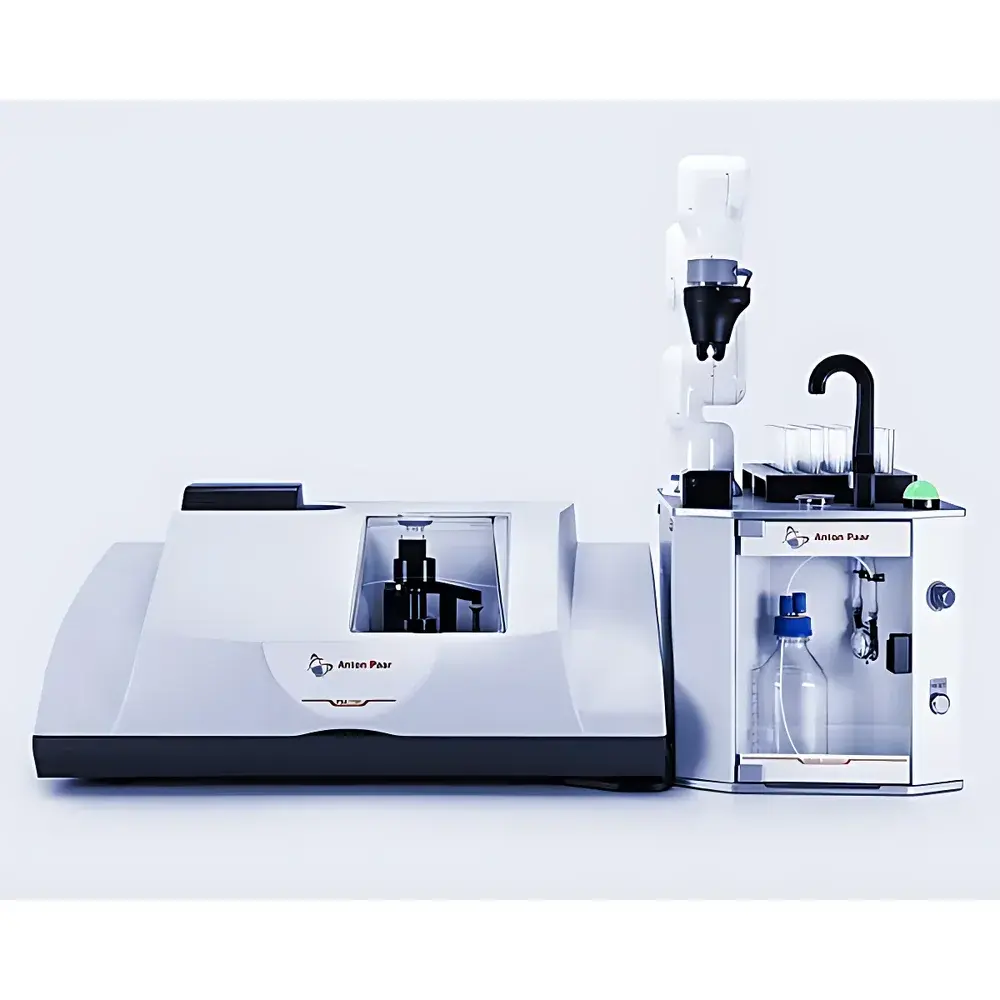
Anton Paar Litesizer Automated Sampler
| Brand | Anton Paar |
|---|---|
| Origin | Austria |
| Manufacturer Type | Original Equipment Manufacturer (OEM) |
| Import Status | Imported |
| Model | Litesizer |
| Particle Size Range | 0.3 nm – 10 µm |
| Size Measurement Repeatability | ±2% |
| Temperature Control Accuracy | ±0.2 °C |
| Sample Concentration Range | 0.1 mg/L – 100 mg/L |
| Sample Volume Range | 12 µL – 1000 µL |
| Zeta Potential Range | −500 mV to +500 mV |
Overview
The Anton Paar Litesizer Automated Sampler is an integrated, high-precision sample handling module engineered exclusively for seamless operation with the PSA series nanoparticle size analyzers — including the PSA 990, PSA 1090, and PSA 1190. Designed around dynamic light scattering (DLS), electrophoretic light scattering (ELS), and static light scattering (SLS) measurement principles, the Litesizer eliminates manual sample introduction bottlenecks while maintaining metrological integrity across wet dispersion, dry powder aerosolization, and zeta potential analysis workflows. Its dual-mode architecture enables true hybrid particle characterization: a single instrument platform supports both liquid-phase colloidal suspensions and dry particulate aerosols without hardware reconfiguration. This capability is grounded in independently validated fluidic pathways, temperature-stabilized cuvette positioning, and synchronized pneumatic dispensing — all calibrated against ISO 22412 (DLS), ISO 13321 (ELS), and ISO 13320 (laser diffraction) reference frameworks.
Key Features
- Dual-dispersion mode operation: fully automated switching between wet dispersion (for colloids, emulsions, protein solutions) and dry powder dispersion (for free-flowing powders, catalysts, and pharmaceutical actives)
- 60-position sample carousel with real-time priority queue management — new samples may be inserted mid-run without interrupting active measurements
- Micro-volume precision dosing: programmable aspiration and delivery from 12 µL to 1000 µL with gravimetric validation and air-gap compensation
- Integrated Peltier-controlled thermal chamber: maintains sample temperature stability within ±0.2 °C across the full operating range (4–60 °C), critical for aggregation kinetics and temperature-dependent zeta potential studies
- Autonomous cleaning and rinse cycles between samples: reduces carryover risk and ensures compliance with GLP/GMP traceability requirements
- Direct coupling to Kalliope software via Ethernet or USB 3.0 — no intermediate drivers or third-party middleware required
Sample Compatibility & Compliance
The Litesizer accommodates a broad spectrum of sample types — from low-concentration biopolymer dispersions (0.1 mg/L) to highly loaded industrial slurries (100 mg/L), and from nanoscale quantum dots (0.3 nm hydrodynamic diameter) to micron-scale ceramic powders (up to 10 µm). Dry powder analysis leverages controlled shearing and turbulent dispersion to achieve reproducible aerosol generation without mechanical grinding artifacts. All wet-path components are chemically resistant to aqueous buffers, organic solvents (e.g., THF, ethanol, DMF), and mild acids/bases. The system complies with IEC 61000-6-3 (EMC), IEC 61010-1 (safety), and supports 21 CFR Part 11-compliant audit trails when used with Kalliope’s validated software configuration.
Software & Data Management
Controlled exclusively through Anton Paar’s Kalliope software, the Litesizer enables method-driven automation: users define measurement sequences (e.g., “Zeta + DLS + SLS”) per sample, assign dispersion protocols (wet/dry), set temperature ramps, and configure replicate logic (e.g., 3× DLS at 25 °C → 1× ELS at 37 °C). Raw data streams — including correlation functions, phase analysis light scattering (PALS) interferograms, and intensity-weighted size distributions — are stored in vendor-neutral HDF5 format with embedded metadata (instrument ID, calibration timestamp, operator ID, environmental logs). Batch reporting supports ASTM E2412-compliant summary tables and ISO 9001-aligned PDF certificate generation.
Applications
- Pharmaceutical development: monitoring liposome stability, mRNA nanoparticle aggregation, and excipient compatibility under accelerated storage conditions
- Materials science: characterizing metal-organic frameworks (MOFs), carbon nanotubes, and battery cathode precursors across synthesis batches
- Quality control labs: validating lot-to-lot consistency of silica nanoparticles, polymer latexes, and pigment dispersions per ISO/IEC 17025 internal procedures
- Academic research: conducting time-resolved DLS studies on protein folding/unfolding or surfactant micellization kinetics with unattended overnight runs
- Regulatory submissions: generating auditable, ALCOA+ compliant datasets for FDA IND/ANDA filings and EMA scientific advice requests
FAQ
Can the Litesizer be retrofitted to existing PSA instruments?
Yes — it is compatible with PSA 990, PSA 1090, and PSA 1190 systems manufactured from 2018 onward, provided firmware version ≥3.2.0 is installed.
Does it support non-aqueous solvents for dry powder dispersion?
No — dry mode uses inert gas (N₂ or compressed air) only; solvent-based dispersion must be performed externally and loaded as pre-dispersed wet samples.
Is calibration traceable to NIST standards?
Yes — factory calibration includes NIST-traceable polystyrene and silica nanoparticle reference materials (SRM 1963, SRM 8012), with user-accessible calibration verification routines.
How is carryover prevented during high-concentration sample runs?
The system executes a three-stage cleaning protocol: solvent flush (programmable volume), ultrasonic bath activation (optional external module), and nitrogen purge — all logged with timestamps and pressure profiles.
Can measurement parameters be modified during an active run?
Only priority order and queue insertion are permitted mid-run; core parameters (temperature, laser power, acquisition time) require pausing the sequence.



