
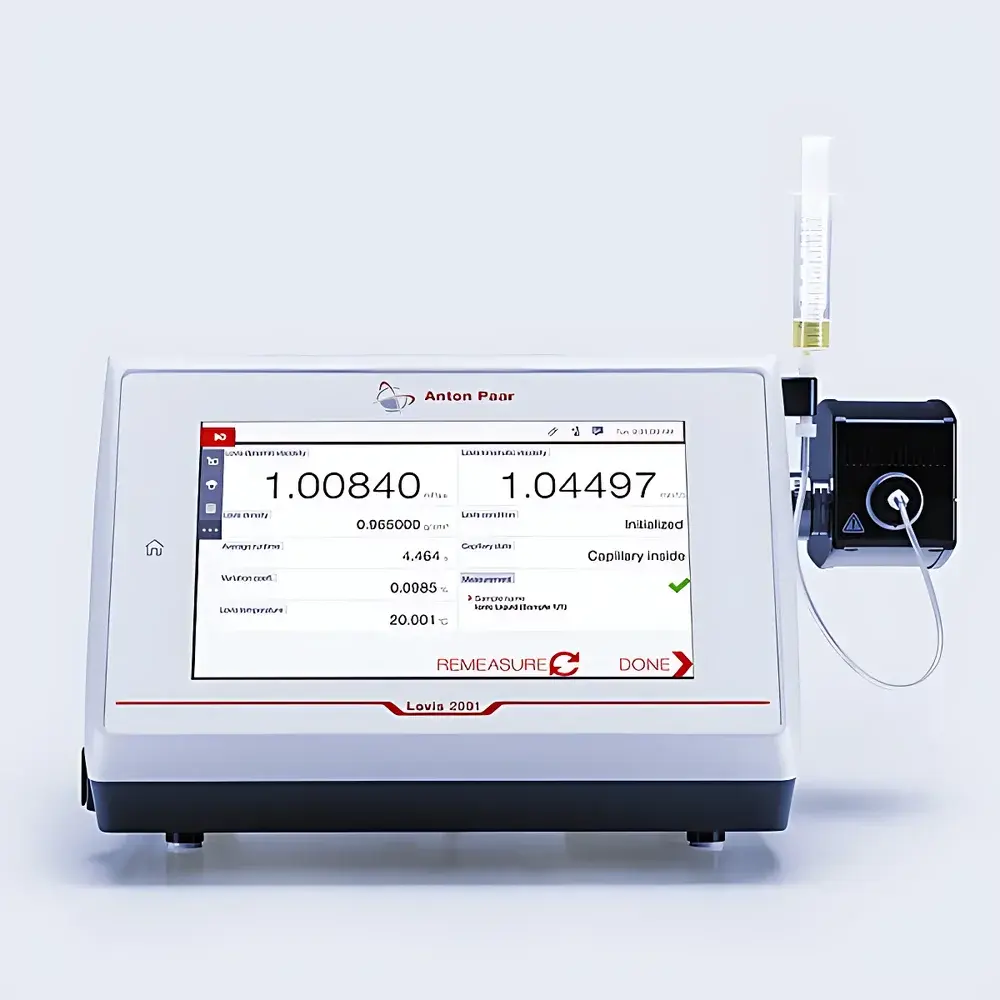
Anton Paar Lovis 2001 Automated Micro Falling-Ball Viscometer
| Brand | Anton Paar |
|---|---|
| Origin | Austria |
| Manufacturer Type | Original Equipment Manufacturer (OEM) |
| Origin Category | Imported |
| Model | Lovis 2001 |
| Instrument Type | Fixed-Position Falling-Ball Viscometer |
| Operating Environment | Ambient Temperature |
| Viscosity Range | 0.2 to 10,000 mPa·s |
| Temperature Range | 5 °C to 100 °C (41 °F to 212 °F) |
| Temperature Resolution | 0.005 °C |
| Temperature Accuracy | ±0.02 °C |
Overview
The Anton Paar Lovis 2001 is a fully automated micro falling-ball viscometer engineered for high-precision kinematic viscosity determination in research, quality control, and regulatory-compliant laboratories. It operates on the Hoeppler principle—measuring the terminal velocity of a calibrated sphere descending through a vertically oriented, temperature-controlled capillary tube filled with sample fluid. This method delivers direct, absolute viscosity values traceable to SI units without calibration against reference oils, ensuring metrological integrity across the full dynamic range. Designed as the successor to the Lovis 2000 series, the Lovis 2001 integrates Peltier-based thermal regulation, modular automation interfaces, and compliance-ready software architecture to support GxP workflows—including pharmaceutical, brewing, polymer, and fine chemical applications where reproducibility, sample economy, and auditability are critical.
Key Features
- Automated falling-ball measurement with adjustable tilt angle (0–90°), enabling optimal flow dynamics across low- to high-viscosity fluids (0.2–10,000 mPa·s)
- High-stability Peltier temperature control system with ±0.02 °C accuracy and 0.005 °C resolution; standard range 5–100 °C, extendable to −40 °C using an external cryostat
- Micro-volume operation: requires only 100 µL per measurement, with full post-measurement sample recovery capability
- Hermetically sealed, chemically resistant measurement cell compatible with volatile, toxic, or corrosive solvents—including halogenated hydrocarbons, strong acids, and organic bases
- Modular expansion architecture supporting seamless integration with Anton Paar DMA density meters (e.g., DMA 4101, DMA 4501, DMA 5001), Xsample autosamplers (Xsample 320/330/520/530), Abbemat refractometers, Alcolyzer alcohol analyzers, Haze 3001 turbidimeters, and pH 3101 modules
- Integrated polymer analysis software for automated calculation of intrinsic viscosity [η], K-value (Fikentscher), and average molar mass (via Mark–Houwink–Sakurada equations) using user-defined constants
Sample Compatibility & Compliance
The Lovis 2001 accommodates a broad spectrum of Newtonian and mildly non-Newtonian liquids—including polymer solutions, pharmaceutical formulations, edible oils, wort, beer, glycols, silicone fluids, and ionic liquids—without mechanical shear degradation. Its sealed glass capillary geometry eliminates evaporation artifacts and prevents operator exposure during hazardous sample handling. The instrument meets stringent regulatory requirements: data acquisition and reporting comply with FDA 21 CFR Part 11 (electronic signatures, audit trails, user access levels), USP “Viscosity”, Ph. Eur. 2.2.49 “Viscosity of Liquids”, and industry-specific standards such as MEBAK (German Brewers’ Association) and ASBC (American Society of Brewing Chemists) for wort and beer analysis. All firmware and software modules undergo periodic validation per ISO/IEC 17025 and GLP/GMP guidelines.
Software & Data Management
Operating via Anton Paar’s proprietary OneClick™ software platform, the Lovis 2001 provides role-based user management, electronic lab notebook (ELN)-compatible export (CSV, PDF, XML), and configurable report templates aligned with SOPs. Measurement sequences—including multi-point temperature ramps, viscosity vs. concentration series, or cross-module parameter correlation (e.g., viscosity + density + refractive index)—are programmable with full metadata logging (timestamp, operator ID, environmental conditions, calibration status). Audit trails record all critical events: parameter changes, result modifications, user logins, and instrument error states—with immutable timestamps and digital signature verification. Raw timing data (ball transit time ±0.1 ms) and derived values are stored in encrypted SQLite databases compliant with ALCOA+ principles (Attributable, Legible, Contemporaneous, Original, Accurate, Complete, Consistent, Enduring, Available).
Applications
- Pharmaceutical development: intrinsic viscosity of biopolymer excipients (e.g., hyaluronic acid, cellulose derivatives), solvent compatibility screening for parenteral formulations
- Brewing & distilling: real-time wort viscosity profiling per ASBC Beer-1 and MEBAK 1.2.2.1; ethanol content correlation in spirits
- Polymer science: solution rheology of synthetic and natural polymers (PVC, PET, starch, chitosan) under controlled thermal gradients
- Chemical manufacturing: QC of lubricants, resins, adhesives, and surfactant micellar systems
- Academic research: fundamental studies of temperature-dependent viscosity behavior, Arrhenius and Vogel–Fulcher–Tammann modeling
- Food & beverage: consistency assessment of syrups, sauces, plant-based milks, and functional ingredients
FAQ
What is the minimum sample volume required for a valid measurement?
A single measurement requires only 100 µL of sample, and the entire volume is recoverable post-analysis due to the closed-loop capillary design.
Can the Lovis 2001 measure non-Newtonian fluids?
It is optimized for Newtonian liquids; however, shear-thinning or weakly viscoelastic samples may be assessed at fixed tilt angles with careful interpretation—though dedicated rotational rheometry is recommended for full viscoelastic characterization.
Is external calibration with certified reference oils necessary?
No. The Hoeppler principle provides absolute viscosity determination based on geometric parameters (ball density/diameter, tube inclination, transit time) and fluid density—eliminating reliance on empirical calibration standards.
How does the system ensure traceability to international temperature standards?
The integrated Pt100 sensor is factory-calibrated against NIST-traceable references, and temperature stability is continuously monitored and logged with 0.005 °C resolution and ±0.02 °C accuracy across the operational range.
What data security protocols are implemented for regulated environments?
OneClick™ enforces 21 CFR Part 11 compliance through electronic signatures, role-based permissions, immutable audit trails, automatic backup scheduling, and encrypted database storage—all validated per IQ/OQ/PQ protocols.



