
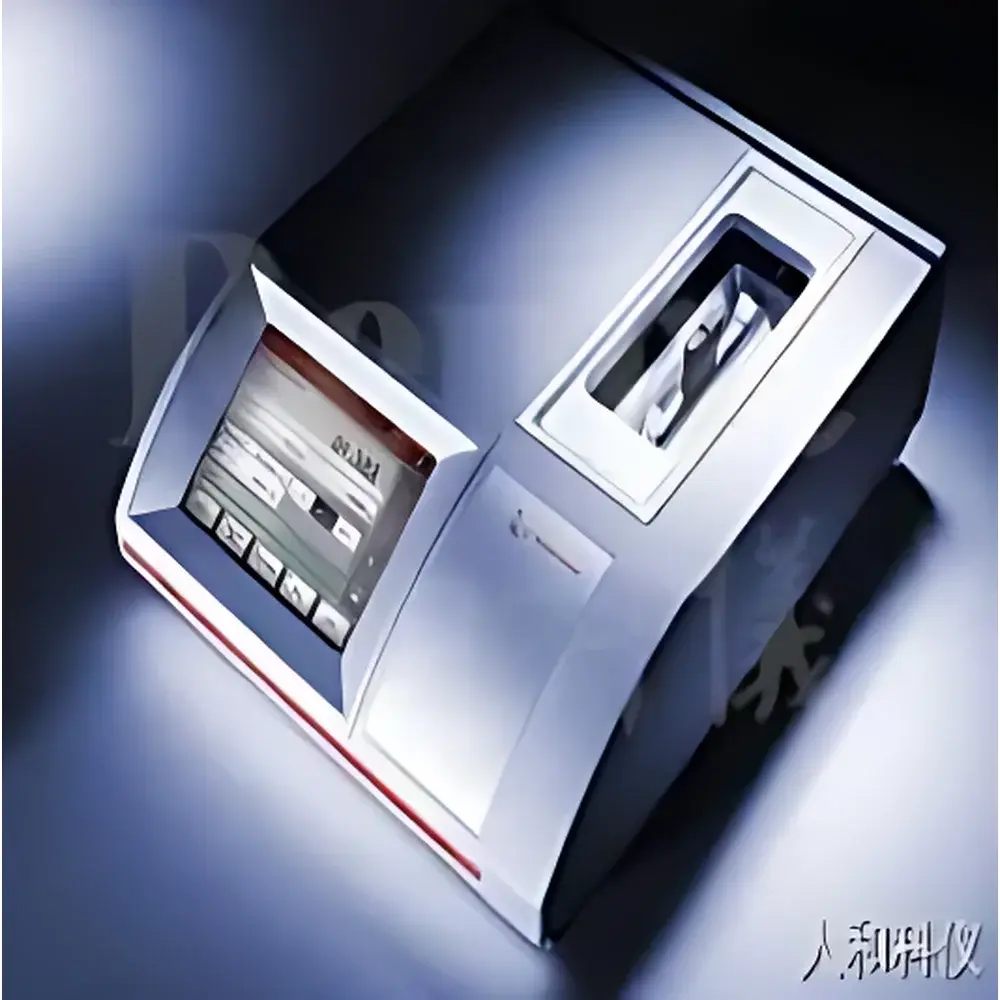
Anton Paar MCP 100 High-Precision Intelligent Automatic Polarimeter
| Brand | Anton Paar |
|---|---|
| Origin | Austria |
| Model | MCP 100 |
| Product Type | Automatic Polarimeter |
| Temperature Control | Peltier-based, programmable (20 °C and 25 °C standard setpoints) |
| Display | 5.7″ TFT color touchscreen (640 × 480 px) |
| Light Source | LED (589 nm, 100,000 h lifetime) |
| Measurement Range | ±89.9° optical rotation (OR) |
| Resolution | 0.001° |
| Accuracy | ±0.01° |
| Repeatability | ±0.01° |
| Response Time | 12 s |
| Wavelength | 589 nm (sodium D-line equivalent) |
| Temperature Sensor | Integrated PT100 |
| Temp. Accuracy | ±0.2 °C |
| Temp. Stability | ±0.1 °C |
| Cell Length Support | 2.5–100 mm |
| OD Compensation | Up to 2.0 |
| Interfaces | 3× USB, RS232, Ethernet, CAN bus |
| Dimensions (L×W×H) | 370 × 320 × 130 mm |
| Weight | 7.8 kg |
| Power | 100–240 VAC, 50/60 Hz, max. 120 VA |
Overview
The Anton Paar MCP 100 is a high-precision, fully automatic polarimeter engineered for rigorous quantitative analysis of optically active substances in regulated and research-intensive environments. It operates on the fundamental principle of optical rotation measurement—determining the angular displacement of plane-polarized light as it passes through chiral compounds—using a stable, narrow-band LED source centered at 589 nm (equivalent to the sodium D-line). This wavelength ensures compatibility with pharmacopoeial standards and enables direct correlation with historically established reference data. The instrument integrates a closed-loop Peltier temperature control system with integrated PT100 sensing, delivering thermal stability within ±0.1 °C and accuracy of ±0.2 °C—critical for reproducible measurements across temperature-sensitive samples such as pharmaceutical intermediates, essential oils, and biopolymer solutions. Its compact benchtop footprint (370 × 320 × 130 mm), low power consumption (≤120 VA), and robust mechanical architecture make it suitable for QC laboratories, formulation development suites, and academic research facilities where space, energy efficiency, and long-term operational reliability are prioritized.
Key Features
- Intuitive 5.7″ full-color TFT touchscreen interface with graphical navigation and context-sensitive soft keys—designed for rapid method setup and real-time parameter monitoring without external peripherals.
- Three preconfigured measurement modes: Optical Rotation (°), Specific Rotation ([α]), and Concentration (% w/w)—each compliant with USP <781>, EP 2.2.7, and JP 6.05 requirements.
- Toolmaster™ RFID-enabled automatic cell recognition: detects and validates polarimetric cells and quartz calibration standards upon insertion—eliminating manual entry errors and ensuring traceable cell-specific calibration parameters.
- Peltier-based thermostatic control with dual fixed-point capability (20 °C and 25 °C) and optional ambient-mode operation—enabling precise thermal management without external chillers or baths.
- Optical path compensation for absorbance up to OD 2.0 via dynamic light-intensity regulation—ensuring accurate readings even for deeply colored or turbid samples common in food extracts and natural product isolates.
- Comprehensive security framework supporting multi-level user authentication, role-based access control (operator, supervisor, administrator), and tamper-evident audit trails—all aligned with FDA 21 CFR Part 11 and EU Annex 11 expectations.
Sample Compatibility & Compliance
The MCP 100 accommodates sample cells ranging from 2.5 mm to 100 mm pathlength, including standard 100 mm, 200 mm, and custom-length tubes—supporting both routine QC assays and low-volume R&D applications. Its optical design minimizes stray light and polarization drift, enabling reliable measurements of low-activity compounds (e.g., dilute amino acid solutions) and highly active materials (e.g., sucrose syrups, menthol-rich essential oils). The system is validated against OIML R 131 for metrological conformity and meets the performance criteria outlined in ISO 13803:2017 (polarimeters—requirements and tests). Full compliance with pharmacopoeial monographs—including USP General Chapter <781>, Ph. Eur. 2.2.7, and JP 6.05—is assured through factory-certified calibration using NIST-traceable quartz control plates and documented IQ/OQ protocols available upon request.
Software & Data Management
Instrument control, data acquisition, and reporting are managed via Anton Paar’s proprietary mPDS (multi-Polarimeter Data System) software, compatible with Windows 10/11 and deployable in networked lab environments. The software enforces ALCOA+ principles: attributable, legible, contemporaneous, original, accurate, complete, consistent, enduring, and available. All measurement events—including cell ID, temperature log, raw signal traces, and user actions—are time-stamped and cryptographically signed. Reports are exportable in PDF/A-1b (archival format) and CSV, with embedded digital signatures and checksums to prevent post-acquisition modification. Integration with LIMS and ELN systems is supported via ASTM E1384-compliant XML export and secure RESTful API endpoints.
Applications
The MCP 100 serves critical analytical functions across multiple regulated sectors: quantification of enantiomeric excess in chiral synthesis (API manufacturing); concentration determination of sugars in beverage and dairy QC; identity and purity verification of natural products per ICH Q5C guidelines; assay of active pharmaceutical ingredients in lyophilized powders and injectables; and quality control of cosmetic actives (e.g., L-ascorbic acid, limonene). Its precision and regulatory readiness also support method validation studies under ICH Q2(R2), stability-indicating assay development, and GLP-compliant toxicology sample analysis.
FAQ
Does the MCP 100 comply with 21 CFR Part 11 requirements for electronic records and signatures?
Yes—the instrument includes configurable audit trail logging, electronic signature enforcement, and data integrity safeguards certified to meet FDA 21 CFR Part 11 and EU Annex 11 specifications.
Can the MCP 100 measure samples with high optical density?
Yes—it features automatic optical density compensation up to OD 2.0, maintaining measurement fidelity for colored or turbid liquids without manual attenuation.
Is external temperature control required for operation?
No—integrated Peltier elements provide self-contained temperature stabilization at 20 °C and 25 °C; ambient-mode operation is also supported.
What calibration standards are included with the instrument?
Each unit ships with NIST-traceable quartz control plates (±5°, ±20°, ±50°) and a comprehensive calibration certificate valid for 12 months.
How is data integrity ensured during export or backup?
All exported reports include embedded digital signatures and SHA-256 checksums; raw data files are write-protected and timestamped with hardware-generated cryptographic tokens.






