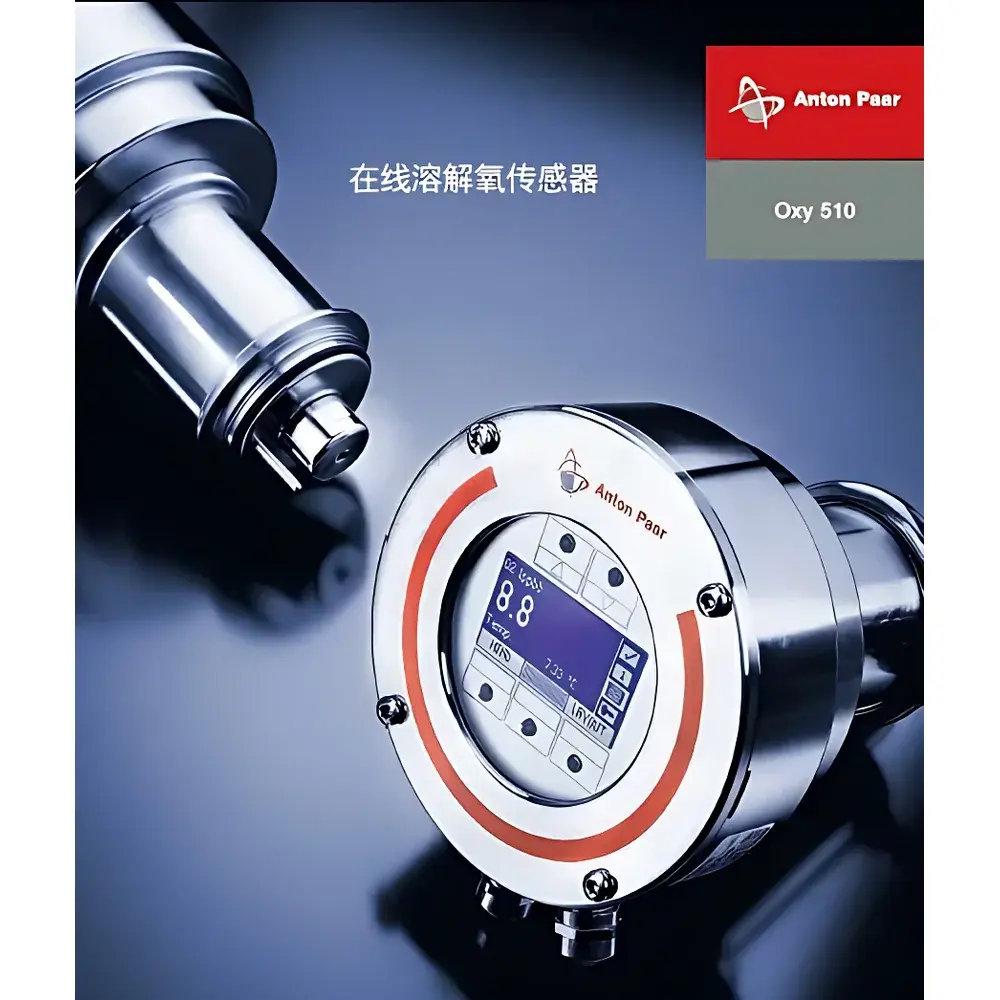
Anton Paar Oxy 5100 Online Dissolved Oxygen Sensor
| Brand | Anton Paar |
|---|---|
| Origin | Austria |
| Manufacturer Type | Original Equipment Manufacturer (OEM) |
| Origin Category | Imported |
| Model | Oxy 5100 |
| Price | Upon Request |
| Resolution | 0.4 ppb |
| Measurement Range | 0–2000 ppb or 0–24 ppm |
| Repeatability | ≤0.5 ppb or ≤1 % of reading |
| Long-term Stability | ≤0.8 ppb per 24 h |
| Temperature Compensation Range | –5 °C to +40 °C |
| Communication Interfaces | Analog Output (AO), Analog Input (AI), Digital Input (DI), Digital Output (DO), CAN bus |
| Dimensions (H × W × D) | 174 mm × 174 mm × 230 mm |
| Operating Ambient Temperature | –5 °C to +50 °C |
Overview
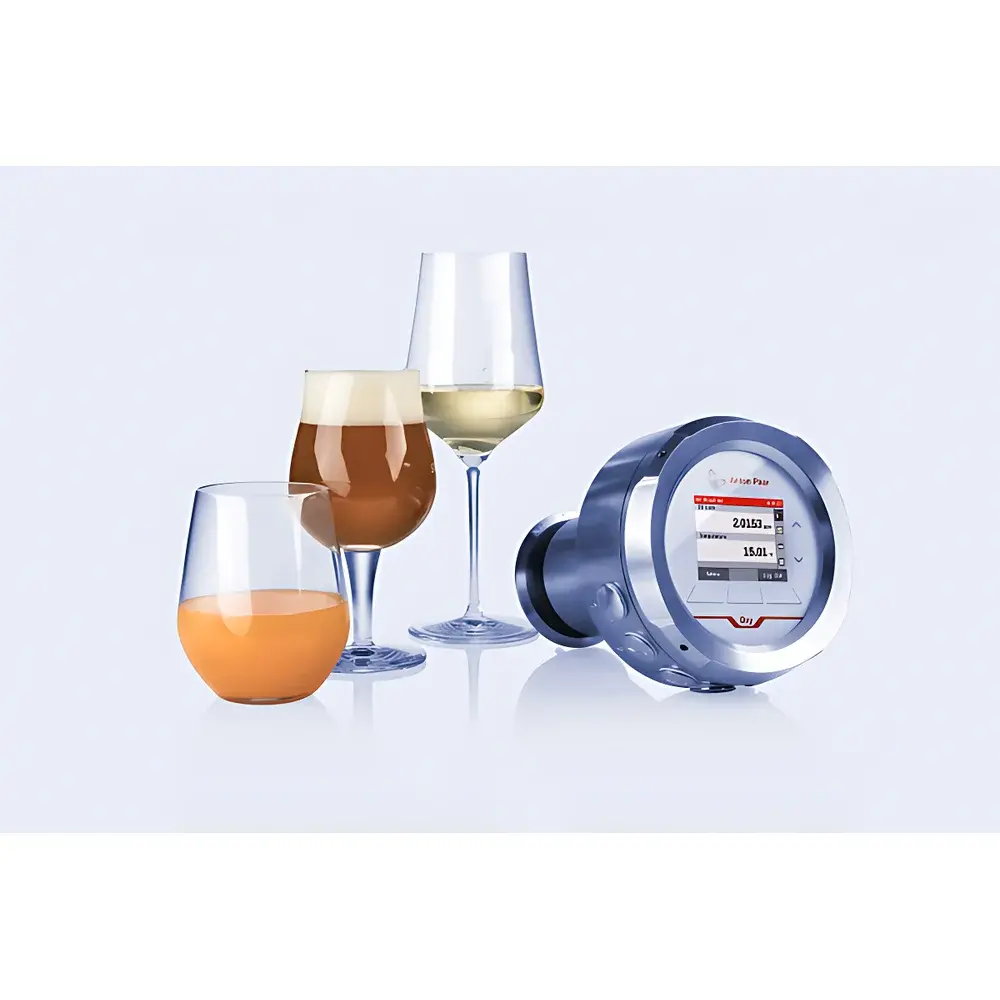
The Anton Paar Oxy 5100 is a high-precision, field-deployable online dissolved oxygen (DO) sensor engineered for continuous, real-time monitoring in demanding industrial process environments. It operates on the principle of optical luminescence quenching—where molecular oxygen modulates the lifetime and intensity of a ruthenium-based luminophore immobilized on the sensor membrane. This non-consumptive, membrane-based detection method eliminates electrolyte depletion, polarization drift, and flow dependency common in traditional electrochemical Clark-type sensors. The Oxy 5100 delivers trace-level sensitivity down to sub-ppb resolution while maintaining full linearity across two calibrated ranges: 0–2000 ppb (ultra-trace) and 0–24 ppm (broad-range), switchable via interchangeable sensor heads—no hardware reconfiguration or recalibration required at the transmitter level.
Key Features
- Optical luminescence-based sensing with factory-traceable calibration certificates compliant with ISO/IEC 17025 requirements
- Dual-range capability: seamless transition between ultra-low (0–2000 ppb) and standard (0–24 ppm) DO measurement modes via Toolmaster-enabled sensor head exchange
- Toolmaster technology: automatic recognition of sensor head identity, calibration parameters, and configuration data—eliminating manual setup via HDI interface and reducing commissioning time by >70%
- Long-term stability of ≤0.8 ppb per 24 hours ensures minimal drift during extended unattended operation—critical for pharmaceutical water-for-injection (WFI) and clean steam validation cycles
- Integrated temperature compensation across –5 °C to +40 °C using a high-accuracy Pt1000 RTD embedded within the sensor head
- Rugged IP66-rated housing with stainless steel (1.4404/316L) wetted parts suitable for CIP/SIP protocols and aggressive cleaning agents (e.g., NaOH, HNO₃, H₂O₂)
Sample Compatibility & Compliance
The Oxy 5100 is validated for use in purified water (PW), water-for-injection (WFI), clean steam condensate, bioreactor broth, and fermentation media under GMP-compliant manufacturing conditions. Its optical design avoids membrane fouling and electrolyte leakage—key failure modes in electrochemical sensors exposed to particulate-laden or viscous streams. The device complies with relevant sections of USP , EP 2.2.43, and ASTM D888-22 for dissolved oxygen determination in aqueous systems. All firmware and configuration logs support audit trails aligned with FDA 21 CFR Part 11 requirements when integrated with compatible SCADA or DCS platforms supporting electronic signature and role-based access control.
Software & Data Management
Configuration, diagnostics, and calibration management are performed via Anton Paar’s proprietary SmartConnect software suite (v3.2+), accessible through Ethernet or USB-C. The Oxy 5100 supports Modbus TCP, CANopen, and analog 4–20 mA output with HART 7.5 protocol compatibility. All sensor events—including head replacement, zero/span verification, and diagnostic alarms—are timestamped and exportable as CSV or XML for integration into LIMS or MES systems. Built-in self-diagnostics monitor membrane integrity, LED drive current, photodiode response, and thermal drift—triggering configurable alerts prior to measurement deviation exceeding ±0.3 ppb.
Applications
- Pharmaceutical water systems: continuous DO monitoring in WFI storage tanks, distribution loops, and point-of-use outlets per EU GMP Annex 1 and FDA guidance on water system qualification
- Biotechnology: real-time DO feedback control in upstream bioreactors (mammalian, microbial, and cell-culture processes) where oxygen transfer rate (OTR) optimization directly impacts yield and product quality
- Power generation: demineralized water and condensate monitoring in boiler feedwater circuits to prevent oxidative corrosion of turbine blades and piping
- Fine chemical synthesis: inertization verification during nitrogen purging of reactors and distillation columns
- Food & beverage: monitoring dissolved oxygen in sterile fill lines, carbonated beverage mixers, and aseptic processing environments
FAQ
Does the Oxy 5100 require periodic electrolyte refilling or membrane replacement?
No—its solid-state optical sensing architecture contains no liquid electrolyte or consumable membranes. Only the disposable sensor head (with pre-integrated luminophore layer) requires replacement every 12–24 months depending on operating conditions.
Can the same transmitter be used for both ultra-trace and ppm-level measurements?
Yes—the Oxy 5100 transmitter automatically detects the installed sensor head type (Oxy 5100-ULTRA or Oxy 5100-PPM) and loads the corresponding calibration curve and range settings without user intervention.
Is the sensor compatible with hazardous area classifications?
The base unit is rated for Zone 2 / Class I Div 2 environments; ATEX/IECEx-certified versions (Oxy 5100-ATEX) are available upon request with intrinsic safety barriers and explosion-proof housings.
How is temperature compensation implemented?
A precision Pt1000 RTD is co-located with the optical sensing element inside the sensor head, enabling real-time, localized temperature correction independent of process fluid bulk temperature gradients.
What validation documentation is provided with each unit?
Each Oxy 5100 ships with a Factory Calibration Certificate (traceable to NIST standards), Material Test Reports (MTRs) for wetted parts, and a Declaration of Conformity per EU Machinery Directive 2006/42/EC and EMC Directive 2014/30/EU.