
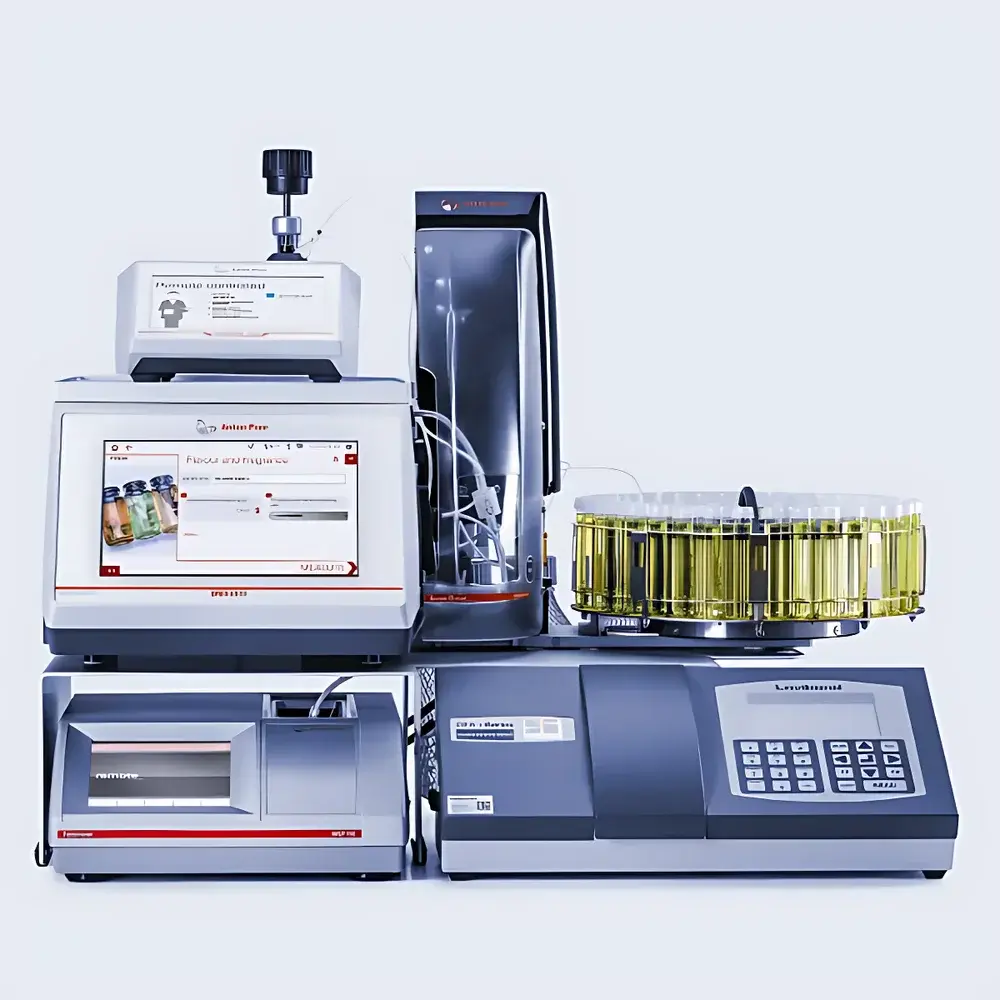
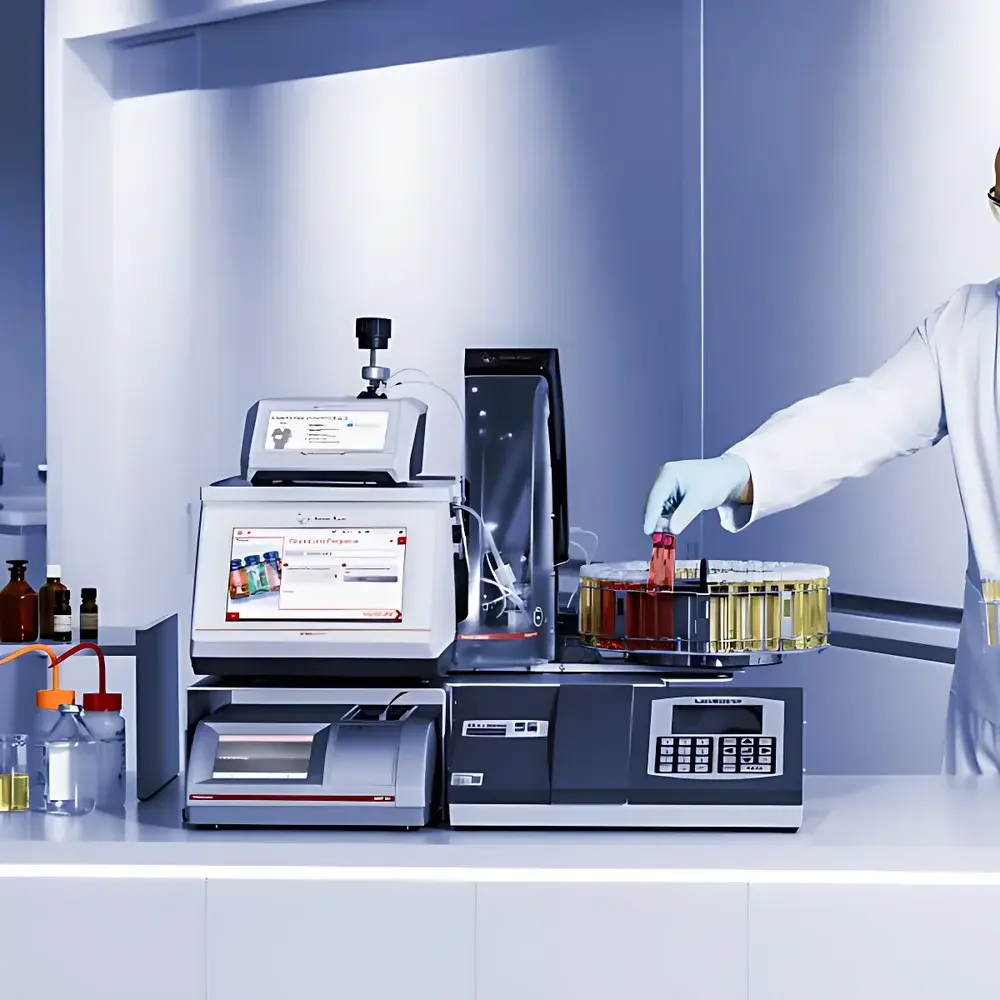
Anton Paar Perfume and Flavor Measurement System
| Brand | Anton Paar |
|---|---|
| Origin | Austria |
| Manufacturer Type | Manufacturer |
| Origin Category | Imported |
| Model | Perfume and Flavor Measurement System |
| Instrument Type | Oscillating U-tube Densimeter |
| Instrument Class | Benchtop Laboratory |
| Sample Type | Liquid |
| Density Range | 0–3 g/cm³ |
| Density Accuracy | ±0.01 g/cm³ |
| Display | 10.1″ TFT WXGA (1280 × 800 px) PCAP Touchscreen |
| Temperature Control Range | 0–100 °C |
| Minimum Sample Volume | 2 mL |
| Integrated Parameters | Density, Refractive Index, Optical Rotation, Colorimetry, Turbidity |
| Automation | Fully Automated Sample Handling with Recovery (Xsample 5200/530), Integrated Cleaning & Drying |
Overview
The Anton Paar Perfume and Flavor Measurement System is a fully integrated, modular benchtop platform engineered for high-precision physical characterization of volatile, high-value liquid formulations—specifically essential oils, fragrance concentrates, flavor extracts, and aromatic distillates. Built upon oscillating U-tube densimetry (ASTM D4052, ISO 12185), Abbe refractometry (ISO 28721, ASTM D1218), polarimetry (USP , Ph. Eur. 2.2.7), and CIE-compliant colorimetry (CIELAB, CIE XYZ), the system delivers concurrent, traceable measurements of density, refractive index, specific optical rotation, chromaticity coordinates, and turbidity in a single automated run. Its architecture eliminates inter-instrument calibration drift and manual data reconciliation by unifying sensor acquisition, thermal equilibration, and digital signal processing within one control environment—ensuring metrological continuity across all parameters.
Key Features
- Single-cycle multi-parameter analysis: Simultaneous determination of density (0–3 g/cm³, ±0.01 g/cm³), refractive index (1.32–1.70 RIU), optical rotation (±89°, resolution 0.001°), and color (L*a*b*, ΔE₀₀, Yellowness Index, APHA, Gardner) without sample transfer or recalibration.
- Ultra-low volume operation: Minimum sample requirement of 2 mL per measurement; optional full-sample recovery mode preserves precious extracts (e.g., rose otto, jasmine absolute) post-analysis via vacuum-assisted return to original vial.
- Automated sample handling: Xsample 5200/530 robotic autosamplers perform precise pipetting, cell filling, rinsing with solvent (e.g., ethanol, isopropanol), thermal conditioning, drying, and waste disposal—all programmable via AP Connect software.
- Thermal stability: Peltier-controlled temperature regulation from 0 °C to 100 °C (±0.02 °C) across all modules ensures compliance with pharmacopoeial methods requiring strict thermal protocols (e.g., USP , EP 2.2.46).
- Modular expandability: Base configuration includes DMA 5002 densimeter and Abbemat 5101 refractometer; MCP 150 polarimeter, Lovibond®-compatible turbidimeter, and pH module can be added non-disruptively via standardized mechanical and data interfaces.
Sample Compatibility & Compliance
The system is validated for use with low-viscosity, thermally sensitive, and highly volatile liquids typical in fragrance and flavor R&D and QC labs—including citrus terpenes, aldehyde-rich bases, ethanolic tinctures, and glycol-based dilutions. All modules meet IEC 61000-4 electromagnetic compatibility standards and carry CE marking for EU conformity. Density and refractive index modules are compliant with ISO/IEC 17025:2017 requirements for accredited testing laboratories when operated under documented SOPs. Data integrity features—including electronic signatures, audit trails, and user-level access controls—support adherence to FDA 21 CFR Part 11 and EU Annex 11 for regulated environments.
Software & Data Management
AP Connect serves as the unified software interface for instrument orchestration, method development, and data governance. It enables creation of multi-step workflows (e.g., “Density → Rinse → Refractometry → Polarimetry → Recovery”) with conditional logic and real-time parameter validation. Measurement results are stored in vendor-neutral .csv and .xml formats, with metadata (operator ID, timestamp, temperature, calibration status) embedded per ISO/IEC 17025 traceability requirements. AP Connect integrates natively with LIMS (e.g., LabWare, Thermo Fisher SampleManager) and ERP systems via ODBC and RESTful APIs. All raw sensor outputs—including oscillation decay curves, interference fringe spectra, and photodiode current logs—are archived for retrospective reprocessing and uncertainty budgeting.
Applications
- Batch release testing of natural isolates (e.g., limonene, linalool, vanillin) against pharmacopoeial monographs (USP-NF, EP, JP).
- Stability assessment of fragrance blends under accelerated aging (40 °C/75% RH), tracking density drift and color shift over time.
- Authentication of origin and adulteration detection via multi-parameter fingerprinting (e.g., anomalous optical rotation + elevated refractive index indicating synthetic diluent).
- Process optimization in extraction and rectification—correlating density/refractive index trends with distillation cut points.
- GMP-compliant QC in contract manufacturing organizations producing IFRA-certified fragrance compounds.
FAQ
Can the system measure samples with suspended particles or emulsions?
Yes—turbidity measurement capability (0–1000 NTU) allows quantitative assessment of haze and phase separation; however, for density and refractive index, samples must be optically clear. Pre-filtration (0.45 µm PVDF) is recommended for particulate-laden extracts.
Is method validation support available for regulatory submissions?
Anton Paar provides IQ/OQ documentation templates, uncertainty calculation tools per GUM (JCGM 100:2008), and on-site qualification services aligned with ASTM E2500 and ICH Q2(R2).
How is temperature uniformity maintained across all modules during simultaneous measurement?
A shared liquid-circulation thermal manifold synchronizes temperature setpoints across DMA, Abbemat, and MCP modules with ≤0.01 °C inter-module deviation, verified daily using NIST-traceable Pt100 probes.
Does the system support GLP-compliant audit trails?
Yes—AP Connect records all user actions, parameter changes, calibration events, and result exports with immutable timestamps and digital signatures, retaining logs for ≥10 years as required by OECD GLP Principles.
What maintenance intervals are recommended for long-term accuracy?
Density cell cleaning every 500 runs; refractometer prism inspection quarterly; polarimeter lamp replacement annually; full system performance verification semiannually using certified reference materials (e.g., Anton Paar CRM-D1, CRM-R1).



