
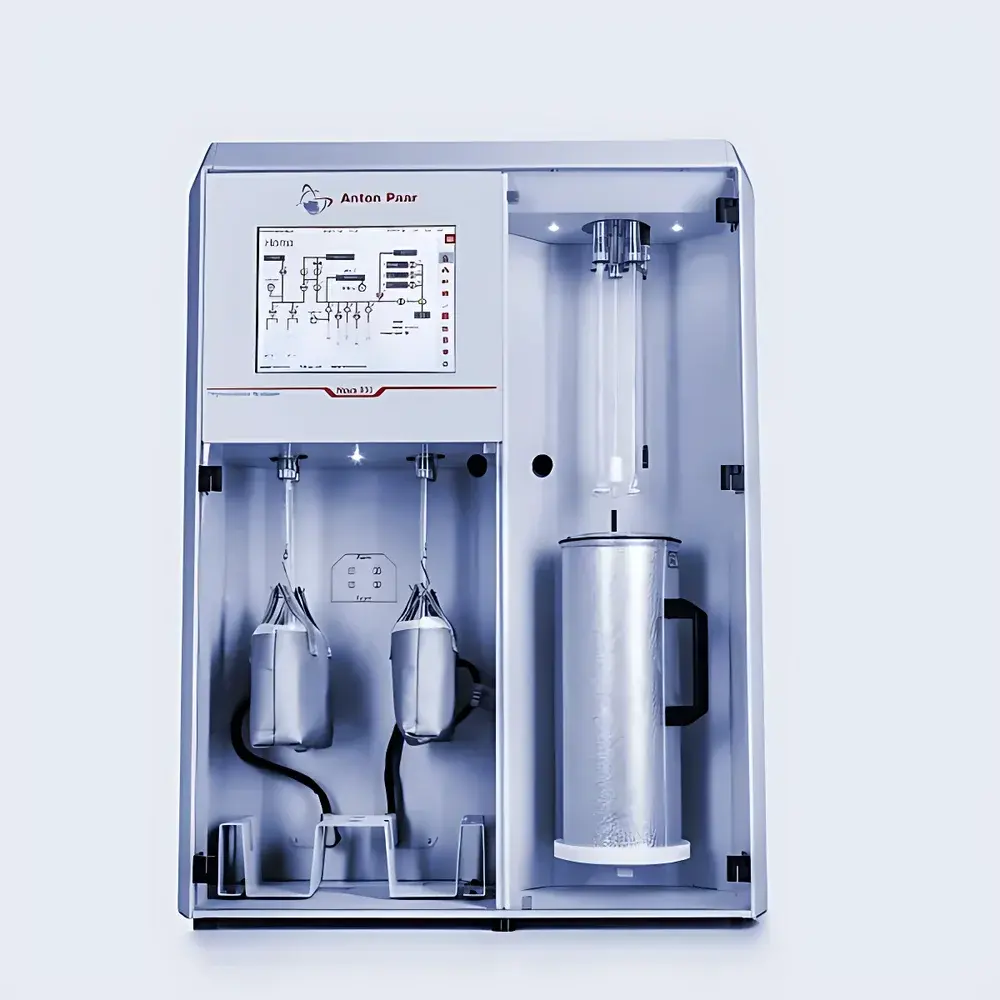
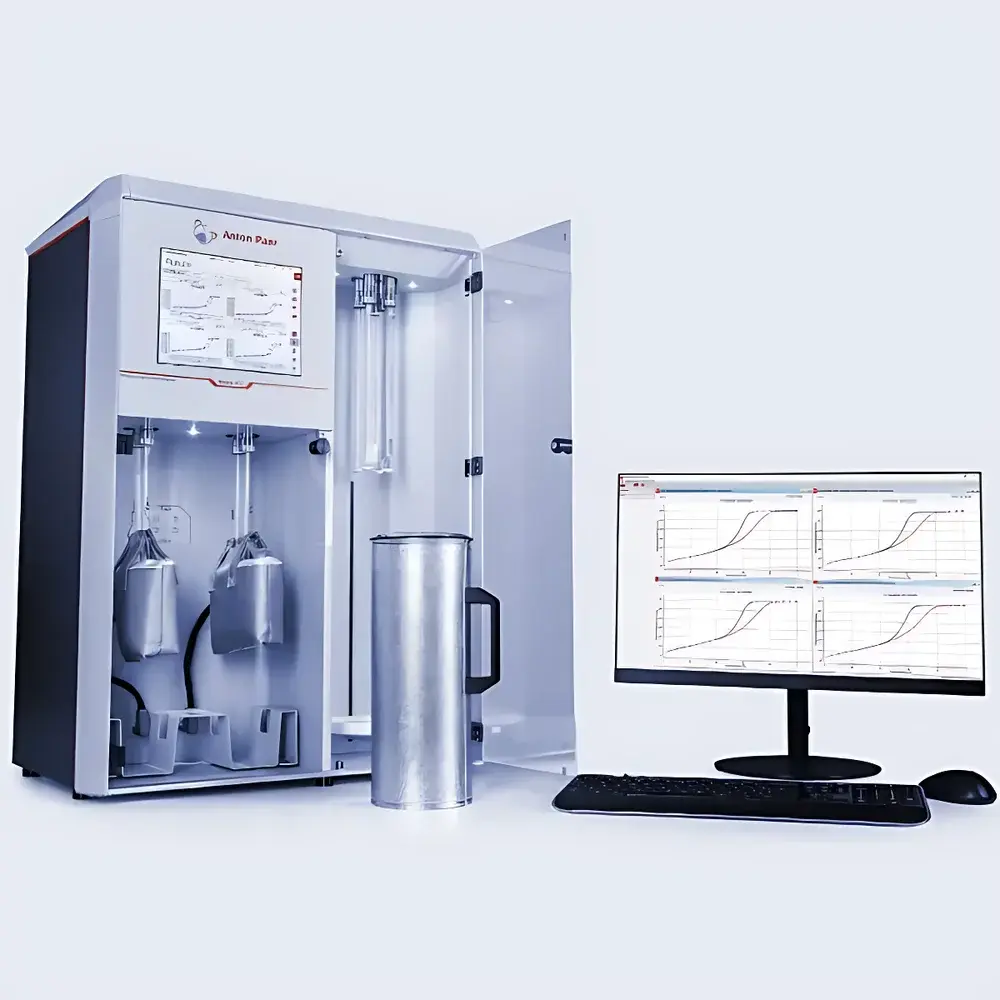
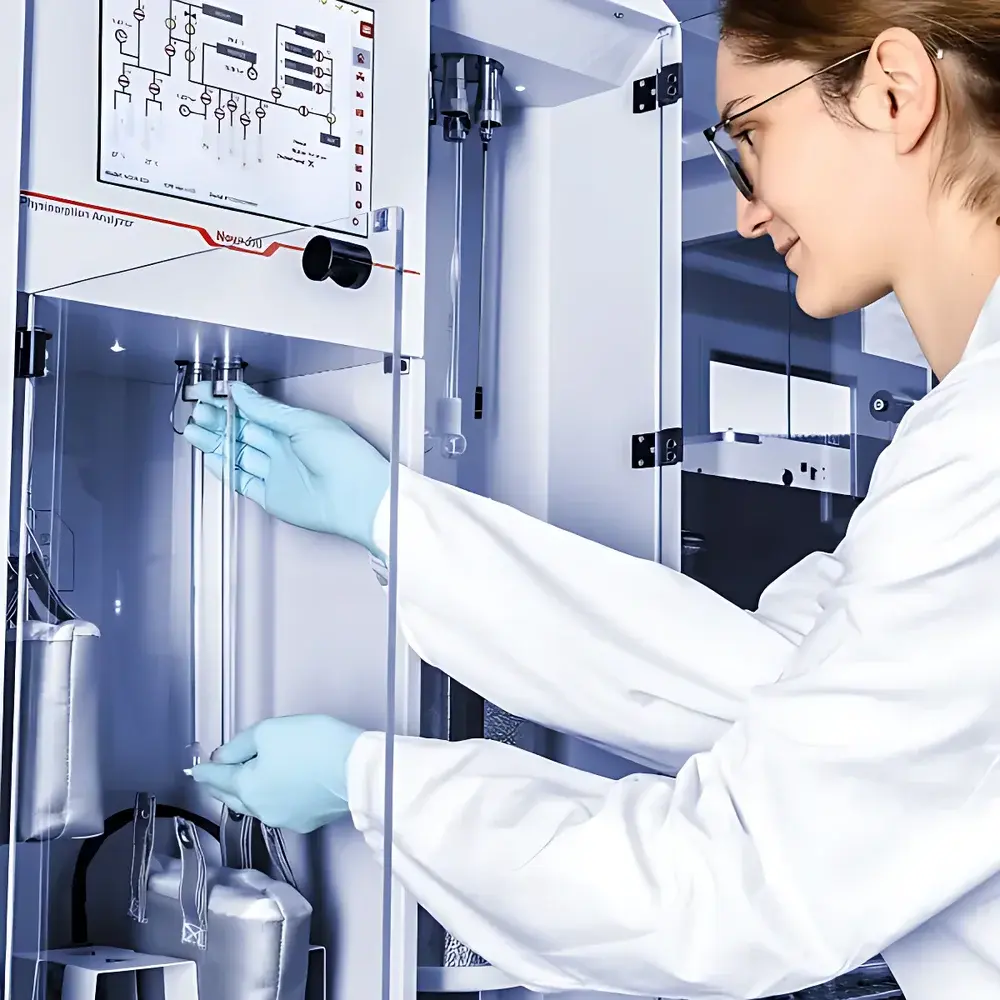
Anton Paar Quantachrome Nova 600BET / 800BET / 600 / 800 Specific Surface Area and Pore Size Analyzer
| Brand | Anton Paar |
|---|---|
| Origin | USA |
| Manufacturer Type | Original Equipment Manufacturer (OEM) |
| Product Category | Imported Instrument |
| Model | Nova 600BET / 800BET / 600 / 800 |
| Instrument Type | Specific Surface Area and Pore Size Analyzer |
| Principle | Static Volumetric Gas Adsorption |
| Number of Analysis Stations | 4 |
| Specific Surface Area Range | ≥ 0.01 m²/g (no upper limit) |
| Pressure Range | 1×10⁻⁴ to 0.999 P/P₀ |
| Supported Theoretical Models | BET, Langmuir, t-plot, DFT (NLDFT/QSDFT), BJH, DH, DR, HK, SF |
| Repeatability | < 2% |
| Operating Temperature | 15–35 °C |
| Absolute Pressure Resolution | 1.2×10⁻⁴ Torr |
| Relative Pressure Resolution | 1.5×10⁻⁷ P/P₀ |
| Pore Diameter Range | 0.35–500 nm (0.35–1.1 nm with CO₂ at 273 K) |
| Minimum Detectable Pore Volume | 1.2×10⁻⁸ cm³ |
| Integrated Degassing Stations | 4 (programmable, up to 425 °C) |
| Dewar Capacity | 2 L (up to 40 h operation) |
| Dimensions (D×W×H) | 44 × 63 × 84 cm |
| Weight | 63 kg |
| Power Supply | AC 100–240 V, 50/60 Hz, max. 345 VA |
Overview
The Anton Paar Quantachrome Nova 600BET / 800BET / 600 / 800 is a high-precision, fully automated static volumetric gas adsorption analyzer engineered for rigorous characterization of specific surface area, pore size distribution, and pore volume in advanced porous materials. Based on the gravimetrically validated volumetric principle, the system measures gas uptake at controlled equilibrium pressures across a broad relative pressure range (P/P₀ = 1×10⁻⁴ to 0.999) using N₂, Ar, CO₂, or other non-corrosive gases. Its quadruple-analysis architecture enables concurrent measurement of four independent samples—each with dedicated pressure transducers, thermal mass control, and isolated gas manifolds—to ensure high reproducibility (<2% RSD) and eliminate cross-contamination risk. The instrument integrates dual-stage vacuum technology (ultimate vacuum ≤2.3×10⁻³ Torr) and ultra-stable temperature regulation (±0.1 °C) to meet ASTM D3663, ISO 9277, USP , and IUPAC-recommended protocols for physisorption analysis.
Key Features
- Four independent analysis stations with individual pressure sensing (accuracy ±0.1% full scale) and real-time P/P₀ resolution down to 1.5×10⁻⁷—enabling detection of sub-monolayer adsorption events.
- Dual-mode degassing: Four integrated, programmable heating stations (RT–425 °C) support both flow and vacuum degassing; multi-step temperature ramps comply with ASTM D7865 and ISO 15901-2 for robust contaminant removal.
- TRUZONE™ pressure management system ensures precise, adaptive dosing via VECTORDOSE™ and DOSEWIZARD™ algorithms—automatically adjusting gas injection volumes based on prior uptake data or user-defined Δq thresholds between adjacent P/P₀ points.
- KAOMI FOR NOVA software platform provides native support for ≥20 pre-validated analytical methods aligned with ASTM, USP, DIN, and ISO standards—including fixed-pressure-point, fixed-dose, and intelligent stepwise isotherm acquisition.
- Comprehensive DFT modeling suite: ≥25 NLDFT and QSDFT kernel libraries cover slit, cylindrical, spherical, and mixed-pore geometries for carbon, zeolites, silica gels, MOFs, and metal oxides—validated against IUPAC Technical Report (2015) recommendations.
- Simultaneous analysis and degassing: While four samples undergo adsorption isotherm measurement, the next quartet can be preconditioned in parallel—reducing total throughput time by up to 40% versus sequential workflows.
Sample Compatibility & Compliance
The Nova series accommodates standard U-shaped quartz sample tubes (short or long format) and supports heterogeneous solid catalysts, battery electrode materials, pharmaceutical excipients, activated carbons, aerogels, and nanocomposites. All wetted surfaces are constructed from electropolished stainless steel and FKM elastomers, ensuring chemical compatibility with high-purity gases (N₂/He ≥99.999%). The system meets CE marking requirements and complies with RoHS 3 Directive 2015/863/EU. Full audit trail functionality—including user logins, method versioning, parameter change history, and raw-data timestamping—supports 21 CFR Part 11 compliance when deployed in GMP/GLP environments. Calibration certificates traceable to NIST standards are provided for all pressure and temperature sensors.
Software & Data Management
KAOMI FOR NOVA is a modular, multi-language (English, French, German, Japanese, Spanish, Chinese) software suite delivering end-to-end workflow automation—from instrument initialization and method selection to real-time isotherm visualization, model fitting, and report generation. Raw adsorption/desorption isotherms are stored in vendor-neutral ASCII format with embedded metadata (instrument ID, operator, date/time, calibration status). The software implements automated quality checks: outlier rejection based on Dubinin–Astakhov consistency criteria, hysteresis loop validation per IUPAC classification, and DFT model selection guidance using statistical AICc scoring. Export options include CSV, PDF, and structured XML for LIMS integration. Remote monitoring and control of up to four Nova instruments via Ethernet is supported without additional licensing.
Applications
This analyzer serves critical QC and R&D functions across multiple sectors: catalyst development teams use CO₂ adsorption at 273 K to resolve ultramicropores (<1.1 nm) in ZSM-5 and SAPO-34 frameworks; battery material scientists quantify BET surface area and mesopore volume (2–50 nm) in silicon anodes and sulfur-carbon composites; pharmaceutical labs assess excipient porosity per USP to predict dissolution kinetics and tablet compressibility; and nanomaterial producers validate pore geometry assumptions in MOF-5 and UiO-66 using QSDFT kernels calibrated for octahedral coordination environments. The inclusion of mercury intrusion merge capability further enables bimodal pore analysis spanning micropores (via gas adsorption) and macropores (via mercury porosimetry) within a unified reporting framework.
FAQ
What gases are supported for adsorption analysis?
N₂ (77 K), Ar (87 K), CO₂ (273 K), Kr (77 K), and other non-corrosive gases—subject to appropriate cryogenic or ambient temperature control.
Can the instrument perform both BET surface area and full isotherm analysis concurrently?
Yes: four samples may undergo rapid 5-point BET analysis in ≤20 minutes while another four are degassed; full multi-point isotherms (≥30 points) for four samples complete within 8 hours.
Is DFT model selection automated or user-guided?
Both: KAOMI FOR NOVA recommends optimal NLDFT/QSDFT kernels based on adsorbate, temperature, and expected pore geometry—but allows manual override and comparative overlay of up to six models.
How is data integrity maintained during extended unattended runs?
All pressure/temperature readings are continuously logged with hardware timestamps; power-loss recovery resumes from last stable equilibrium point without data corruption.
Does the system support regulatory-compliant reporting for pharmaceutical submissions?
Yes: preconfigured USP and ASTM D3663 templates generate audit-ready reports with electronic signatures, deviation flags, and raw-data appendices compliant with FDA expectations.
Related Products



