
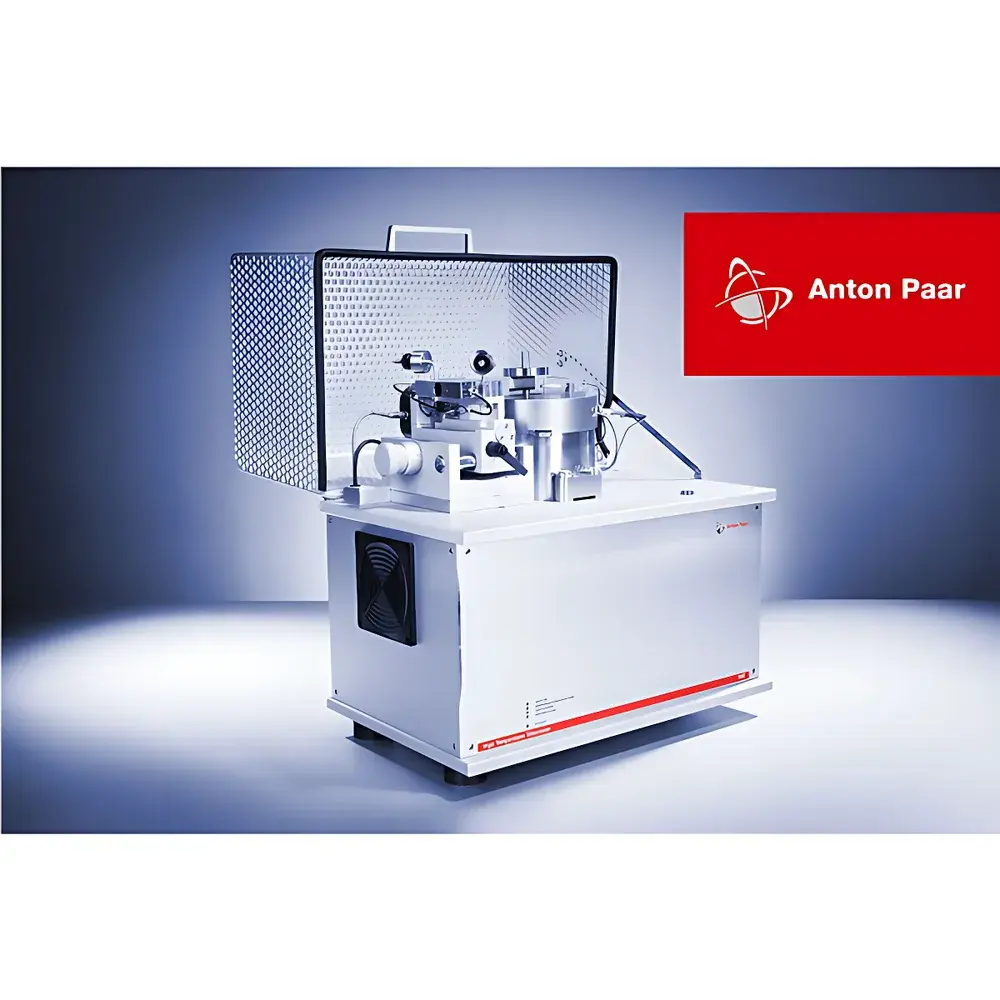
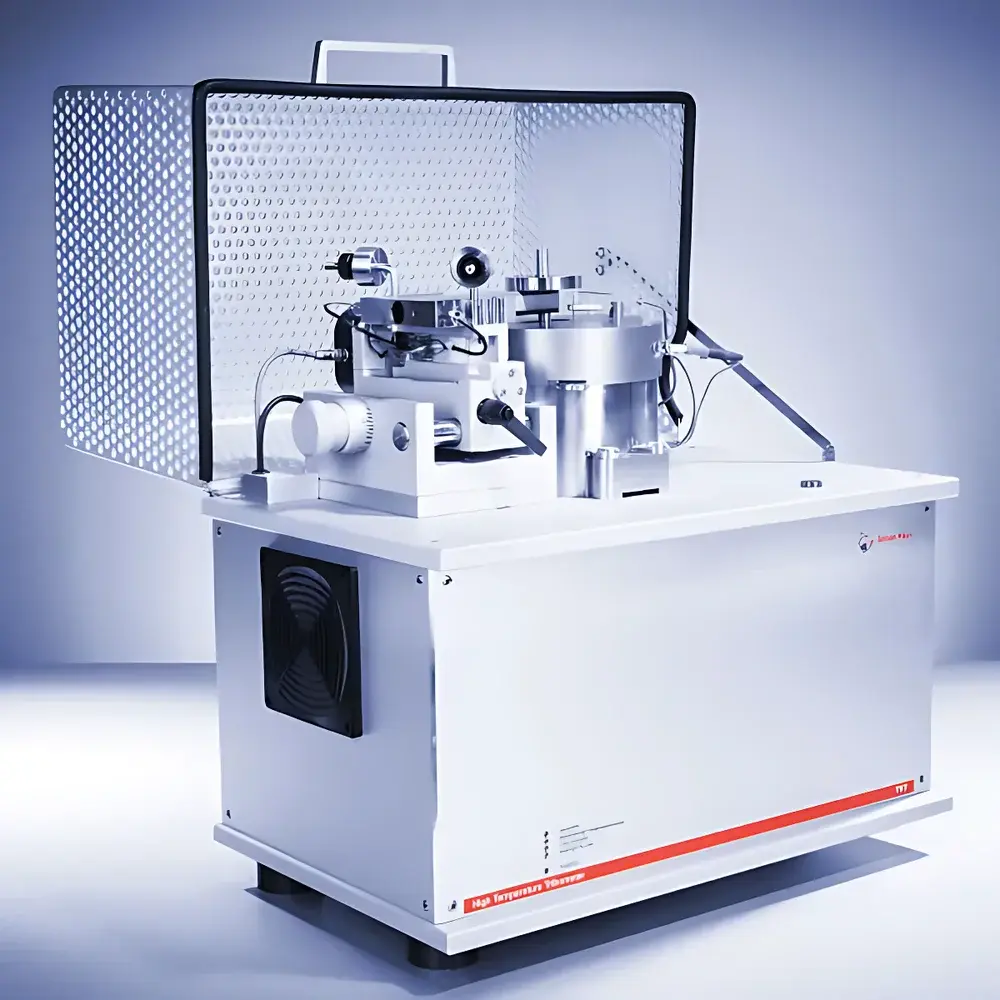
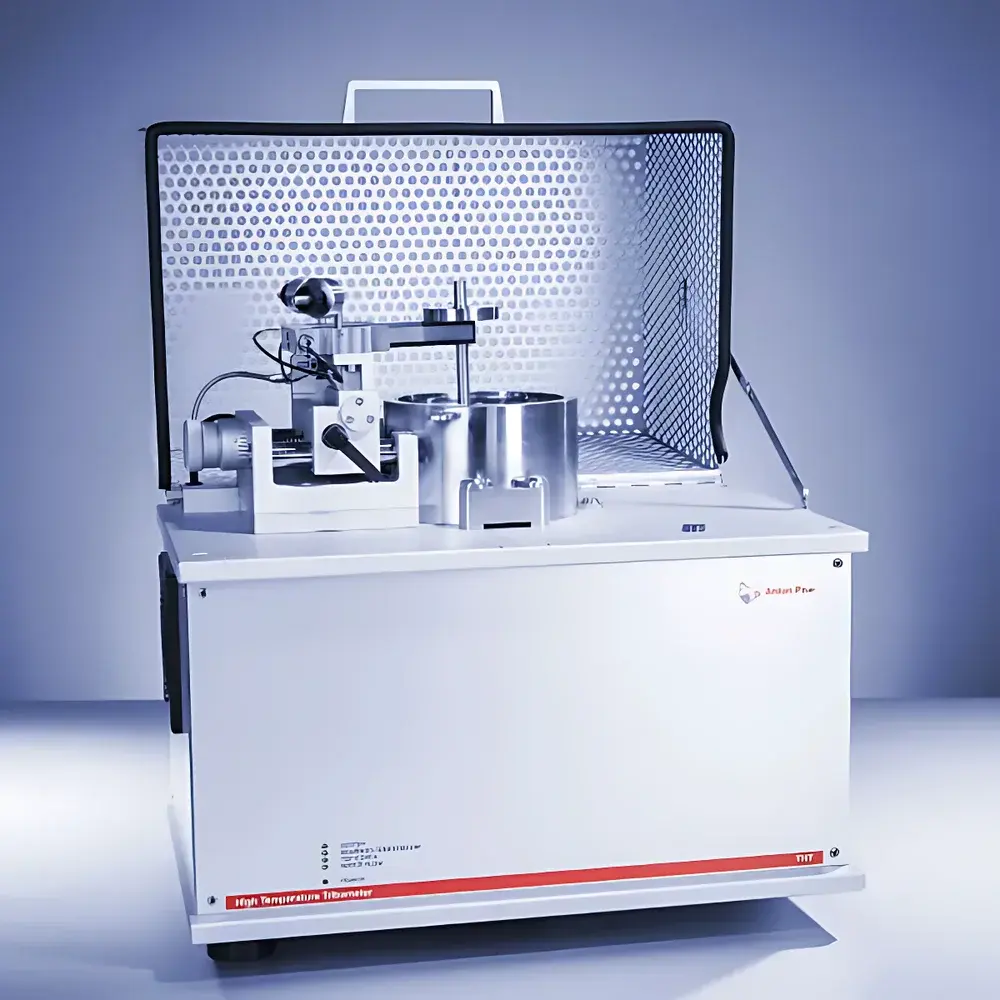
Anton Paar THT High-Temperature Tribological Tester
| Brand | Anton Paar |
|---|---|
| Origin | Switzerland |
| Manufacturer | Anton Paar GmbH |
| Type | High-Temperature Tribological Tester |
| Model | THT |
| Maximum Friction Force | 20 N |
| Friction Force Resolution | 0.03 mN |
| Maximum Operating Temperature | 1000 °C |
| Rotational Speed Range | 0.3–500 rpm (optional up to 1500 rpm) |
| Maximum Torque | 450 N·mm |
| Compliance Standards | DIN 50324, ASTM G99, ASTM G133 |
Overview
The Anton Paar THT High-Temperature Tribological Tester is an engineered solution for quantitative evaluation of frictional behavior and wear mechanisms under thermally extreme conditions—up to 1000 °C. Based on the well-established pin-on-disk (or ball-on-disk) configuration, the THT employs a controlled sliding contact geometry to replicate real-world tribological stress states encountered in high-temperature engineering systems, including combustion chamber components, turbine blades, exhaust valves, and next-generation thermal barrier coatings. Its core measurement principle relies on precision force transduction via differential LVDT-based friction sensing, coupled with synchronized angular position tracking and continuous displacement monitoring. Unlike conventional tribometers limited to ambient or moderately elevated temperatures, the THT integrates a robust, vacuum-compatible heating/cooling architecture that ensures thermal stability ±1 °C across the full operational range—enabling reproducible, time-resolved tribological data acquisition under isothermal or programmed thermal profiles.
Key Features
- Differential friction sensor system with intrinsic thermal stability up to 1000 °C—eliminates drift-induced signal artifacts common in strain-gauge or piezoelectric transducers at elevated temperatures
- Modular furnace design with rapid heating (up to 50 °C/min) and active cooling capability, supporting both steady-state and transient thermal testing protocols
- High-resolution angular encoder enabling precise control of reciprocating stroke length, rotational cycles, or automatic termination upon reaching user-defined friction coefficient thresholds
- Integrated electrical contact resistance (ECR) measurement channel for in situ monitoring of interfacial conductivity changes—critical for evaluating oxide film formation, tribochemical reactions, or lubricant breakdown
- Continuous wear depth tracking via high-precision displacement sensor (sub-micrometer resolution), synchronized with force and temperature data streams
- Vacuum-compatible chamber (down to 10−6 mbar) with optional gas dosing ports for controlled atmosphere testing (e.g., inert Ar, oxidizing O2, or reactive H2S environments)
Sample Compatibility & Compliance
The THT accommodates standard tribological specimens per ISO 20806, ASTM G99 (pin-on-disk), and ASTM G133 (linear reciprocating), including cylindrical pins (Ø 3–10 mm), spherical indenters (Ø 3–12 mm), and flat disk substrates (up to Ø 100 mm × 15 mm thick). Sample holders are machined from high-purity alumina or molybdenum depending on temperature class, ensuring minimal thermal expansion mismatch and chemical inertness. All test methodologies align with DIN 50324 for wear volume quantification and support traceable calibration against NIST-traceable reference materials. The system architecture complies with GLP/GMP documentation requirements—including full audit trail logging, electronic signature support, and 21 CFR Part 11–compliant data integrity controls when operated with Anton Paar’s TRIBOware software suite.
Software & Data Management
TRIBOware v4.x provides unified control of mechanical, thermal, and electrical subsystems, with real-time visualization of friction coefficient (μ), normal load, wear depth, ECR, and temperature. Raw data streams are acquired at 1 kHz sampling rate and stored in HDF5 format—ensuring long-term readability and interoperability with MATLAB, Python (via h5py), or third-party statistical analysis platforms. Automated test sequencing supports multi-step protocols (e.g., temperature ramp → dwell → load increase → cycle count), while post-processing modules enable wear rate calculation (mm³/N·m), Stribeck curve generation, and statistical wear scar morphology analysis. All data files include embedded metadata (operator ID, calibration certificate IDs, environmental logs), satisfying ISO/IEC 17025 documentation rigor for accredited laboratories.
Applications
- Development and qualification of high-temperature alloys (e.g., Ni-based superalloys, Mo-Si-B composites) for aerospace and power generation applications
- Evaluation of solid lubricants (e.g., CaF2/BaF2 eutectics, MAX phase coatings) under oxidizing atmospheres up to 800 °C
- Tribo-oxidation kinetics studies of ceramic matrix composites (CMCs) used in gas turbine hot sections
- Validation of thermo-mechanical fatigue models through correlated friction–wear–temperature datasets
- Quality control of PVD/CVD-coated engine components against batch-to-batch tribological variability
FAQ
What temperature uniformity can be achieved across the contact interface at 1000 °C?
The THT maintains axial temperature deviation < ±2 °C over a 5-mm diameter contact zone during steady-state operation, verified by embedded Pt/Rh thermocouples and IR pyrometry cross-calibration.
Is the system compatible with third-party data acquisition hardware?
Yes—THT provides analog voltage outputs (±10 V) for friction, load, temperature, and displacement signals, along with TTL-triggered digital I/O for synchronization with external high-speed cameras or spectrometers.
Can wear depth be measured without interrupting the test?
Absolutely—the integrated capacitive displacement sensor operates continuously during sliding, delivering real-time wear depth with sub-100 nm resolution independent of surface reflectivity or oxidation state.
Does the THT support ASTM G133 linear reciprocating mode?
Yes—via optional linear actuator module with programmable stroke length (0.1–25 mm), frequency (0.1–10 Hz), and dwell time, fully integrated into TRIBOware test definition workflow.
How is calibration traceability maintained across temperature ranges?
Each THT undergoes factory calibration using NIST-traceable dead-weight standards at 25 °C, 500 °C, and 1000 °C; calibration certificates include temperature-dependent sensitivity matrices and uncertainty budgets per ISO/IEC 17025 Annex A.3.
Related Products



