
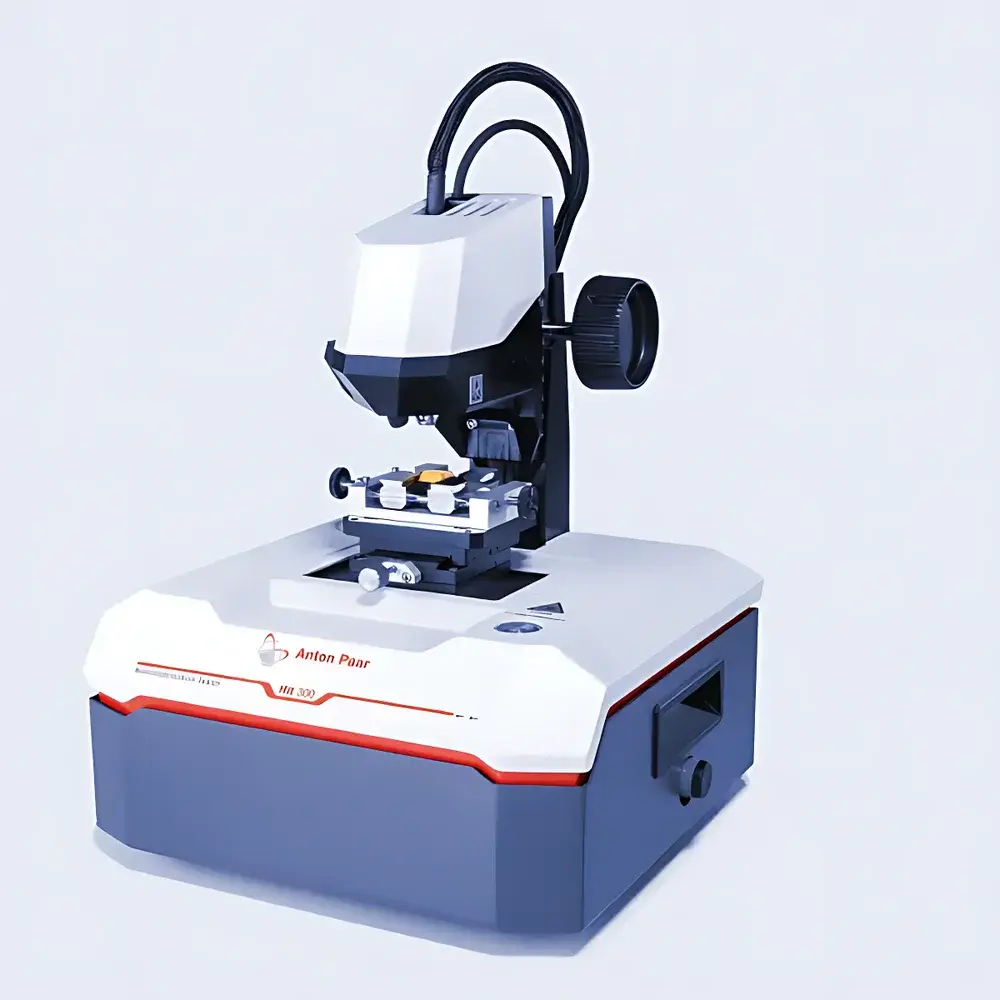
Anton Paar TriTec HIT 300 Nanoindentation and Scratch Tester
| Brand | Anton Paar TriTec (formerly CSM Instruments, Switzerland) |
|---|---|
| Origin | Switzerland |
| Model | HIT 300 |
| Instrument Type | Nanoindentation and Scratch Tester |
| Thermal Drift | ≤0.0008 nm/s |
| Frame Stiffness | 10⁸ µN/µm |
| Positioning Accuracy | <1 µm |
| Repeatability | High |
| Compliance | ASTM E2546, ISO 14577, ISO 20519, USP <1089>, GLP/GMP-ready data traceability |
Overview
The Anton Paar TriTec HIT 300 Nanoindentation and Scratch Tester is an engineered solution for quantitative mechanical characterization of surfaces and thin films at the nanoscale. Based on instrumented indentation methodology—where a precisely shaped indenter (typically Berkovich, cube-corner, or spherical) is driven into a sample surface under controlled force while simultaneously recording load (F) and displacement (h)—the HIT 300 delivers high-fidelity data for hardness (H), reduced elastic modulus (Er), creep compliance, viscoelastic relaxation, adhesion energy, and stress–strain behavior. Its design integrates fundamental principles of contact mechanics (Oliver–Pharr method), dynamic mechanical analysis (DMA-mode), and continuous stiffness measurement (CSM) to enable multi-parameter extraction from single or sequential indentations. Unlike conventional microhardness testers, the HIT 300 operates with sub-nanometer displacement resolution and real-time load feedback, ensuring compliance with international standards including ISO 14577-1:2022 (Metallic materials — Instrumented indentation test for hardness and materials parameters) and ASTM E2546-21 (Standard Test Method for Instrumented Indentation Testing). The system is optimized for R&D laboratories, quality control environments, and academic surface science facilities requiring reproducible, metrologically traceable surface mechanical data.
Key Features
- Ultra-low thermal drift performance: ≤0.0008 nm/s, achieved via proprietary surface reference technology that decouples thermal expansion effects between sample stage and transducer assembly—eliminating need for post-test drift correction.
- Rigid mechanical architecture: Frame stiffness of 10⁸ µN/µm ensures minimal frame compliance, enabling accurate measurement of soft polymers, biomaterials, and compliant coatings without signal distortion.
- Sub-micron positioning accuracy: <1 µm repositioning repeatability across the full XY stage travel range (100 × 100 mm), supported by integrated dual-laser targeting and high-resolution optical microscopy (dual-view stereo optics with 2×–200× magnification).
- Multi-mode testing capability: Standard quasi-static indentation, continuous stiffness measurement (CSM), dynamic mechanical analysis (DMA), constant strain-rate loading, and stress–strain curve acquisition—all accessible via unified software interface.
- Active vibration isolation: Built-in electromagnetic damping system suppresses environmental micro-vibrations, permitting stable operation on standard laboratory benches without dedicated inertial tables.
- Rapid deployment: System warm-up time <15 minutes; full operator training-to-first-result workflow achievable within 60 minutes, minimizing downtime and accelerating method development cycles.
Sample Compatibility & Compliance
The HIT 300 accommodates a broad spectrum of solid materials—including metals, ceramics, semiconductors, polymer films, optical coatings, biomedical implants, and layered stacks—with sample thickness ranging from 100 nm to >10 mm. Its modular sample stage accepts standard SEM stubs, wafer chucks (up to 200 mm), and custom fixtures. All test protocols adhere to ISO 14577 parts 1–4 (instrumented indentation), ISO 20519 (scratch testing of coatings), and ASTM E2546 for instrument calibration and uncertainty quantification. Data files include full metadata (timestamp, operator ID, environmental conditions, calibration history) and support audit trails compliant with FDA 21 CFR Part 11 and GLP/GMP requirements when used with optional electronic signature modules.
Software & Data Management
Control and analysis are performed using the proprietary iNano software platform, which provides intuitive workflow-driven test setup, real-time visualization of load–displacement curves, automated tip geometry calibration (area function), and batch processing for statistical reporting. Raw data export is available in ASCII (.txt), CSV, and HDF5 formats for third-party analysis (e.g., MATLAB, Python SciPy). The software includes built-in compliance with ISO/IEC 17025 documentation standards, automatic generation of calibration certificates, and configurable report templates aligned with internal SOPs or external regulatory submissions.
Applications
- Thin-film mechanical property mapping (e.g., DLC, TiN, SiO₂, hydrogels)
- Hardness and modulus gradients across diffusion zones or heat-affected regions
- Creep and relaxation behavior of viscoelastic biomaterials and pharmaceutical tablets
- Adhesion strength assessment of PVD/CVD coatings via progressive scratch testing
- Quality assurance of MEMS device layers and semiconductor packaging interfaces
- Correlation of nano-mechanical response with microstructure (via correlative AFM/SEM)
FAQ
What standards does the HIT 300 comply with for nanoindentation testing?
It fully supports ISO 14577-1:2022, ASTM E2546-21, and ISO 20519 for scratch testing, with documented traceability to NIST-traceable reference materials.
Can the HIT 300 perform tests on temperature-controlled samples?
Yes—optional heating/cooling stages (−100 °C to +600 °C) are available and fully integrated into the software control loop.
Is tip calibration automated?
Yes—the iNano software includes automated area function calibration routines using certified fused silica and sapphire reference samples.
How is data integrity ensured for regulated environments?
All measurements include digital signatures, time-stamped audit logs, and version-controlled method files compatible with 21 CFR Part 11 and EU Annex 11 validation frameworks.
What is the typical maintenance interval for the HIT 300?
Annual preventive maintenance is recommended; no routine recalibration is required between service intervals due to the system’s inherent thermal and mechanical stability.



