
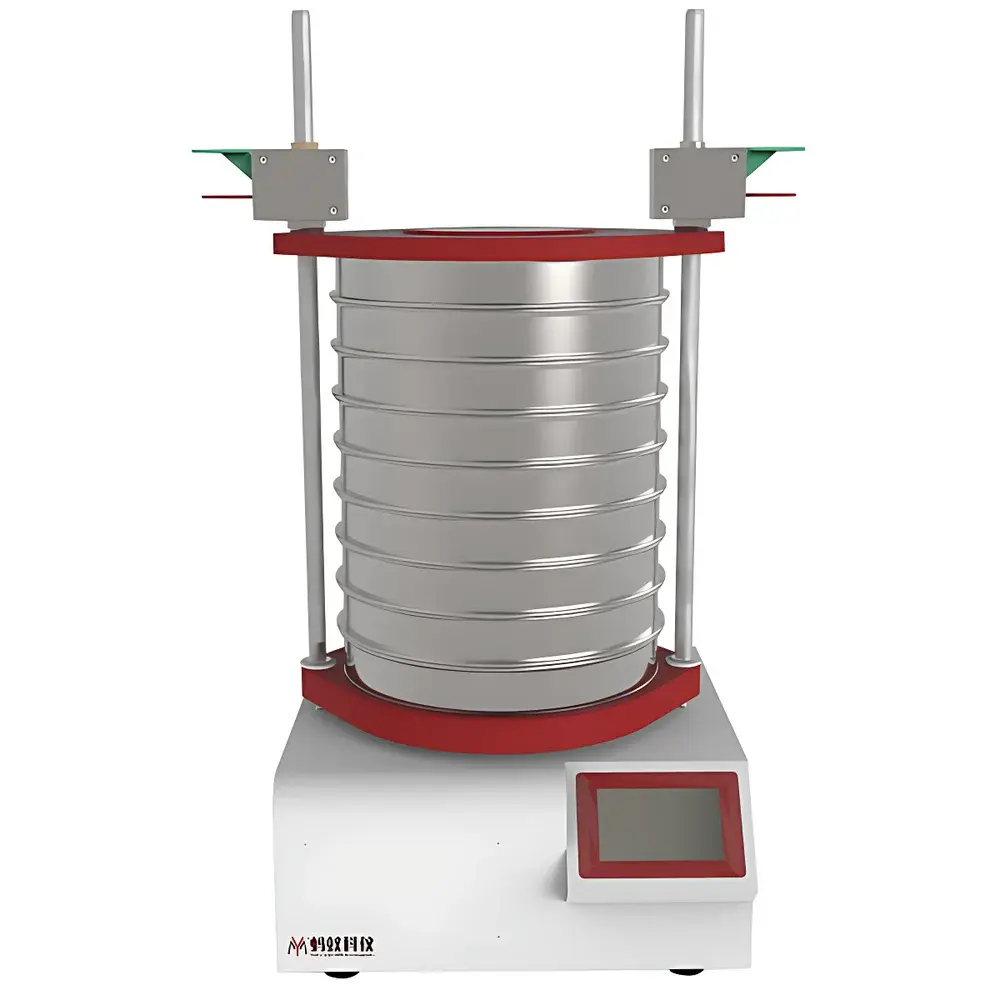
Ants Scientific Instruments AF100 Three-Dimensional Sieve Analyzer
| Brand | Ants Scientific Instruments |
|---|---|
| Origin | Beijing, China |
| Manufacturer Type | Authorized Distributor |
| Country of Origin | China |
| Model | AF100 |
| Price Range | USD 1–700 (FOB) |
| Sample Type | Powders, Granular Materials, Suspensions |
| Measurement Range | 20 µm – 25 mm |
| Max. Sample Load | 6 kg |
| Max. Sieving Stages | 9 |
| Max. Sieve Stack Mass | 10 kg |
| Amplitude Adjustment | 0.2–3 mm |
| Timer Display | Digital, 1–99 min |
| Intermittent Pause | 5 s – 99 s |
| Stored Methods | 9 user-defined protocols |
| Sieve Diameters | 200 mm & 300 mm |
| Sieve Mesh Range | 20 µm – 25 mm |
| Sieve Materials | Stainless Steel & Nylon |
| Sieving Modes | Dry Sieving & Wet Sieving |
Overview
The Ants Scientific Instruments AF100 Three-Dimensional Sieve Analyzer is an electromagnetically driven particle size distribution instrument engineered for precision mechanical sieving of dry and wet particulate systems. Unlike conventional single-axis vibratory sieves, the AF100 generates a controlled three-dimensional parabolic motion—combining horizontal orbital displacement with vertical oscillation—to ensure uniform sample dispersion across the sieve surface and enhanced particle stratification. This motion profile minimizes particle agglomeration, reduces blinding of fine mesh apertures, and improves separation efficiency across broad particle size distributions. The system operates on the principle of gravitational stratification under dynamic excitation: particles smaller than the aperture pass through each successive sieve layer while larger fractions remain retained, enabling quantitative fractionation into up to nine discrete size classes in a single run. Designed for routine QC laboratories, R&D facilities, and materials characterization centers, the AF100 complies with fundamental sieving standards referenced in ISO 2591-1, ASTM E11, and USP , supporting method validation under GLP and GMP-aligned workflows.
Key Features
- Electromagnetic drive system delivering reproducible 3D parabolic motion (horizontal + vertical components) for improved particle fluidization and reduced segregation bias
- Dual-diameter sieve compatibility: interchangeable 200 mm and 300 mm sieve frames support flexible throughput—from small R&D samples (≤500 g) to bulk industrial batches (up to 6 kg)
- Adjustable amplitude (0.2–3 mm) and programmable timing (1–99 min per cycle) with configurable intermittent pauses (5–99 s) to optimize separation for cohesive, fibrous, or high-density powders
- Quick-lock clamping mechanism enables tool-free assembly/disassembly of multi-tier sieve stacks—reducing setup time by >40% versus threaded or lever-based systems
- Integrated digital control panel with backlight LCD display; stores up to nine user-defined sieving protocols including amplitude, duration, pause intervals, and mode selection (dry/wet)
- Wet sieving capability with optional splash guard and drainage base—enabling compliant analysis of slurries, suspensions, and moisture-sensitive materials without cross-contamination
- Modular construction using corrosion-resistant stainless steel (304/316) and food-grade nylon sieve meshes (20 µm–25 mm nominal aperture), certified per ISO 3310-1
Sample Compatibility & Compliance
The AF100 accommodates a wide spectrum of particulate materials—including crystalline APIs, mineral ores, polymer granules, agricultural seeds, metal powders, soil aggregates, and detergent formulations—without requiring pre-drying or dispersion aids in most cases. Its dual-mode operation satisfies both dry-sieving requirements (e.g., ASTM C136 for aggregates) and wet-sieving applications (e.g., ISO 11277 for soil particle-size analysis). All sieve meshes are traceably calibrated and supplied with certificate of conformity referencing ISO/IEC 17025-accredited calibration practices. The instrument’s mechanical design meets CE safety directives (2006/42/EC) and electromagnetic compatibility standards (EN 61326-1), and its operational logs—when paired with optional PC interface software—support audit trails compatible with FDA 21 CFR Part 11 data integrity expectations.
Software & Data Management
While the AF100 operates as a standalone unit, it features an RS-232 serial port for integration with third-party LIMS or laboratory informatics platforms. Optional companion software (AF-SieveLink v2.1) provides method export/import, real-time parameter monitoring, automatic mass balance calculation per fraction, and PDF report generation compliant with ISO 9001 documentation requirements. All stored methods include timestamped metadata (operator ID, date/time, environmental notes), facilitating retrospective review during internal audits or regulatory inspections.
Applications
- Quality control of pharmaceutical excipients and final dosage forms per USP and Ph. Eur. 2.9.31
- Particle size grading of catalyst supports, battery electrode materials, and additive manufacturing feedstocks
- Agricultural soil texture classification (sand/silt/clay fractions) per USDA and FAO protocols
- Characterization of construction aggregates, recycled concrete fines, and asphalt binder fillers
- Process optimization of powder metallurgy, ceramic green bodies, and pigment dispersion processes
- Environmental monitoring of airborne particulates, dredged sediments, and waste incineration residues
FAQ
What standards does the AF100 comply with for sieve calibration and performance verification?
The AF100 uses ISO 3310-1 certified stainless steel and nylon sieves, and its motion parameters are validated against ISO 2591-1 Annex A for vibratory sieving equipment. Calibration certificates are provided with each sieve set.
Can the AF100 be used for regulatory submissions in pharmaceutical or food manufacturing?
Yes—when operated with documented SOPs, calibrated sieves, and traceable parameter logs (via optional software), the AF100 supports data packages compliant with ICH Q5A, FDA Guidance for Industry on Powder Flow, and EFSA particle size assessment requirements.
Is wet sieving performed under closed-loop or open drainage conditions?
Wet sieving utilizes an open-drain configuration with integrated splash containment; users supply external water flow and filtration. No recirculation pump is included, preserving method flexibility and minimizing microbial risk.
How is mass balance verified across multiple sieve fractions?
Total recovered mass is calculated manually or via AF-SieveLink software by summing individual pan weights; deviation tolerance is configurable (default ±2% of initial load) and logged automatically.
Does the AF100 require annual recalibration of its electromagnetic drive system?
No scheduled recalibration is required—the drive is factory-tuned and stable over ≥5 years of continuous use. Amplitude linearity is verified annually using a certified laser vibrometer per ISO 16063-21.



