
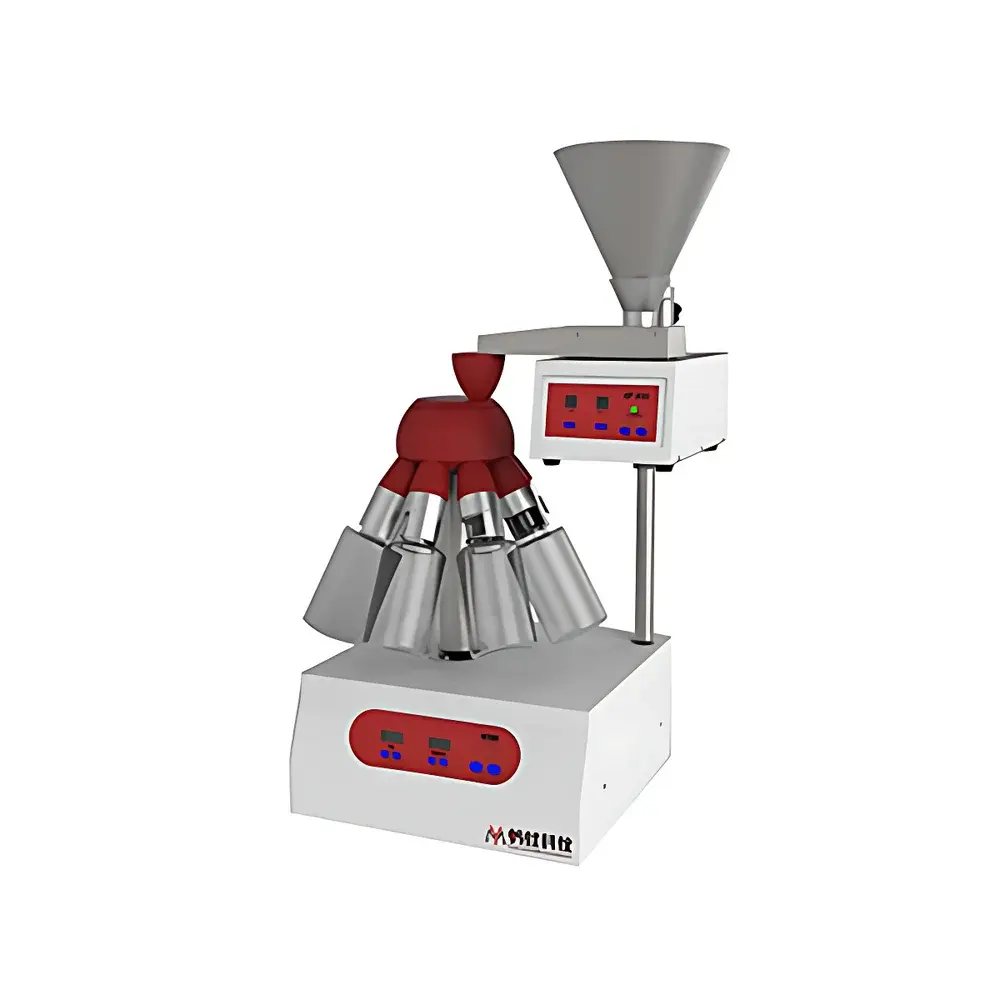
Ants Scientific Instruments AF200 Automatic Rotary Sample Divider
| Brand | Ants Scientific Instruments |
|---|---|
| Origin | Beijing, China |
| Manufacturer Type | Authorized Distributor |
| Country of Origin | China |
| Model | AF200 |
| Price Range | USD 7,000 – 14,000 |
| Sample Type | Free-flowing granular or powdered materials |
| Max Feed Size | ≤12 mm |
| Max Single Division Volume | 5 L |
| Division Time Setting | 1–99 min (digital, continuously adjustable) |
| Rotational Speed | 70–120 rpm (customizable) |
| Volumetric Feed Rate | Up to 5 L/min |
| Number of Subsamples | 6 / 8 / 10 |
| Available Sample Bottle Volumes | 30 mL, 100 mL, 250 mL, 500 mL |
| Material of Dividing Head | Anodized aluminum alloy |
| Dust Cap | Integrated for fine-particle handling |
| Fast-Release Mounting | Tool-free head assembly/disassembly |
| Noise Level | <62 dB(A) at 1 m |
| Footprint | Compact benchtop design (W×D×H ≈ 420×380×560 mm) |
| Compliance | Designed in accordance with ISO 11552:2022 (Sampling of bulk materials — Mechanical sample dividers), ASTM D7429–22 (Standard Practice for Sampling Powdered and Granular Materials), and GLP-aligned operational traceability requirements |
Overview
The Ants Scientific Instruments AF200 Automatic Rotary Sample Divider is an engineered solution for high-fidelity mechanical subdivision of free-flowing bulk solids—including powders, granules, pellets, and crushed minerals—where representative sampling is critical to downstream analytical integrity. Based on the rotary cup principle (a variant of the riffle divider geometry adapted for continuous volumetric distribution), the AF200 employs a precision-machined, rotating dividing head that directs material flow into equally spaced receiving channels. This architecture ensures uniform mass partitioning by gravity-fed trajectory control and consistent angular displacement, minimizing segregation bias associated with particle size, density, or shape heterogeneity. Unlike static or manual splitters, the AF200 eliminates operator-induced variability and prevents cross-contamination through fully enclosed transport pathways. Its design adheres to fundamental sampling theory as codified in Gy’s sampling equation, prioritizing mass-based proportionality and statistical representativeness over arbitrary volume division.
Key Features
- Integrated feed-and-division architecture: Eliminates intermediate transfer steps, ensuring zero sample loss and preserving original particle size distribution.
- Programmable operation: Digital timer (1–99 min), adjustable rotational speed (70–120 rpm), and variable feed rate control enable method standardization across batches and operators.
- Modular dividing head system: Interchangeable configurations support 6-, 8-, or 10-way subdivision; anodized aluminum construction provides wear resistance and low surface adhesion for diverse chemistries (e.g., hydrophobic polymers, hygroscopic salts).
- Dust mitigation engineering: Integrated dust cap prevents airborne dispersion during fine-particle handling (<100 µm), supporting ISO 14644-compliant cleanroom-adjacent workflows.
- Rapid head servicing: Tool-free quick-lock mechanism allows full disassembly and cleaning within 90 seconds—critical for multi-product laboratories operating under changeover protocols.
- Benchtop footprint with acoustic optimization: Enclosed drive train and vibration-damped base reduce operational noise to <62 dB(A), suitable for shared laboratory environments.
- Scalable volumetric capacity: Compatible with certified borosilicate glass or polypropylene sample bottles (30 mL to 500 mL); optional custom bottle adapters support up to 5 L total output per cycle.
Sample Compatibility & Compliance
The AF200 accommodates dry, non-cohesive, and moderately cohesive particulates with maximum particle dimensions ≤12 mm—covering applications from agricultural grains and pharmaceutical excipients to metallurgical concentrates and ceramic raw materials. It is not intended for fibrous, sticky, or highly electrostatic materials without prior conditioning. All mechanical components comply with RoHS Directive 2011/65/EU and meet CE machinery safety standards (2006/42/EC). The instrument supports audit-ready documentation: time-stamped operation logs (via optional RS-232/USB interface), parameter lockout for SOP enforcement, and alignment with FDA 21 CFR Part 11 data integrity principles when paired with validated LIMS integration. Method validation reports may be generated per ISO/IEC 17025:2017 clause 7.2.2 for sampling procedure verification.
Software & Data Management
While the AF200 operates as a standalone electromechanical system, its digital control module provides ASCII-protocol serial output for external logging. Optional firmware upgrade enables timestamped parameter export (start time, duration, rpm, bottle ID) to CSV or Excel-compatible formats. When deployed in regulated environments, users may integrate the device into electronic batch records via OPC UA or Modbus TCP gateways—ensuring full traceability of sampling events in compliance with ALCOA+ (Attributable, Legible, Contemporaneous, Original, Accurate, Complete, Consistent, Enduring, Available) data governance frameworks. No proprietary software installation is required for basic operation.
Applications
- Quality control laboratories processing incoming raw materials (e.g., limestone, coal, polymer resins) prior to elemental analysis or thermal testing.
- Pharmaceutical manufacturing facilities performing content uniformity sampling per USP <905> and ICH Q5C stability protocols.
- Environmental testing labs subdividing soil or sediment composites for heavy metal extraction and ICP-MS quantification.
- Research institutions conducting reproducible powder rheology or compaction studies where inter-batch homogeneity must be preserved.
- Mining and mineral processing QA/QC workflows requiring ISO 3082-compliant sub-sampling of drill core or conveyor belt streams.
FAQ
Is the AF200 suitable for moisture-sensitive samples?
Yes—its fully enclosed feed path and optional nitrogen purge port (accessory) minimize atmospheric exposure during division.
Can the rotation speed be calibrated and verified?
Yes—built-in optical tachometer output allows third-party calibration against NIST-traceable reference standards.
Does the instrument support IQ/OQ documentation?
Ants Scientific Instruments provides a factory-verified Installation Qualification (IQ) template and Operational Qualification (OQ) test protocol aligned with ASTM E2500-13.
What maintenance intervals are recommended?
Lubrication-free operation requires only quarterly visual inspection of the dividing head alignment and annual verification of motor encoder accuracy.
Is cleaning validation supported?
The smooth-surface anodized aluminum head and tool-free disassembly enable swab recovery studies per ICH Q5A and EU Annex 15 guidelines.



