
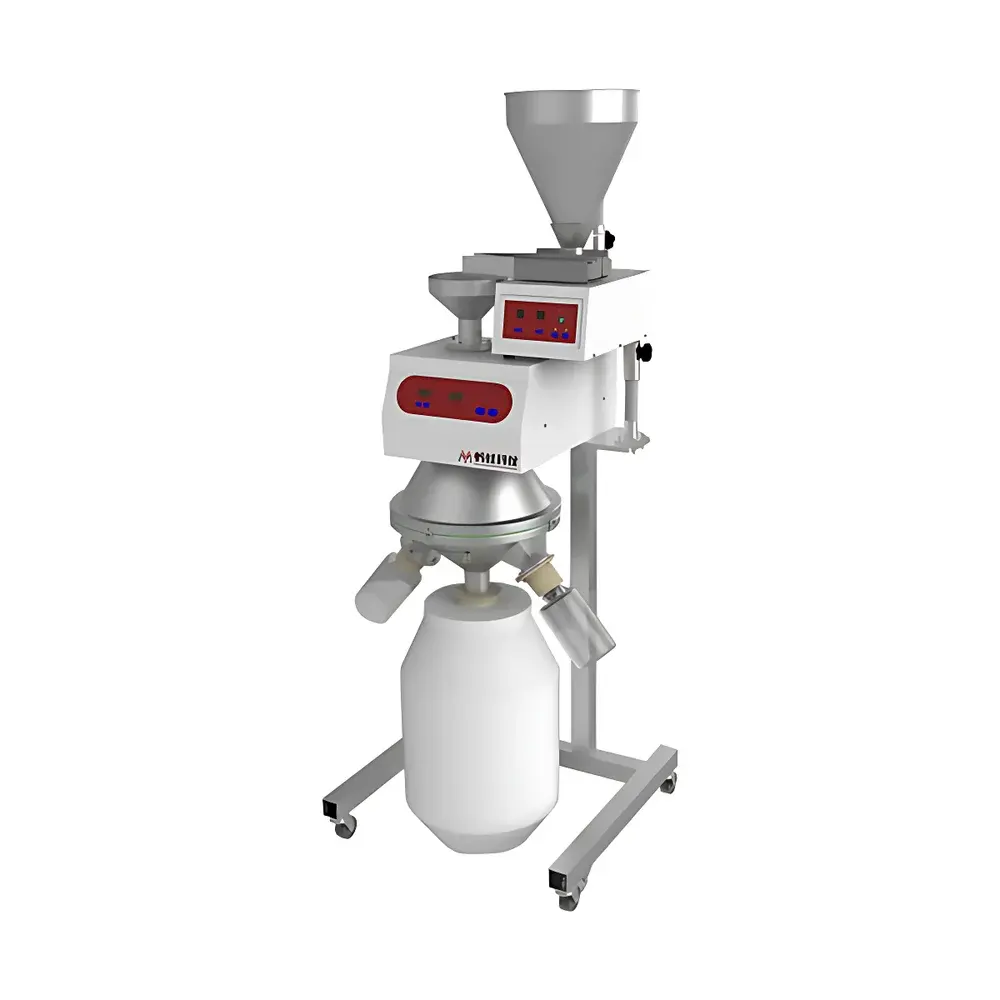
Ants Scientific Instruments AF400 Automatic Rotary Sample Divider
| Brand | Ants Scientific Instruments |
|---|---|
| Origin | Beijing, China |
| Manufacturer Type | Authorized Distributor |
| Product Origin | Domestic (China) |
| Model | AF400 |
| Price Range | USD 7,000 – 14,000 |
| Sample Type | Free-flowing granular or particulate materials |
| Max Feed Size | ≤10 mm |
| Number of Output Fractions | 1–3 |
| Fraction Collection Capacity | 250 mL or 500 mL per receiver |
| Waste Bin Capacity | 30 L (customizable) |
| Dividing Time Range | 1–99 min (digital display, continuously adjustable) |
| Rotational Speed | 50–120 rpm |
| Adjustable Slit Width | 0–159 mm (1-port), 0–110 mm (2-port), 0–53 mm (3-port) |
| Max Division Ratio | 1×1:5 (1-port), 2×1:7.2 (2-port), 3×1:15 (3-port) |
| Min Division Ratio | 1:26 (universal across all base cones) |
| Compatibility | Optional integration with AF300 Automatic Feeder |
Overview
The Ants Scientific Instruments AF400 Automatic Rotary Sample Divider is a precision-engineered device designed for representative, dust-minimized subdivision of bulk free-flowing granular and powdered materials. It operates on the principle of rotary gravitational distribution—where a rotating conical distributor ensures uniform radial dispersion of material across a replaceable base cone equipped with 1, 2, or 3 discrete outlet ports. As the upper guide tube rotates at a controlled speed (50–120 rpm), feed material introduced via gravity or an optional AF300 automatic feeder is evenly distributed along the circumference of the base cone. A precisely adjustable slit width determines the volumetric fraction diverted to each collection vessel per revolution; the remainder is directed to the waste bin. This mechanism guarantees high reproducibility in mass-based division without segregation bias, making it suitable for quality control laboratories, mining assay preparation, environmental sample homogenization, and R&D workflows requiring statistically valid sub-sampling from heterogeneous bulk lots.
Key Features
- Modular base cone system supporting 1-, 2-, or 3-fraction output configurations—enabling flexible experimental design and parallel analysis
- Digitally controlled dividing time (1–99 minutes) with real-time display for precise process repeatability
- Continuously adjustable slit width (0–159 mm for single-port; 0–110 mm for dual-port; 0–53 mm for triple-port) enabling fine-tuned division ratios from 1:26 up to 1:15 per fraction
- Robust stainless-steel construction with sealed bearing assembly for long-term stability under continuous operation
- Optional integration with the AF300 Automatic Feeder for consistent feed rate, reduced operator intervention, and minimized handling-induced variability
- Waste bin capacity of 30 L (customizable upon request) supports extended unattended operation during large-batch processing
- Standardized 250 mL and 500 mL collection vessels comply with common laboratory container specifications
Sample Compatibility & Compliance
The AF400 accommodates dry, non-cohesive, free-flowing particulates with maximum particle dimensions ≤10 mm—including crushed ores, agricultural grains, polymer pellets, pharmaceutical granules, and soil aggregates. It is not intended for sticky, fibrous, or moisture-sensitive materials that may cause bridging or channeling. While the instrument itself does not carry CE or UL certification, its mechanical architecture conforms to general ISO 5725-2:2019 principles for measurement accuracy and repeatability in sampling procedures. When used in regulated environments (e.g., ISO/IEC 17025-accredited labs), documented operational parameters—including rotational speed, slit setting, feed duration, and cone configuration—can be recorded manually or via external logging systems to support audit readiness and GLP-compliant documentation.
Software & Data Management
The AF400 operates as a standalone electromechanical system with no embedded firmware or proprietary software. All operational parameters—including runtime, RPM, and cone type—are set via front-panel digital controls with LED readout. For traceability in regulated settings, users are advised to log setup configurations and run records in laboratory notebooks or LIMS-integrated spreadsheets. When paired with the AF300 feeder, synchronized start/stop signals can be implemented using standard 24 V DC I/O interfaces, allowing coordination with external data acquisition hardware. No FDA 21 CFR Part 11 compliance features are built-in; however, the absence of electronic storage or user authentication aligns with low-risk instrumentation classification per ICH Q7 Annex 12 guidelines.
Applications
- Preparation of analytical subsamples for XRF, ICP-OES, and combustion analysis in metallurgical and geochemical laboratories
- Homogenization and reduction of composite soil or sediment cores prior to contaminant screening
- Batch-wise subdivision of raw material lots in food, feed, and fertilizer production QA/QC
- Generation of statistically equivalent test portions for particle size distribution validation studies
- Supporting ASTM D75, ISO 13320, and ISO 14885 sampling protocols where mechanical division is specified over manual riffle splitting
- Integration into automated sample prep lines for high-throughput environmental monitoring programs
FAQ
What types of materials are compatible with the AF400?
Free-flowing, dry granular or particulate solids with particle sizes ≤10 mm—such as crushed rock, sand, plastic pellets, dried biomass, and ceramic powders. Cohesive, wet, or electrostatically charged materials are not recommended.
Can the AF400 be validated for use in ISO/IEC 17025-certified laboratories?
Yes—provided operators maintain documented evidence of calibration (e.g., tachometer verification of RPM, micrometer confirmation of slit width), routine performance checks using reference standards, and full procedural traceability for each run.
Is the AF300 automatic feeder required for optimal performance?
No, but its integration significantly improves feed consistency, reduces operator-dependent variability, and enables true hands-free operation—particularly valuable for multi-hour batch processing or GMP-aligned workflows.
How is the division ratio calculated and verified?
Division ratio is determined by the geometric relationship between slit width, cone geometry, and rotational speed. Users verify actual mass split ratios empirically using pre- and post-division gravimetric measurements per ASTM D75 Annex A3.
Are replacement base cones and slits available as spare parts?
Yes—Ants Scientific Instruments supplies certified replacement cones (1-, 2-, and 3-port variants) and calibrated slit adjustment kits with traceable dimensional certification.



