
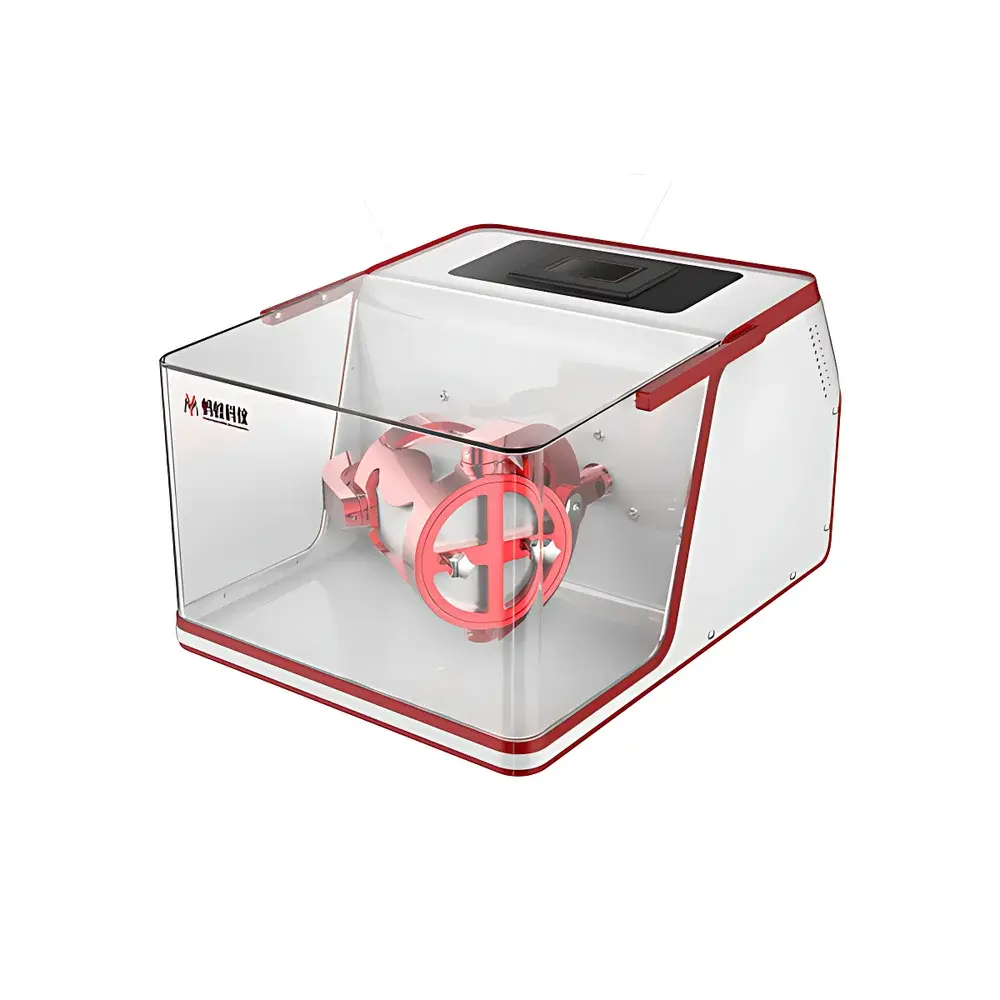
Ants Scientific Instruments AF500 Three-Dimensional Sample Mixer
| Brand | Ants Scientific Instruments |
|---|---|
| Origin | Beijing, China |
| Manufacturer Type | Authorized Distributor |
| Country of Origin | China |
| Model | AF500 |
| Price Range | USD 7,000 – 14,000 |
| Sample Types | Dry powders, granules, slurries, pastes |
| Container Volumes | 0.5 L, 1 L, 2 L (interchangeable) |
| Container Materials | Food-grade polymer, 316 stainless steel, anodized aluminum |
| Speed Range | 20–120 rpm (digital display, continuously adjustable) |
| Time Settings | 1 s – 99 h 59 min 59 s (digital, continuous adjustment for mixing, pause, and stop intervals) |
| Cycle Count | 1–20 cycles |
| Operating Modes | Forward rotation, reverse rotation, intermittent operation |
| Control Interface | Capacitive touchscreen LCD panel |
| Power Supply | 220 V AC, 50 Hz |
| Ambient Operating Conditions | 10–40 °C, 10–90% RH (non-condensing) |
| Acoustic Noise Level | <62 dB(A) |
| Compliance | CE-marked, conforms to IEC 61000-6-3 (EMC), IEC 61000-6-2 (immunity), and ISO 14644-1 Class 8 cleanroom-compatible operation |
Overview
The Ants Scientific Instruments AF500 Three-Dimensional Sample Mixer is an engineered solution for high-fidelity homogenization of heterogeneous particulate systems under fully enclosed conditions. Unlike conventional tumbling or vortex mixers that rely on uniaxial or dual-axis motion, the AF500 employs a synchronized triaxial kinematic mechanism—simultaneously rotating, translating, and inverting the sample container along orthogonal X-, Y-, and Z-axes. This motion profile generates complex laminar flow trajectories within the sealed vessel, promoting convective redistribution without inducing excessive shear or particle attrition. The system is optimized for applications requiring statistical representativeness in sampling preparation—particularly where compositional heterogeneity, density segregation, or moisture gradient effects compromise analytical reproducibility. Designed for compliance with GLP and GMP pre-analytical workflows, the AF500 supports traceable, repeatable sample conditioning prior to downstream analysis by laser diffraction, BET surface area analyzers, XRD, or elemental spectrometry.
Key Features
- Triaxial motion architecture delivering uniform spatial reorientation—eliminating dead zones and minimizing wall adhesion effects in powder beds
- Modular container system with quick-release clamping: interchangeable 0.5 L, 1 L, and 2 L vessels fabricated from USP Class VI-certified polymer, electropolished 316 stainless steel, or aerospace-grade anodized aluminum
- Digital precision control: real-time rpm feedback via optical encoder; time resolution of 1 second across all timing parameters (mix duration, pause interval, dwell time, cycle count)
- Low-inertia drive train and vibration-damped base platform ensure acoustic emissions remain below 62 dB(A) at 1 m distance—suitable for shared laboratory environments
- Capacitive touchscreen interface with multilingual firmware (English, German, French, Spanish, Chinese), password-protected parameter locking, and audit trail logging capability
- Sealed chamber design compliant with ISO 14644-1 Class 8 cleanroom standards—prevents cross-contamination and enables post-run wipe-down without disassembly
Sample Compatibility & Compliance
The AF500 accommodates dry powders (e.g., lactose monohydrate, titanium dioxide, silica fume), cohesive granules (e.g., pharmaceutical excipients, catalyst pellets), and viscous suspensions (e.g., ceramic slips, battery slurry precursors) without phase separation or sedimentation bias. Its non-contact mixing principle avoids mechanical wear debris generation—critical for trace-metal-sensitive analyses. All wet-capable vessels meet FDA 21 CFR Part 11 requirements for electronic records when paired with optional USB data export and timestamped event logs. Device certification includes CE marking per Machinery Directive 2006/42/EC and Electromagnetic Compatibility Directive 2014/30/EU. Routine performance verification aligns with ASTM D6938 (standard practice for powder blending validation) and ISO 13320:2020 (laser diffraction particle size analysis—sample dispersion guidance).
Software & Data Management
The embedded firmware supports 10 programmable method templates, each storing full parameter sets—including rotational direction sequence, ramp profiles, inter-cycle rest periods, and fail-safe auto-shutdown triggers. Optional PC connectivity via USB-C enables method synchronization, remote monitoring, and CSV-formatted export of operational metadata (start time, total runtime, actual vs. setpoint rpm variance, thermal drift compensation logs). Audit trails record user ID, timestamp, parameter changes, and emergency stop events—fully compatible with laboratory information management systems (LIMS) implementing 21 CFR Part 11-compliant electronic signatures.
Applications
- Preparation of statistically representative sub-samples from bulk powders prior to particle size distribution (PSD) analysis per ISO 13320 or USP <429>
- Homogenization of multi-component pharmaceutical blends prior to content uniformity testing (USP <905>)
- Stabilization of heterogeneous catalyst slurries for rheological characterization and coating consistency assessment
- Blending of food-grade functional ingredients (e.g., probiotics, vitamins, minerals) into carrier matrices while preserving viability and dispersion integrity
- Conditioning of environmental solid waste composites (e.g., fly ash–soil mixtures) for leaching test protocols (TCLP, SPLP)
- Material science R&D involving composite precursor mixing—e.g., polymer nanocomposites, metal-organic framework (MOF) suspensions, or conductive ink formulations
FAQ
What types of containers are certified for use with the AF500?
The system supports three validated vessel types: USP Class VI polypropylene (for general-purpose dry blending), electropolished 316 stainless steel (for abrasive or high-density materials), and hard-anodized aluminum (for lightweight, thermally sensitive samples). Each is supplied with silicone O-ring seals rated to IP65 ingress protection.
Can the AF500 be integrated into automated sample preparation lines?
Yes—via optional RS-485 Modbus RTU interface, enabling PLC-level coordination with robotic arms, weigh stations, or downstream analyzers. Integration requires configuration through the device’s extended command protocol manual.
Is validation documentation available for GMP environments?
Ants Scientific Instruments provides IQ/OQ documentation packages—including factory calibration certificates, installation checklists, operational boundary testing reports, and software verification summaries—upon request for regulated users.
How is cleaning verified between batches?
The smooth, crevice-free interior geometry of all vessels allows visual inspection and swab recovery validation per ISO 14644-1 Annex B. No lubricants or consumable gaskets are used in the drive mechanism, eliminating residue transfer risk.
Does the AF500 support variable acceleration/deceleration profiles?
No—the motor operates at constant angular velocity during active mixing phases. However, programmable pause intervals between directional reversals provide de facto kinetic energy dissipation control for fragile agglomerates.



