
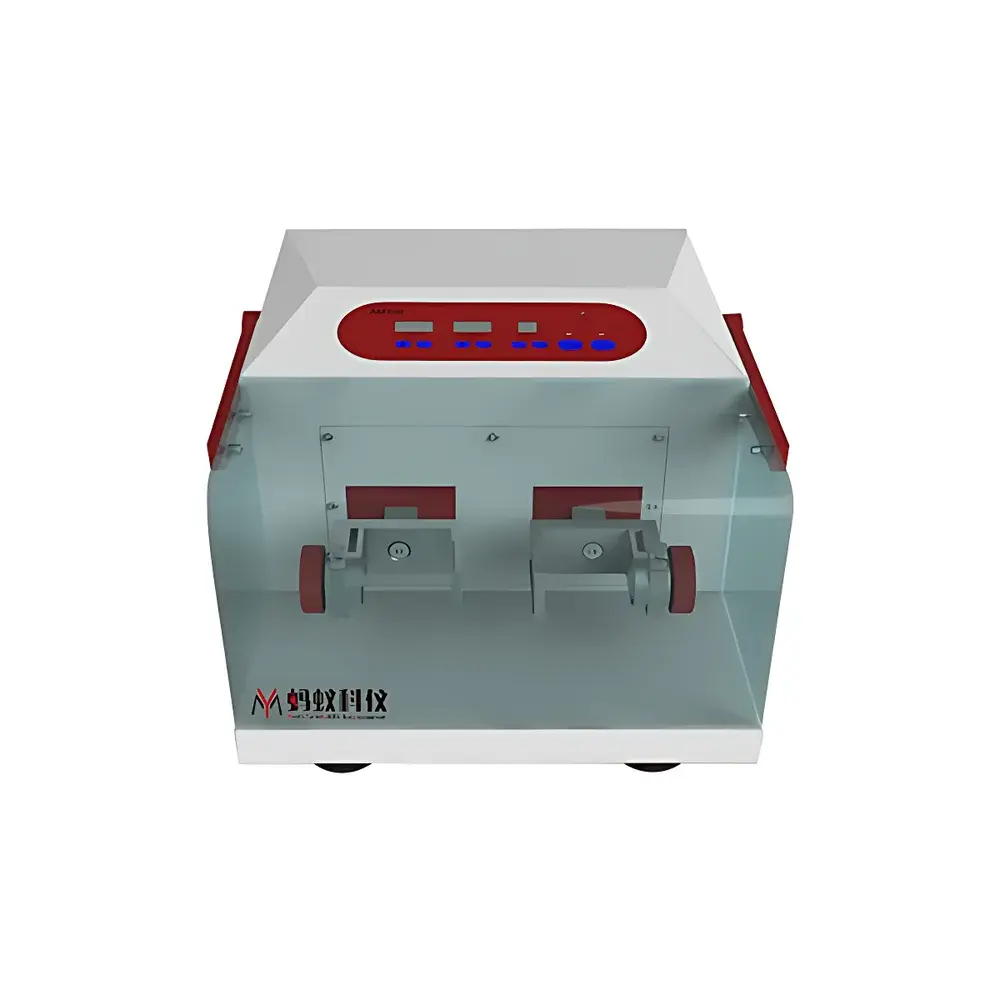
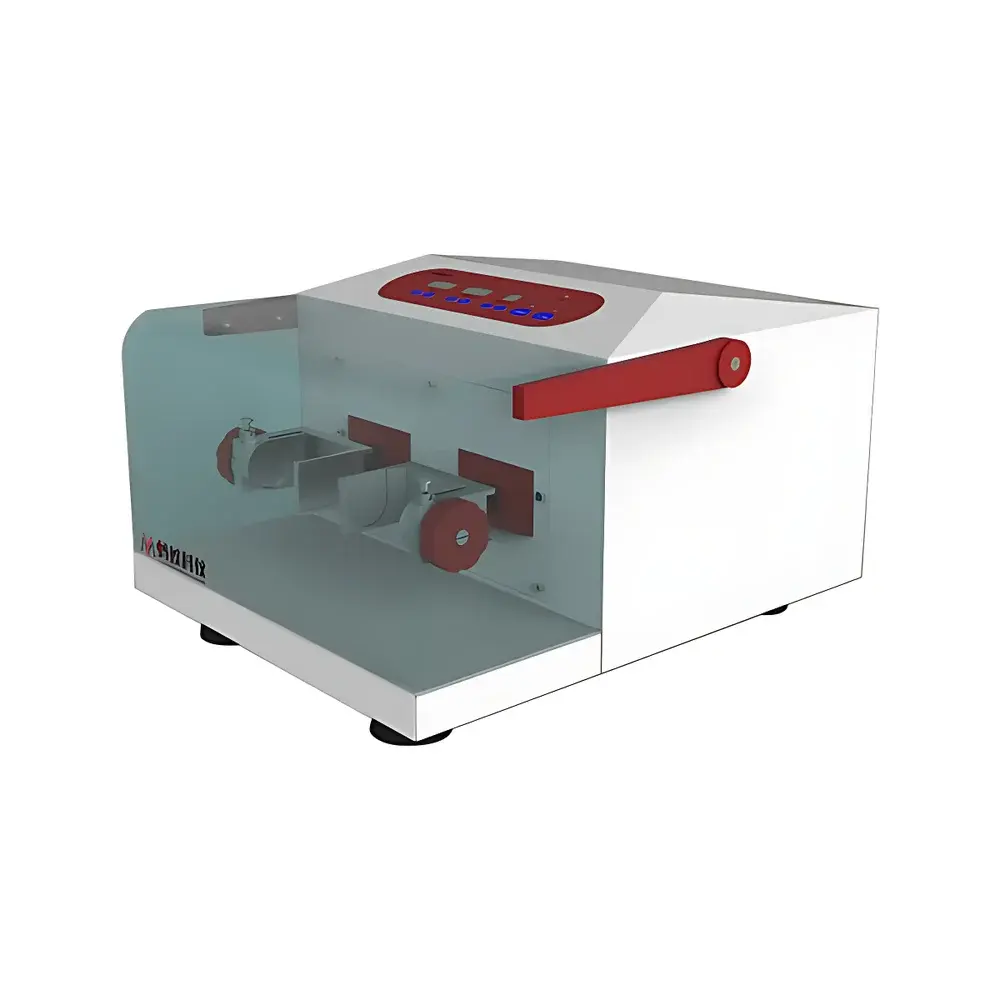
Ants Scientific Instruments AM100 High-Throughput Vibratory Ball Mill
| Brand | Ants Scientific Instruments |
|---|---|
| Origin | Beijing, China |
| Model | AM100 |
| Instrument Type | Vibratory Ball Mill |
| Sample Applicability | Soft, brittle, elastic, fibrous, and moderately hard materials |
| Feed Size | ≤15 mm |
| Final Particle Size | ≤5 µm (sub-micron achievable under optimized conditions) |
| Throughput Capacity | 6 × 100 mL per run (using multi-well adapter) |
| Vibration Frequency Range | 1–35 Hz (60–2100 rpm) |
| Grinding Time Setting | 1 s – 99 min 59 s (digitally adjustable) |
| Number of Programmable Methods | 9 |
| Dual Grinding Platforms | Yes |
| Safety Features | Electromagnetic interlock, auto-centering mechanism, mechanical safety latch |
| Grinding Vessel Options | 5–80 mL volumes |
| Adapter Configurations | Up to 96-well (1.2 mL), with PTFE, stainless steel, or aluminum construction |
| Grinding Media Diameters | 0.1–30 mm |
Overview
The Ants Scientific Instruments AM100 High-Throughput Vibratory Ball Mill is an engineered solution for rapid, reproducible sample homogenization and particle size reduction in analytical and preparative laboratory workflows. It operates on the principle of horizontal arcuate radial vibration—where grinding jars undergo controlled oscillatory motion along a circular path, inducing high-frequency inertial impacts between grinding media (balls) and sample material. This dynamic energy transfer enables efficient comminution across diverse material classes—including soft biological tissues, fibrous plant matter, brittle ceramics, and moderately hard minerals—without requiring excessive thermal input or prolonged processing times. Unlike planetary ball mills, the AM100’s dual-platform vibratory architecture delivers simultaneous, independent processing of two sample sets, significantly improving lab throughput while maintaining consistent mechanical energy input per unit mass. Its design adheres to core principles of mechanical alloying and mechanochemical activation, making it suitable not only for routine sample preparation but also for applications demanding controlled amorphization or solid-state reaction initiation.
Key Features
- Dual independent grinding platforms support parallel processing of up to 6 × 100 mL samples using high-capacity adapters—or up to 2 × 45 mL in standard jars—enabling true high-throughput operation.
- Digitally controlled vibration frequency (1–35 Hz) and time (1 s–99 min 59 s) ensure precise method reproducibility across operators and shifts.
- Nine programmable method presets allow standardized protocols for routine analyses—critical for GLP-compliant environments and inter-laboratory method transfer.
- Auto-centering mechanism and mechanical safety latch guarantee rapid, repeatable jar/adapter positioning and eliminate manual alignment errors.
- Integrated electromagnetic safety interlock prevents operation unless all grinding assemblies are fully seated and secured—meeting IEC 61000-6-2 and ISO 13857 requirements for operator protection.
- Sealed grinding vessels minimize cross-contamination risks and enable inert-atmosphere or cryogenic grinding (e.g., liquid nitrogen-cooled operations).
- Modular jar and adapter system supports application-specific configurations—from single-tube DNA/RNA extraction (96-well PTFE adapters) to heavy-metal-free soil analysis (agate or zirconia jars).
Sample Compatibility & Compliance
The AM100 accommodates a broad spectrum of sample types: soft (e.g., mammalian tissue, freeze-dried proteins), brittle (e.g., pharmaceutical tablets, glass frits), fibrous (e.g., lignocellulosic biomass), elastic (e.g., rubber compounds), and moderately hard (e.g., limestone, clays). Its compatibility with cryogenic grinding extends utility to thermolabile biomolecules and polymers. All grinding components comply with ISO 8502-12 for trace metal contamination control when using agate, zirconia, or PTFE variants—essential for environmental and clinical trace-element analysis. The instrument’s operational parameters align with ASTM E1985 (standard practice for mechanical milling of powders) and support method validation per USP and ICH Q5C guidelines for biopharmaceutical raw material characterization.
Software & Data Management
While the AM100 utilizes a dedicated digital keypad interface rather than PC-based software, its embedded controller provides full audit-trail capability: each run logs timestamp, selected method number, actual frequency/time applied, and cycle completion status. These records can be manually transcribed into LIMS or ELN systems compliant with FDA 21 CFR Part 11 when paired with electronic signature workflows. The nine stored methods facilitate SOP-driven operation in regulated QC labs—reducing variability associated with manual parameter entry and supporting ISO/IEC 17025 clause 7.2.2 on method validation and control.
Applications
- Biological sample preparation: Rapid cell lysis for genomic DNA/RNA isolation from blood, plant leaves, or microbial pellets using 96-well PTFE adapters.
- Pharmaceutical QA/QC: Uniform particle size reduction of active pharmaceutical ingredients (APIs) prior to dissolution testing or XRD analysis.
- Environmental testing: Homogenization of soil, sediment, or airborne particulate filters for heavy metal quantification by ICP-MS.
- Materials science: Mechanochemical synthesis of nanocomposites, catalyst precursors, or amorphous phases via controlled high-energy impact.
- Food safety: Representative subsampling and comminution of heterogeneous food matrices (e.g., spices, infant formula) for mycotoxin or allergen testing.
- Forensic toxicology: Efficient grinding of seized drug substances or botanical evidence for GC-MS screening.
FAQ
What is the maximum recommended feed particle size for optimal performance?
For consistent sub-5 µm output, feed material should be pre-sieved to ≤15 mm; smaller initial particle sizes (<5 mm) further reduce grinding time and improve size distribution uniformity.
Can the AM100 perform cryogenic grinding without external modifications?
Yes—the sealed grinding jars are compatible with liquid nitrogen immersion or pre-chilling; no retrofitting is required. PTFE and stainless steel jars are recommended for low-temperature use.
How does the dual-platform design affect method reproducibility?
Both platforms operate at identical frequency and amplitude settings; independent calibration ensures ≤±0.5 Hz inter-platform deviation—verified during factory acceptance testing.
Is the instrument suitable for GMP-regulated environments?
It supports GMP practices through programmable method storage, operator-accessible run logs, and mechanical safety interlocks—though full 21 CFR Part 11 compliance requires integration with validated electronic record systems.
What maintenance is required to sustain long-term precision?
Annual verification of vibration amplitude (via laser Doppler vibrometer) and torque calibration of the safety latch mechanism is recommended; no lubrication of the drive system is needed due to brushless DC motor design.
Related Products



