
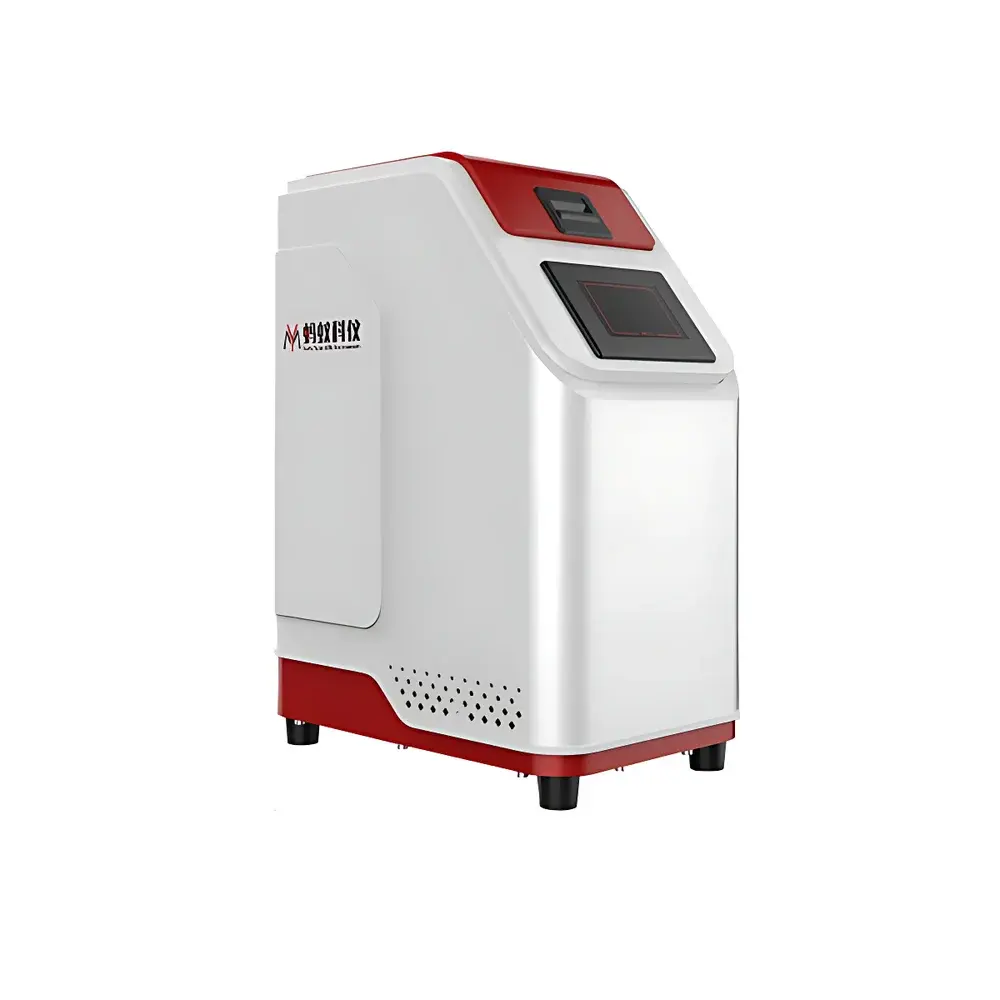
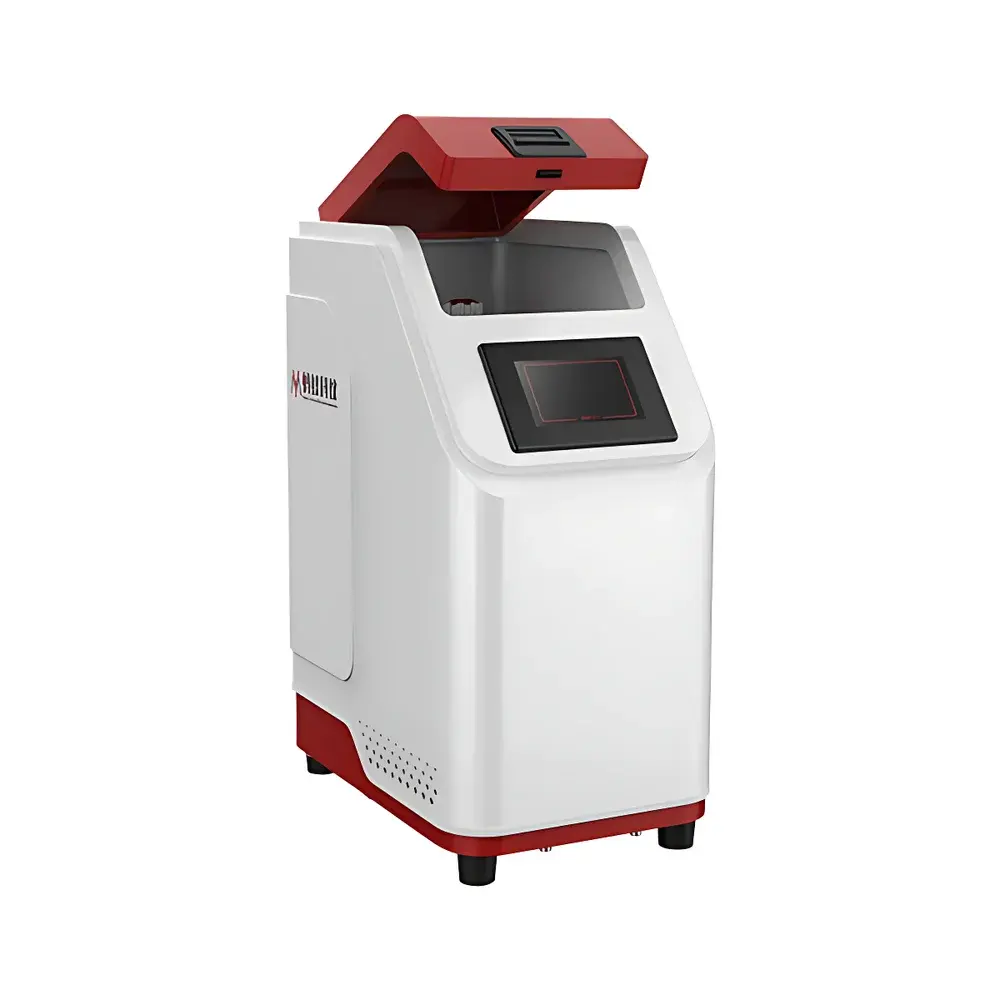
Ants Scientific Instruments AM151 High-Throughput Vibratory Ball Mill
| Brand | Ants Scientific Instruments |
|---|---|
| Origin | Beijing, China |
| Manufacturer Type | Authorized Distributor |
| Country of Origin | China |
| Model | AM151 |
| Instrument Type | Vibratory Ball Mill |
| Sample Compatibility | Soft, brittle, elastic, fibrous, and moderately hard materials |
| Feed Size | ≤15 mm |
| Final Particle Size | ≤5 µm (dependent on material properties and grinding conditions) |
| Throughput Capacity | 48 × 2 mL tubes |
| Vibration Frequency Range | 1–70 Hz |
| Grinding Time Setting | 1 s – 99 h 59 min 59 s (continuous, programmable) |
| Interval & Pause Time | 1 s – 99 min 59 s |
| Display | LCD touchscreen interface |
| Grinding Vessel Options | 5 mL, 10 mL, 25 mL |
| adapter formats | 5 mL × 12-well, 2 mL × 24-well, 2 mL × 48-well |
| Vessel Materials | Stainless steel, chrome steel, zirconia, agate, PTFE |
| Grinding Media Diameters | 0.1–30 mm |
| Auto-centering Mechanism | Yes |
| Load Monitoring | Yes |
| Parameter Storage Slots | 10 user-defined protocols |
| Safety Features | Electromagnetic interlock, mechanical safety latch, sealed vessel system |
Overview
The Ants Scientific Instruments AM151 High-Throughput Vibratory Ball Mill is an engineered solution for rapid, reproducible sample homogenization and particle size reduction in analytical and preparative laboratories. It operates on the principle of high-frequency vertical vibration—inducing intense impact, shear, and friction forces between grinding media and sample within sealed vessels. Unlike planetary or centrifugal mills, the AM151 employs a horizontal-axis vibratory motion with dual-platform synchronization, enabling simultaneous processing of two independent sample sets without cross-contamination. Its design targets applications requiring sub-10 µm particle size distribution, including genomic sample preparation, pharmaceutical formulation development, environmental soil analysis, and advanced materials dispersion. The instrument is not intended for continuous industrial milling but optimized for discrete, controlled batch processing under GLP-aligned workflows.
Key Features
- High-throughput capability: Supports up to 48 × 2 mL tubes via dedicated PTFE, stainless steel, or aluminum adapters—ideal for parallel lysis of biological tissues in DNA/RNA extraction protocols.
- Dual-mode operation: Configurable for dry grinding, wet grinding (with solvents or dispersants), and cryogenic grinding using liquid nitrogen-cooled vessels.
- Material-flexible grinding system: Interchangeable vessels in agate, zirconia, stainless steel, chrome steel, and PTFE—ensuring trace-metal-free processing for environmental and clinical samples (e.g., soil heavy metal analysis per ISO 11466 or EPA Method 6020B).
- Precision parameter control: Full digital programming of vibration frequency (1–70 Hz), total grinding time (1 s–99 h 59 min 59 s), interval cycles, and pause duration—enabling method standardization across operators and labs.
- Integrated safety architecture: Electromagnetically actuated door interlock, mechanical auto-locking clamps, real-time load monitoring, and hermetic sealing prevent accidental opening during operation and eliminate aerosol leakage.
- Compact footprint and portability: Weighing under 35 kg with integrated carrying handles, the AM151 meets IEC 61000-6-3 EMC requirements and is suitable for field-deployable analytical setups (e.g., on-site soil screening or forensic evidence processing).
- Reproducibility assurance: Automatic centering ensures consistent energy transfer across all wells; 10 programmable method slots support audit-ready SOP execution compliant with ISO/IEC 17025 documentation requirements.
Sample Compatibility & Compliance
The AM151 accommodates a broad spectrum of sample matrices—including soft biological tissues (liver, muscle), fibrous plant matter, brittle ceramics, elastic polymers, and moderately hard minerals. Feed size must not exceed 15 mm; optimal results are achieved when pre-crushed to <5 mm. Final particle size typically reaches 1–5 µm depending on dwell time, media density, and matrix toughness—validated by laser diffraction (ISO 13320) or electron microscopy post-processing. All vessel materials comply with USP Class VI biocompatibility standards (for PTFE and zirconia) and FDA 21 CFR 177.1550 (for food-contact-grade stainless steel). The instrument’s closed-system design meets ISO 15195:2018 requirements for contamination-controlled sample preparation in clinical diagnostics.
Software & Data Management
The AM151 features an embedded LCD touchscreen interface with no external PC dependency. All operational parameters—including frequency, time, intervals, and active protocol ID—are logged internally with timestamps and stored in non-volatile memory. Each of the 10 user-programmable methods includes metadata fields for operator ID, sample ID, and QC notes—supporting traceability in regulated environments. While the device does not offer network connectivity or remote access, its parameter export function (via USB-A port) enables CSV-formatted logs compatible with LIMS integration and 21 CFR Part 11-compliant electronic record systems when paired with validated third-party data capture software.
Applications
- Molecular biology: High-yield cell disruption for nucleic acid isolation from mammalian, plant, and microbial sources—compatible with commercial kits (e.g., Qiagen DNeasy, Zymo Quick-DNA).
- Environmental testing: Homogenization of contaminated soils and sediments prior to elemental analysis (ICP-MS, AAS) per ISO 11464 and ASTM D7574.
- Pharmaceutical R&D: Milling of active pharmaceutical ingredients (APIs) and excipients for dissolution testing and solid-state characterization (XRD, DSC).
- Materials science: Dispersion of nanocellulose, graphene oxide, or metal oxides into polymer matrices for composite development.
- Forensic toxicology: Uniform grinding of hair, nail, or tissue specimens prior to LC-MS/MS quantification of drugs and metabolites.
- Food safety: Reduction of heterogeneous food matrices (spices, grains, dairy powders) for mycotoxin or pesticide residue analysis (AOAC 2007.01).
FAQ
What is the maximum recommended feed size for optimal grinding efficiency?
The AM151 accepts feed particles up to 15 mm; however, pre-sizing to ≤5 mm significantly improves throughput and final particle uniformity.
Can the instrument be used for cryogenic grinding without modification?
Yes—the standard vessel holders accommodate liquid nitrogen-cooled grinding jars; PTFE and stainless steel adapters are rated for sustained operation at –196°C.
Is cross-contamination prevented between wells in multi-tube adapters?
Each well is physically isolated by robust gasketed seals; independent vibration coupling eliminates lateral energy transfer, verified by dye diffusion tests per ISO 21528-1.
Does the AM151 meet regulatory requirements for GMP or CLIA laboratories?
While the device itself is not GMP-certified, its programmable parameters, audit trail logging, and material compliance enable validation per FDA guidance for laboratory equipment used in regulated bioanalytical workflows.
How often should the grinding media be replaced?
Media wear depends on sample hardness and cumulative runtime; zirconia balls show minimal attrition after 500+ cycles with soft organic matrices—monitor via visual inspection or mass loss ≥0.5% per 100 h.



