
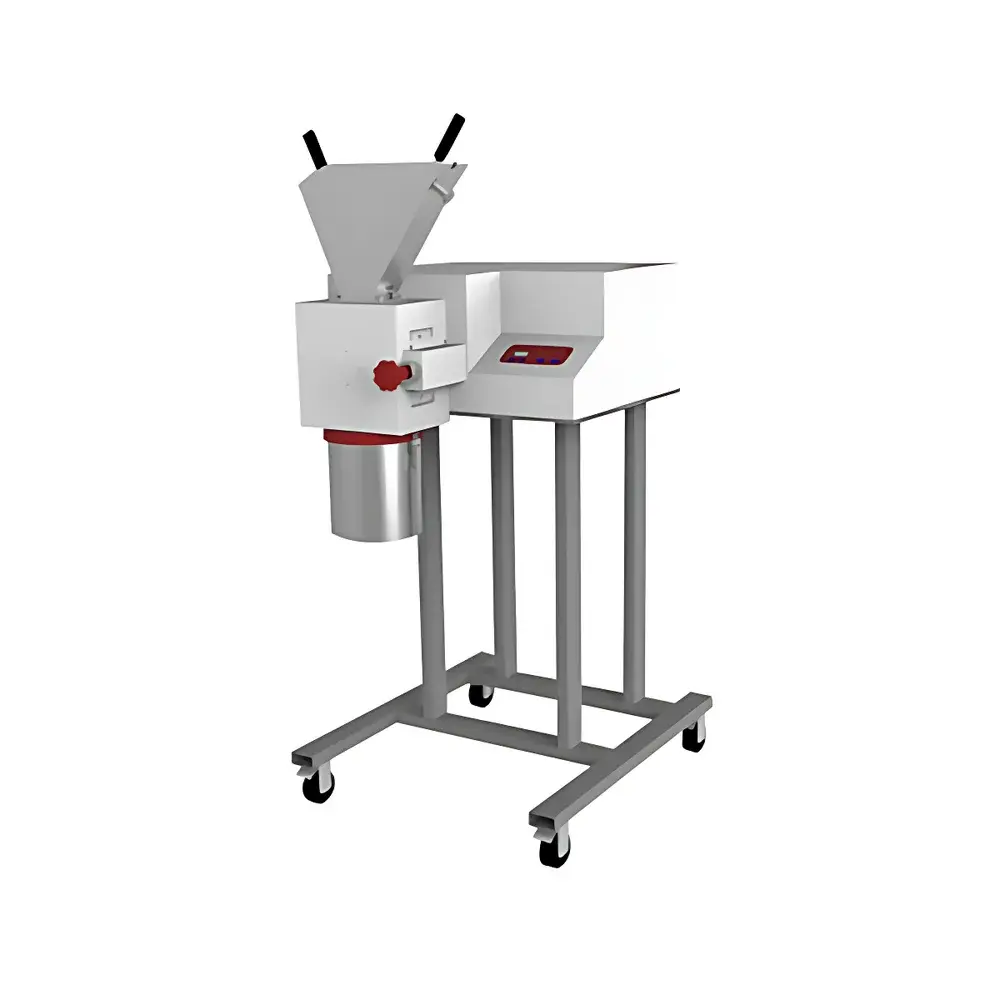
Ants Scientific Instruments AM300 Cutting-Grinding Mill
| Brand | Ants Scientific Instruments |
|---|---|
| Origin | Beijing, China |
| Manufacturer Type | Authorized Distributor |
| Product Category | Domestic |
| Model | AM300 |
| Instrument Type | Cutting Grinder |
| Sample Compatibility | Soft, Semi-Hard, Tough, Elastic & Fibrous Materials |
| Feed Size | 70 × 90 mm |
| Output Particle Size Range | 100–250 µm (adjustable via interchangeable screens) |
| Throughput | 80 L/h |
| Motor Power | 3 kW |
| Speed Range | 100–3000 rpm (infinitely variable) |
| Screen Options | Trapezoidal apertures (0.2, 0.25, 0.5, 1.0, 1.5 mm) |
| Rotor Types | 3-tooth parallel or 24-tooth continuous stainless steel / tungsten carbide / heavy-metal-free alloy rotors |
| Safety | Interlocked chamber door, dynamic motor braking, dust-shielded hopper, full-access grinding chamber |
| Optional Accessories | Spiral feeder, cyclone separator (0.5–30 L), multiple collection vessels (0.5–30 L) |
Overview
The Ants Scientific Instruments AM300 Cutting-Grinding Mill is an industrial-grade, high-throughput laboratory grinder engineered for reproducible size reduction of heterogeneous organic and polymeric materials. It operates on the principle of high-shear cutting—where rotational kinetic energy from a three-phase 3 kW motor is transferred to a precision-machined rotor, generating controlled mechanical stress between rotating blades, fixed cutting edges, and a replaceable perforated screen. This shear-dominated comminution mechanism avoids excessive compression or impact forces, minimizing thermal degradation and preserving sample integrity—particularly critical for thermolabile botanicals, pharmaceutical excipients, polymer blends, and biological tissues. Designed for routine QC/QA workflows in regulated environments, the AM300 delivers consistent particle size distributions (PSD) across batch loads up to 80 L/h, supporting method transfer from R&D to production-scale sample preparation.
Key Features
- Infinitely variable speed control (100–3000 rpm) enables precise optimization of shear rate for diverse material rheologies—from fibrous straw to elastomeric rubber compounds.
- Modular rotor–screen architecture: Interchangeable 3-tooth parallel or 24-tooth continuous rotors paired with stainless steel, tungsten carbide, or heavy-metal-free alloy screens (trapezoidal: 0.2–1.5 mm; round/square: 2.0–20.0 mm) ensures application-specific wear resistance and contamination control.
- Thermally managed grinding chamber: Low heat generation during operation—validated by infrared surface temperature monitoring (<45 °C under continuous 80 L/h load)—supports processing of heat-sensitive APIs, enzymes, and volatile plant extracts.
- Full-access chamber design with interlocked safety door: Prevents operation when open; facilitates rapid cleaning and visual inspection of rotor geometry and screen integrity—critical for cross-contamination prevention in multi-product labs.
- Digital load monitoring on control panel: Real-time torque feedback allows operators to dynamically adjust feed rate via manual hopper or optional spiral feeder, preventing overload and ensuring stable PSD output.
- Integrated dynamic braking system: Halts rotor rotation within <3 seconds after shutdown—reducing turnaround time between batches and enhancing operational safety during maintenance.
Sample Compatibility & Compliance
The AM300 accommodates soft, semi-hard, tough, elastic, and fibrous matrices without pre-sizing—accepting feed pieces up to 70 × 90 mm. Validated applications include agricultural biomass (straw, corn stover), polymer granules (PP, PET, TPE), environmental waste streams (e-waste plastics, leather scraps), animal feed pellets, dental composites, and dried bone tissue. Its mechanical design conforms to IEC 61000-6-2 (EMC immunity) and IEC 61000-6-4 (EMC emissions). While not intrinsically rated for ATEX zones, it supports GLP/GMP-aligned documentation protocols—including audit trails for speed settings, runtime, and screen/rotor change logs—when integrated with compliant LIMS or ELN systems per FDA 21 CFR Part 11 requirements.
Software & Data Management
The AM300 features a microprocessor-based digital controller with LED display showing real-time RPM, load percentage, and cumulative operating hours. Though standalone, its analog output (0–10 V) and RS-485 interface enable integration with SCADA platforms or custom LabVIEW-based data acquisition systems for automated parameter logging. All operational parameters are manually recorded per batch; for fully traceable workflows, users may pair the instrument with third-party electronic lab notebooks that support structured metadata capture (e.g., screen ID, rotor type, feed mass, ambient RH/T).
Applications
- Agriculture & Bioenergy: Homogenization of lignocellulosic feedstocks prior to enzymatic hydrolysis or pyrolysis analysis.
- Pharmaceuticals: Pre-formulation grinding of tablets, excipients, and herbal powders under controlled thermal conditions.
- Materials Science: Size reduction of recycled polymers and composites for DSC, TGA, or rheological characterization.
- Environmental Testing: Preparation of heterogeneous waste samples (e.g., WEEE fractions) for heavy metal leaching assays (EPA Method 1311).
- Food & Feed QA: Standardized milling of animal feed pellets or spice blends for proximate analysis and mycotoxin screening.
FAQ
What types of materials are incompatible with the AM300?
Highly abrasive minerals (e.g., quartz sand), wet or sticky slurries, and metallic alloys exceeding HB 300 hardness are not recommended—these may accelerate wear or cause rotor imbalance.
Can the AM300 be used for cryogenic grinding?
No—it lacks integrated cooling ports or LN₂ compatibility; however, pre-chilled samples (≤ –20 °C) may be processed briefly if thermal stability permits.
Is screen calibration traceable to national standards?
Screen apertures are manufactured to ISO 3310-1 tolerances (±5% for ≤1 mm openings); calibration certificates are available upon request for GMP audits.
How often should the rotor and screen be replaced?
Under typical use (8 h/day, soft-to-medium materials), stainless steel rotors last ≥12 months; tungsten carbide variants exceed 24 months. Screen replacement frequency depends on abrasiveness—monitor aperture deformation visually or via laser micrometer every 200 h.
Does the AM300 meet UL or CE safety certification?
It carries CE marking per Machinery Directive 2006/42/EC and EMC Directive 2014/30/EU; UL listing is not held but design complies with UL 61010-1 general safety requirements for lab equipment.



