
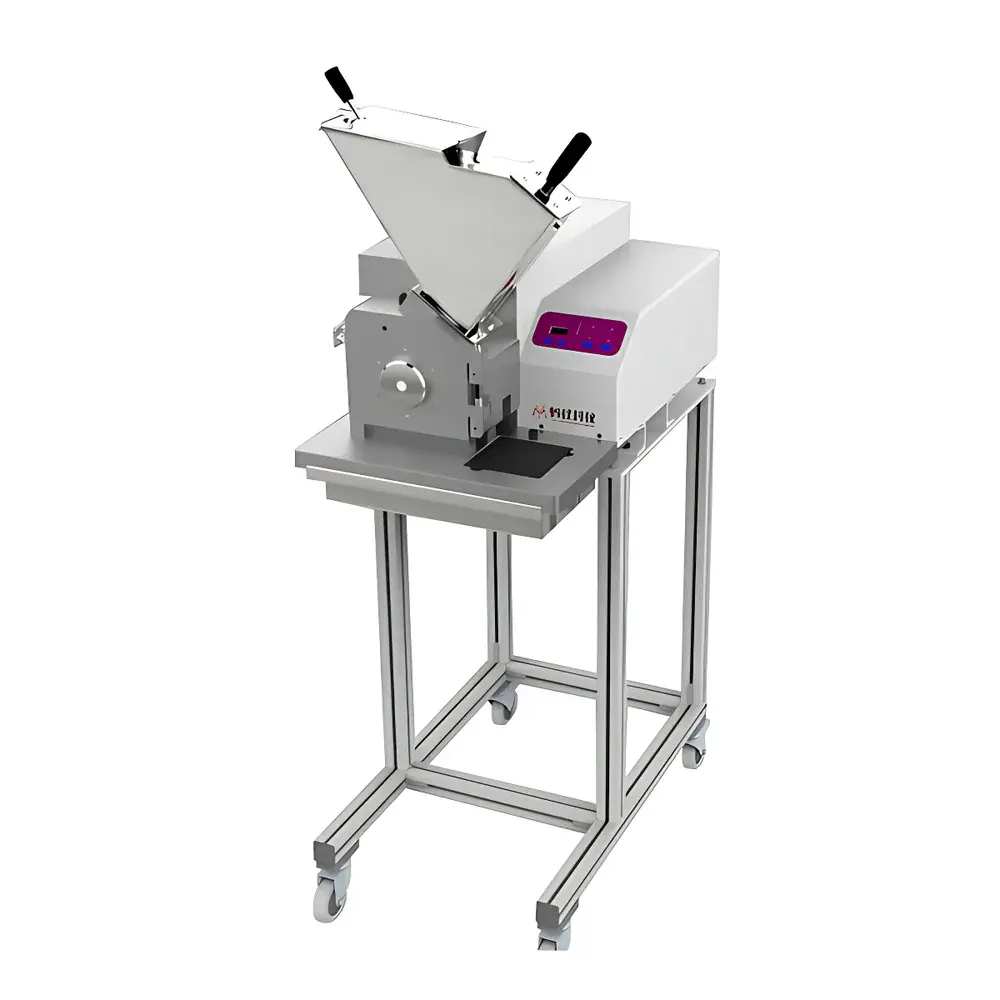
Ants Scientific Instruments AM300S Cutting Grinder
| Brand | Ants Scientific Instruments |
|---|---|
| Origin | Beijing, China |
| Manufacturer Type | Authorized Distributor |
| Product Category | Domestic |
| Model | AM300S |
| Instrument Type | Cutting Mill |
| Sample Applicability | Soft, Medium-Hard, Tough, Elastic & Fibrous Materials |
| Output Particle Size | 100–250 µm (adjustable via sieve selection) |
| Maximum Feed Size | 70 × 90 mm |
| Throughput Capacity | 80 L/h |
| Speed Range | 100–3000 rpm (infinitely variable) |
| Motor Power | 3 kW (three-phase) |
| Safety Features | Interlocked chamber door, electromagnetic brake, dust-shielded hopper, full-access grinding chamber |
| Optional Accessories | Spiral feeder, cyclone separator (0.5–30 L), stainless steel / tungsten carbide / low-metal-contamination rotors, interchangeable sieves (trapezoidal: 0.2–1.5 mm |
| round/square | 2.0–20.0 mm) |
Overview
The Ants Scientific Instruments AM300S Cutting Grinder is an industrial-grade, high-throughput laboratory cutting mill engineered for reproducible size reduction of heterogeneous organic and synthetic materials. It operates on the principle of high-shear mechanical comminution—where rotating cutters engage stationary cutting edges and a precision-machined sieve to fracture samples via controlled shearing, tearing, and impact forces. Unlike impact or planetary mills, the AM300S maintains low thermal load during operation, making it particularly suitable for thermolabile biological tissues, polymers, pharmaceutical excipients, and plant-based feedstocks where structural integrity or chemical stability must be preserved post-grinding. Its robust aluminum-frame modular architecture supports rapid reconfiguration for diverse throughput demands—from benchtop R&D to pilot-scale batch processing—while maintaining compliance with fundamental safety and ergonomics expectations in ISO/IEC 17025-accredited laboratories.
Key Features
- 3 kW three-phase motor delivering high torque at low-to-mid rotational speeds (100–3000 rpm), enabling consistent performance across variable sample densities and viscoelasticities.
- Interchangeable rotor configurations—including 3-tooth parallel and 24-tooth continuous-cut designs—optimized for fibrous, elastic, or cohesive matrices.
- Modular sieve system with 11 standard aperture options: trapezoidal holes (0.2, 0.25, 0.5, 1.0, 1.5 mm) and round/square openings (2.0–20.0 mm), all fabricated from corrosion-resistant stainless steel or custom alloys.
- Plug-and-play rotor and sieve assembly allowing tool-free disassembly within <60 seconds for cleaning, cross-contamination mitigation, or method transfer validation.
- Digital speed control panel with real-time load monitoring—enabling operators to dynamically adjust feed rate based on amperage feedback and prevent motor overload or incomplete comminution.
- Integrated electromagnetic braking system ensuring full rotor stop within ≤1.2 seconds after shutdown, critical for routine maintenance and emergency response protocols.
- Full-opening grinding chamber with interlocked safety latch: power is automatically disabled when the chamber door is unlatched, satisfying IEC 61000-6-2 and EN 60204-1 requirements for machinery safety.
- Dust-suppressed hopper design with integrated baffle and sealed gasketing minimizes airborne particulate release during loading, supporting OSHA PEL and EU Directive 2004/37/EC exposure limits.
Sample Compatibility & Compliance
The AM300S accommodates a broad spectrum of non-hazardous solid matrices including but not limited to: botanical tissues (leaves, stems, seeds), animal-derived substrates (bone, dental composites, freeze-dried tissue), polymeric compounds (PP, PE, PET, silicone elastomers), composite waste streams (e-waste plastics, automotive trim, textile blends), and agro-industrial feedstocks (straw, hay, spent grain). It is not intended for explosive, pyrophoric, or highly abrasive mineral ores (e.g., quartz >7 Mohs). While not certified to ATEX or IECEx standards, its grounding design, non-sparking rotor options (tungsten carbide), and absence of internal ignition sources permit safe use in general-purpose lab environments under local fire safety codes. Documentation supports traceability per GLP Annex 3 and GMP Annex 15 for equipment qualification (IQ/OQ/PQ), including calibration records for speed sensor linearity (±0.5% FS) and load cell accuracy (±1.0% FS).
Software & Data Management
The AM300S operates as a standalone instrument with no embedded firmware or network interface. All operational parameters—speed setpoint, runtime, and real-time load—are displayed via a backlit LED interface with tactile push-button controls. For regulated environments requiring audit trails, external data loggers (e.g., Omega OM-DAQPRO-5300) may be connected via analog 4–20 mA output (motor load signal) and digital pulse output (rotational counter). Method files—including sieve ID, rotor type, speed profile, and feed duration—are maintained manually in laboratory notebooks or LIMS-integrated electronic records. The system complies with FDA 21 CFR Part 11 when paired with validated electronic signature workflows and access-controlled documentation systems.
Applications
- Agricultural science: Homogenization of cereal grains, forage grasses, and lignocellulosic biomass prior to enzymatic hydrolysis or NIR spectroscopic analysis.
- Pharmaceutical development: Pre-formulation particle size distribution studies of herbal extracts, tablet granules, and biodegradable polymer carriers.
- Environmental testing: Preparation of heterogeneous waste samples (e.g., WEEE fractions, municipal solid fuel pellets) for heavy metal leaching assays (TCLP, SPLP) and calorific value determination (ASTM D5865).
- Food & feed analytics: Reduction of heterogeneous pet food kibbles, animal feed pellets, and spice blends to achieve representative sub-sampling for proximate analysis (AOAC 985.29, 991.42).
- Materials engineering: Size conditioning of recycled polymer flakes prior to melt flow index (MFI) testing (ISO 1133) or rheological characterization.
FAQ
What types of materials are incompatible with the AM300S?
Materials exceeding 70 × 90 mm in maximum dimension, highly abrasive minerals (e.g., alumina, silicon carbide), or substances classified as flammable liquids, gases, or self-reactive solids per UN GHS criteria should not be processed.
Can the AM300S be validated for GMP-compliant production environments?
Yes—its mechanical design, repeatability (RSD <3% for replicate 500 g batches), and documentation-ready operational logs support IQ/OQ execution per ASTM E2500 and ISPE Good Practice Guide for Equipment Qualification.
Is the cyclone separator compatible with all collection vessel sizes?
The optional cyclone separator (0.5–30 L) interfaces directly with all standard collection containers (0.5 L, 3 L, 5 L, 30 L) via standardized conical flange connections (DIN 11851).
How often should the rotor and sieve be replaced under routine use?
Under typical daily operation (≤4 h/day, soft-to-medium hardness samples), stainless steel rotors last ≥12 months; tungsten carbide variants exceed 24 months. Sieves require replacement only upon visible deformation or aperture wear exceeding ±5% of nominal diameter.
Does the AM300S meet CE marking requirements?
The instrument conforms to the essential health and safety requirements of the EU Machinery Directive 2006/42/EC and Electromagnetic Compatibility Directive 2014/30/EU, with technical documentation available upon request for end-user CE self-declaration.



