
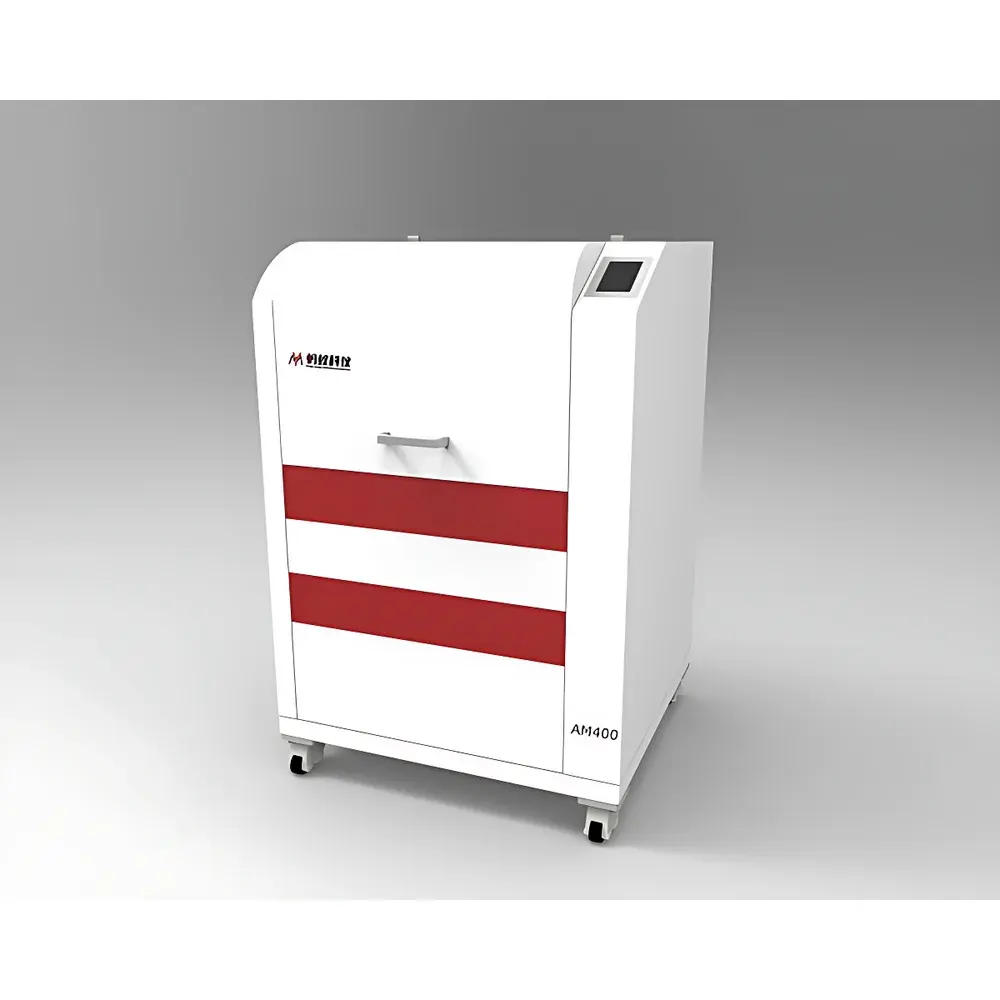
Ants Scientific Instruments AM402 Planetary Ball Mill
| Brand | Ants Scientific Instruments |
|---|---|
| Origin | Beijing, China |
| Manufacturer Type | Authorized Distributor |
| Country of Origin | China |
| Model | AM402 |
| Instrument Type | Planetary Ball Mill |
| Sample Suitability | Hard, brittle, tough, and medium-hard materials |
| Feed Size | ≤15 mm |
| Final Particle Size | ≤1 µm (dry grinding), down to <100 nm (wet grinding or extended milling) |
| Batch Capacity | 4 × 220 mL |
| Jar Volume Range | 50–500 mL |
| Rotation Speed | Up to 650 rpm (sun wheel) |
| Programmable Parameters | 10 user-defined protocols with bidirectional rotation, pause intervals, and cooling cycles |
| Safety Features | Motor-interlocked lid safety lock, overtemperature protection, automatic ventilation system |
| Compliance | Designed per ISO 17025 laboratory environment requirements |
Overview
The Ants Scientific Instruments AM402 Planetary Ball Mill is an engineered high-energy grinding system based on the principle of planetary motion—where grinding jars rotate eccentrically around a central sun wheel while simultaneously rotating on their own axes. This dual rotational motion generates intense centrifugal and Coriolis forces, resulting in highly efficient impact, shear, and frictional energy transfer between grinding media and sample material. The AM402 is specifically designed for demanding applications in advanced materials research, including nanomaterial synthesis, mechanical alloying, solid-state reaction initiation, and colloidal dispersion preparation. Its robust architecture supports continuous operation under controlled thermal conditions, making it suitable for reproducible, scalable sample preparation in academic, industrial R&D, and quality control laboratories.
Key Features
- High-energy planetary kinematics with programmable rotation speed up to 650 rpm (sun wheel), enabling acceleration forces exceeding 30 g for rapid size reduction.
- Bidirectional rotation mode with adjustable forward/reverse timing and customizable pause intervals to minimize heat accumulation and prevent particle agglomeration.
- Integrated automatic ventilation system actively circulates ambient air through the grinding chamber during operation, maintaining stable thermal profiles across extended milling durations.
- 10-user protocol memory with timestamped parameter storage—including speed, duration, direction sequence, pause duration, and cooling cycles—supporting audit-ready method traceability.
- Four-position jar holder accommodating simultaneous processing of up to four 220 mL grinding jars, each independently secured with motor-interlocked safety latches compliant with IEC 61000-6-2 EMC standards.
- Modular jar compatibility: standard offerings include stainless steel, tungsten carbide, agate, zirconia, polyethylene, and PTFE-lined vessels (50–500 mL), enabling chemically inert, low-contamination, or cryogenic milling configurations.
Sample Compatibility & Compliance
The AM402 accommodates a broad spectrum of inorganic and organic solids—including oxides, metals, alloys, ceramics, polymers, pharmaceutical actives, and geological specimens—provided feed particles are ≤15 mm. Dry grinding routinely achieves median particle sizes below 1 µm; wet grinding with optimized dispersants and extended cycles yields sub-100 nm distributions, verified by laser diffraction (ISO 13320) or TEM analysis. All mechanical components conform to RoHS Directive 2011/65/EU. Electrical design meets CE marking requirements (EN 61000-6-3, EN 61000-6-4). The instrument’s parameter logging capability supports alignment with GLP/GMP documentation frameworks and FDA 21 CFR Part 11-compliant data integrity practices when paired with validated third-party LIMS integration.
Software & Data Management
The AM402 operates via an embedded microcontroller interface with tactile keypad and LCD display. While no proprietary PC software is bundled, all operational parameters—including start/stop timestamps, total runtime, direction transitions, and pause events—are logged internally with non-volatile memory retention. Export-ready CSV logs can be retrieved via USB port for integration into laboratory information management systems (LIMS) or statistical process control (SPC) platforms. Optional RS-485 communication module enables remote monitoring and synchronized operation within automated sample prep workflows.
Applications
- Mechanical alloying of immiscible metal systems (e.g., Al–Fe, Cu–Ti) for metastable phase synthesis.
- Nanoparticle production from bulk precursors (e.g., TiO₂, SiC, Fe₃O₄) via top-down attrition.
- Homogenization of composite powders prior to sintering or additive manufacturing feedstock qualification.
- Cell disruption and extraction enhancement for botanical or microbial samples in analytical chemistry.
- Preparation of ultrafine catalyst supports and electrode materials for battery and fuel cell research.
- Standardized sample comminution for XRD, SEM-EDS, and BET surface area analysis per ASTM C117 and ISO 13322-1.
FAQ
What is the maximum recommended continuous run time for the AM402?
Under standard ambient conditions (20–25°C) and with active ventilation enabled, the AM402 supports uninterrupted operation for up to 96 hours—subject to thermal monitoring and periodic jar inspection.
Can the AM402 perform cryogenic milling?
Yes, when equipped with stainless steel or tungsten carbide jars pre-cooled with liquid nitrogen (LN₂) or dry ice/acetone baths, provided external condensation is managed and jar seals remain intact.
Is the instrument compatible with hazardous or reactive samples?
Only when using sealed, pressure-rated jars (e.g., hardened steel with O-ring gaskets) and operated inside a certified fume hood or glovebox; inert gas purging (Ar/N₂) is strongly advised for pyrophoric or oxidation-sensitive materials.
How is calibration and performance verification performed?
Routine verification uses certified reference materials (e.g., NIST SRM 1977 silica powder); particle size distribution is confirmed via laser diffraction (ISO 13320) or sedimentation analysis (ASTM D1894). No factory calibration certificate is supplied, but users may document repeatability per ISO/IEC 17025 Annex A.3.
Does the AM402 meet regulatory requirements for pharmaceutical development?
While not GMP-certified as a standalone unit, its programmable parameters, audit trail functionality, and material-of-construction options support compliance with ICH Q5D and USP <1119> guidelines for raw material processing in early-phase formulation studies.
Related Products



