
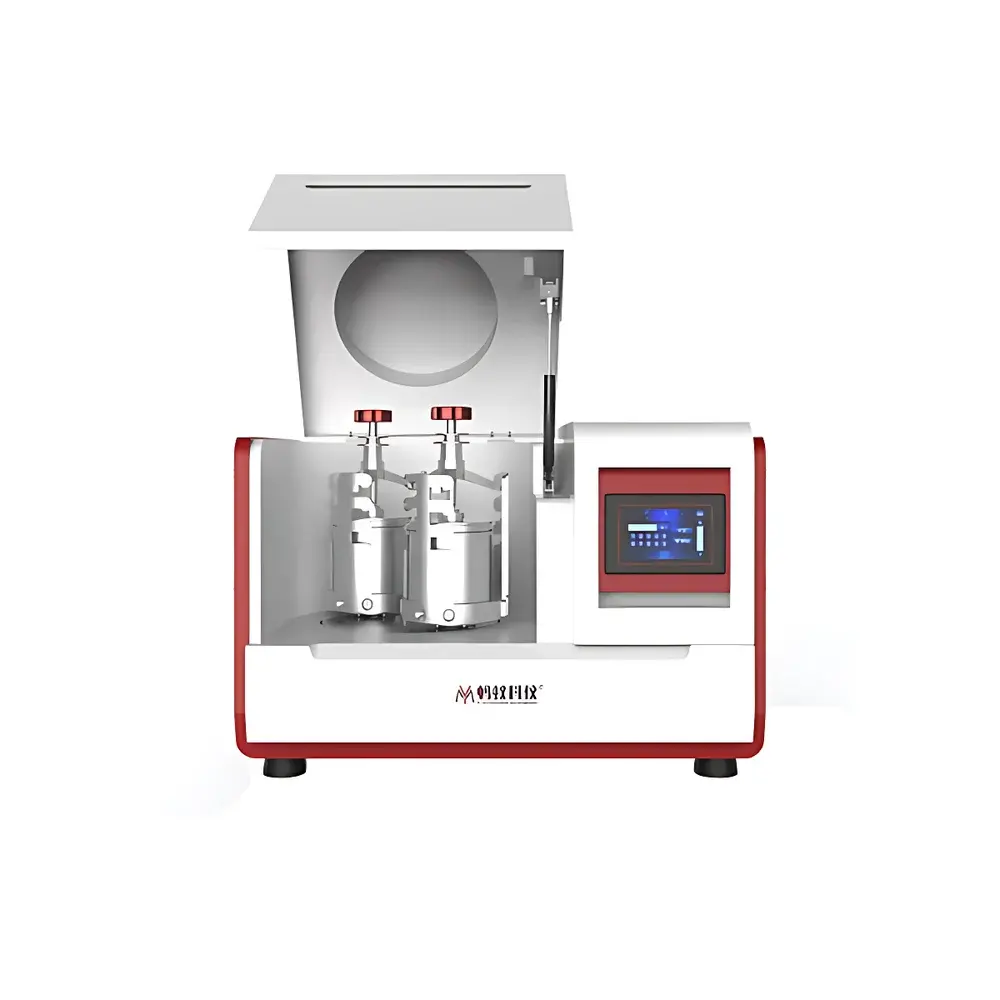
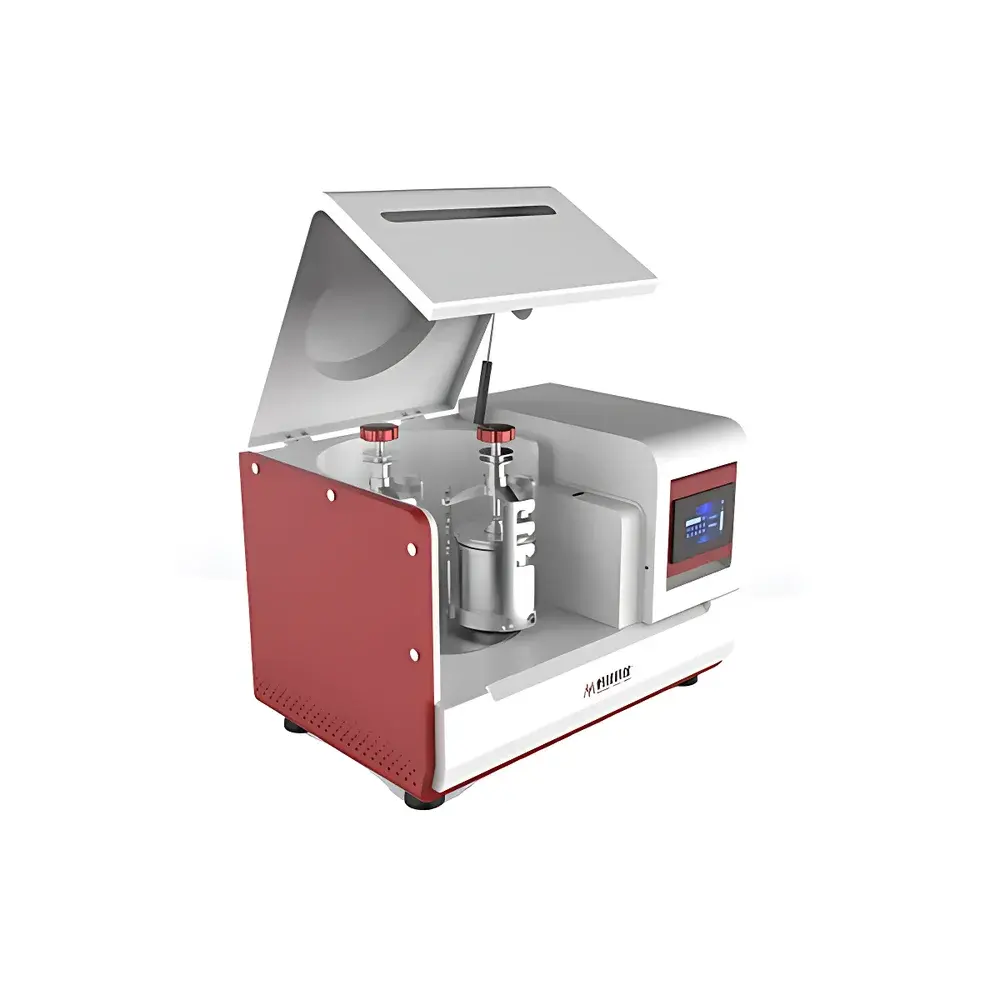
Ants Scientific Instruments AM420 Planetary Ball Mill
| Brand | Ants Scientific Instruments |
|---|---|
| Origin | Beijing, China |
| Manufacturer Type | Authorized Distributor |
| Country of Origin | China |
| Model | AM420 |
| Instrument Type | Planetary Ball Mill |
| Sample Suitability | Hard, brittle, tough, soft and medium-hard materials |
| Feed Size | < 15 mm |
| Final Particle Size | < 1 µm (dry grinding), < 0.1 µm (wet colloidal grinding) |
| Batch Capacity | 2 × 220 mL |
| Sun Wheel Speed | 100–650 rpm |
| Speed Ratio | 1:−2 |
| Grinding Jar Volume Options | 50–500 mL |
| Jar Materials | Hardened steel, stainless steel, tungsten carbide, agate, sintered corundum, zirconia |
| Max. Grinding Time | 99 h 59 min 59 s |
| Programmable Segments | 2 independent time/speed segments |
| Memory Slots | 10 parameter sets |
| Safety Lock | Integrated mechanical interlock |
| Cooling | Automatic ventilation system |
| Display | Rotatable LCD touchscreen interface |
Overview
The Ants Scientific Instruments AM420 Planetary Ball Mill is a high-energy, dual-station laboratory mill engineered for reproducible, scalable particle size reduction across diverse material classes—including hard metals, brittle ceramics, polymeric composites, and biological matrices. Its operation follows the fundamental principle of planetary motion: two grinding jars rotate on individual axes while simultaneously revolving in the opposite direction around a central sun wheel. This dual rotational motion generates centrifugal accelerations up to 65×g, inducing intense impact, shear, and friction forces between grinding media and sample particles. The resulting mechanical energy input enables consistent sub-micron comminution (<1 µm) under dry conditions and colloidal-level dispersion (<0.1 µm) in wet grinding configurations—making the AM420 suitable for nanomaterial synthesis, mechanochemical alloying, and high-integrity sample preparation for XRD, SEM, and BET analysis.
Key Features
- Dual independent grinding stations with synchronized yet counter-rotating motion for parallel processing of two samples or comparative method development
- Programmable two-stage grinding protocol: each segment supports independent speed (100–650 rpm), duration (1 s to 99 h 59 min 59 s), direction (forward/reverse), and pause intervals—optimized for multi-phase materials or staged activation protocols
- Rotatable 7-inch capacitive touchscreen display with ergonomic tilt adjustment; full graphical interface eliminates physical buttons and supports intuitive parameter entry, real-time status monitoring, and error diagnostics
- Integrated safety interlock system: automatic power cutoff when lid is opened during operation, coupled with reinforced jar clamping and vibration-dampened base architecture
- Active ventilation module maintains thermal stability during extended runs (>8 h), mitigating heat-induced phase transformation or polymer degradation
- 10-user-programmable memory slots with timestamped parameter recall—fully compatible with GLP-compliant documentation workflows
- Modular jar compatibility: accepts 50–500 mL vessels in six chemically inert and wear-resistant materials (stainless steel, hardened steel, tungsten carbide, agate, sintered corundum, and yttria-stabilized zirconia)
- Adjustable grinding media selection: spherical balls ranging from 0.1 mm to 30 mm diameter, enabling precise control over impact energy density and shear-to-impact ratio
Sample Compatibility & Compliance
The AM420 accommodates heterogeneous feedstock with initial particle sizes up to 15 mm, including metallic alloys, oxide ceramics, geological aggregates, pharmaceutical excipients, and freeze-dried biological tissues. Its mechanical design conforms to IEC 61000-6-2 (EMC immunity) and IEC 61000-6-4 (EMC emission) standards. While not certified to ISO/IEC 17025 as a standalone testing instrument, its programmability, audit-trail-capable parameter storage, and repeatable energy input profile support method validation per ASTM E2906 (Standard Guide for Mechanical Alloying and Milling), ISO 13320 (Laser Diffraction Particle Size Analysis), and USP (Particle Size Distribution). For regulated environments, the device operates within GMP-aligned workflows when paired with validated SOPs and electronic lab notebook (ELN) integration.
Software & Data Management
The AM420 embeds firmware supporting traceable parameter logging—including start/stop timestamps, actual vs. set rpm, total operational cycles, and thermal sensor feedback (optional external probe). All 10 stored methods are exportable via USB port in CSV format for integration into LIMS or statistical process control platforms. No proprietary software installation is required; configuration and monitoring occur exclusively through the onboard interface. Audit trail functionality meets minimum requirements for FDA 21 CFR Part 11 compliance when used in conjunction with institutional electronic signature policies and secure user access controls.
Applications
- Nanoparticle synthesis via top-down mechanical attrition (e.g., TiO₂, Fe₃O₄, graphene oxide exfoliation)
- Mechanochemical synthesis of metal–organic frameworks (MOFs) and solid-state battery cathode precursors
- Homogenization of heterogeneous catalysts prior to BET surface area and pore size analysis
- Preparation of ultrafine reference materials for interlaboratory proficiency testing
- Grinding of cementitious binders and mineral admixtures for particle size distribution mapping (ASTM C150/C563)
- Routine QC milling of polymer blends and composite fillers prior to rheological or DSC characterization
- Environmental sample preparation: soil, sediment, and fly ash digestion matrix homogenization for heavy metal leaching assays (TCLP, SPLP)
FAQ
What is the maximum continuous operating time per cycle?
The AM420 supports uninterrupted grinding for up to 99 hours, 59 minutes, and 59 seconds per program segment, with automatic thermal management ensuring stable performance across multi-day syntheses.
Can the AM420 be used for cryogenic milling?
The base unit is not equipped with integrated cooling; however, liquid nitrogen-compatible grinding jars (e.g., stainless steel or hardened steel) may be used with external cryo-manifolds—subject to user-developed safety protocols and jar integrity verification.
Is remote monitoring or network connectivity supported?
No Ethernet, Wi-Fi, or Bluetooth interfaces are built into the AM420. Data transfer occurs solely via USB flash drive; remote supervision requires third-party industrial IoT gateways interfaced at the facility level.
How does the 1:−2 speed ratio affect grinding efficiency?
This fixed kinematic ratio ensures optimal energy transfer: the jar rotates at twice the angular velocity of the sun wheel but in the opposing direction, maximizing relative velocity between grinding media and sample—critical for achieving uniform submicron distributions without excessive amorphization.
Are calibration certificates or metrological traceability documents available?
As a mechanical process instrument—not a measurement device—the AM420 does not require NIST-traceable calibration. However, users may validate rotational speed accuracy using external tachometers per ISO 27887, and jar volume tolerances comply with ISO 4787 volumetric glassware specifications where applicable.



