
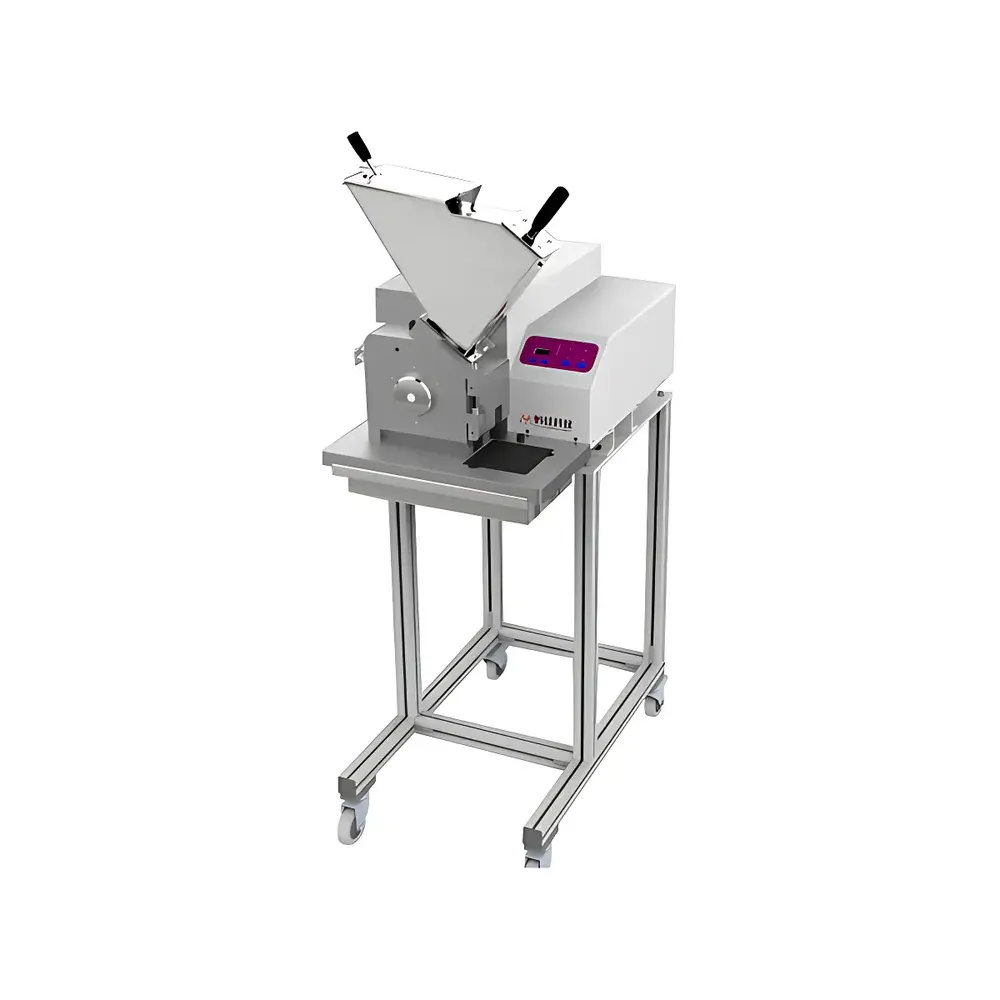
Ants Scientific Instruments AM600 Cryogenic Food Grinder
| Brand | Ants Scientific Instruments |
|---|---|
| Origin | Beijing, China |
| Model | AM600 |
| Grinding Principle | High-Speed Rotational Shear |
| Sample Type Compatibility | Dry, Elastic, Fibrous, Soft, Medium-Hard, High-Moisture, High-Oil, High-Fat Samples |
| Feed Size | 10–50 mm |
| Final Particle Size | 300 µm (typical), adjustable down to 10 µm with optimized protocol |
| Batch Capacity | 100–750 mL |
| Grinding Cup Volume | 1 L |
| Cup Materials | Stainless Steel / Polypropylene (PP) / Polycarbonate (PC) |
| Speed Range | 1,000–12,000 rpm |
| Grinding Time | 1 s–5 min (programmable) |
| Operation Modes | Continuous, Intermittent, Reverse Rotation |
| Pre-Set Methods | 9 user-configurable protocols |
| Motor Power | 1500 W |
| Dimensions (W×H×D) | 350 × 450 × 400 mm |
| Net Weight | 13 kg |
| Compliance | Designed for GLP-compliant food testing labs |
Overview
The Ants Scientific Instruments AM600 Cryogenic Food Grinder is a high-torque, variable-speed laboratory grinder engineered for reproducible, low-temperature homogenization of challenging biological and food matrices. It operates on the principle of high-shear rotational cutting—where a precision-balanced rotating blade assembly mounted coaxially at the base of a sealed grinding cup subjects samples to controlled mechanical impact, frictional attrition, and fluid shear forces. Unlike planetary ball mills or bead-based homogenizers, the AM600 delivers rapid particle size reduction without introducing significant thermal load—especially when used with pre-chilled cups or cryogenic accessories—making it suitable for preserving heat-labile analytes (e.g., lipids, enzymes, volatile flavor compounds) during sample preparation. Its architecture integrates an industrial-grade 1500 W brushless motor, microprocessor-controlled speed regulation (1,000–12,000 rpm), and programmable timing logic to support method standardization across QC, R&D, and regulatory testing environments.
Key Features
- Variable-speed control (1,000–12,000 rpm) with real-time digital display and ±50 rpm stability under load
- Interchangeable grinding cups (1 L capacity) in three chemically resistant materials: medical-grade stainless steel (for high-fat meats), autoclavable polypropylene (for routine food matrices), and impact-resistant polycarbonate (for visual process monitoring)
- Dual-edge rotor blades: blunt-edged for fibrous or elastic tissues (e.g., muscle fibers, tendons); sharp-edged for soft, high-moisture samples (e.g., fresh fish, frozen berries)
- Programmable operation modes—including forward rotation, intermittent pulsing, and reverse rotation—to prevent sample caking and improve dispersion uniformity
- Nine recallable method presets with independent time/speed/rotation-mode parameters, supporting SOP-driven workflows
- Cryogenic compatibility: accommodates liquid nitrogen-cooled cups and optional insulated sleeves for sub-zero grinding of frozen meat blocks (−20 °C to −80 °C)
- Integrated safety interlock system: automatic shutdown upon cup misalignment or lid disengagement
Sample Compatibility & Compliance
The AM600 processes heterogeneous organic materials commonly encountered in food safety, nutritional analysis, and veterinary diagnostics—including raw/frozen meat cuts, poultry carcasses, fish fillets, oilseeds (soybean, rapeseed), cereal grains, feed pellets, and composite ready-to-eat meals. It meets mechanical performance expectations outlined in ISO 6425 (food grinding equipment specifications), ASTM D5630 (standard test method for particle size distribution of ground food products), and USP (grinding uniformity requirements for pharmaceutical excipients and nutraceuticals). When operated within validated parameters (e.g., ≤3 min grinding at 8,000 rpm with pre-chilled stainless-steel cup), the system achieves batch-to-batch coefficient of variation (CV) ≤4.2% for particle size distribution (measured by laser diffraction per ISO 13320). All cup materials comply with FDA 21 CFR §177.1520 (PP), §177.1550 (PC), and §177.1555 (stainless steel) for food-contact applications.
Software & Data Management
The AM600 operates via an embedded microcontroller interface with no external PC dependency. All method parameters—including speed setpoint, duration, rotation direction sequence, and pause intervals—are stored locally in non-volatile memory with timestamped execution logs. While the instrument does not feature Ethernet or USB data export, its operational history supports manual audit trail generation for GLP/GMP documentation. For laboratories requiring electronic records, integration with LIMS platforms is achievable through optional RS-232 serial output (ASCII protocol), enabling logging of start/stop timestamps, total runtime, and active method ID into centralized QA databases. Firmware updates are performed via SD card slot, ensuring traceability per FDA 21 CFR Part 11 Annex A guidelines for software validation.
Applications
- Routine homogenization of meat samples prior to pathogen detection (e.g., Salmonella, Listeria monocytogenes) per ISO 6579-1 and USDA-FSIS MLG protocols
- Preparation of representative subsamples from bulk frozen poultry or beef for proximate analysis (moisture, protein, fat, ash) per AOAC 985.23 and ISO 1442
- Particle size reduction of oilseeds and feed ingredients for near-infrared (NIR) calibration model development
- Cryogenic grinding of lipid-rich tissues (e.g., salmon belly, pork adipose) to minimize oxidation prior to GC-FID fatty acid profiling
- High-throughput tissue disruption for DNA/RNA extraction from animal-derived food products (e.g., species identification assays)
- Standardized comminution of composite food products (e.g., sausages, pet foods) for heavy metal screening by ICP-MS
FAQ
Can the AM600 grind frozen meat blocks directly without thawing?
Yes—when equipped with a pre-chilled stainless-steel cup and operated at speeds ≥6,000 rpm for ≤90 seconds, the AM600 effectively fragments frozen meat (−18 °C) into a homogeneous slurry with median particle size <300 µm.
Is the grinding cup autoclavable?
Polypropylene (PP) and stainless-steel cups are fully autoclavable (121 °C, 20 min); polycarbonate (PC) cups are not recommended for steam sterilization due to thermal deformation risk.
What maintenance is required for long-term reliability?
Blade sharpening is not required—the hardened stainless-steel or titanium rotors maintain edge integrity for ≥500 grinding cycles under standard operating conditions; routine cleaning with ethanol/water and visual inspection of cup sealing gaskets every 100 uses is advised.
Does the AM600 meet FDA 21 CFR Part 11 requirements?
As a standalone instrument with local parameter storage and timestamped execution logs, it supports Part 11 compliance when integrated into a validated procedural framework—including written SOPs, operator training records, and periodic performance verification using NIST-traceable reference standards.
Can grinding parameters be exported for regulatory submission?
Method settings and run logs are viewable on-device and can be manually transcribed; for automated export, RS-232 serial output enables integration with third-party data acquisition systems compliant with ALCOA+ principles.



