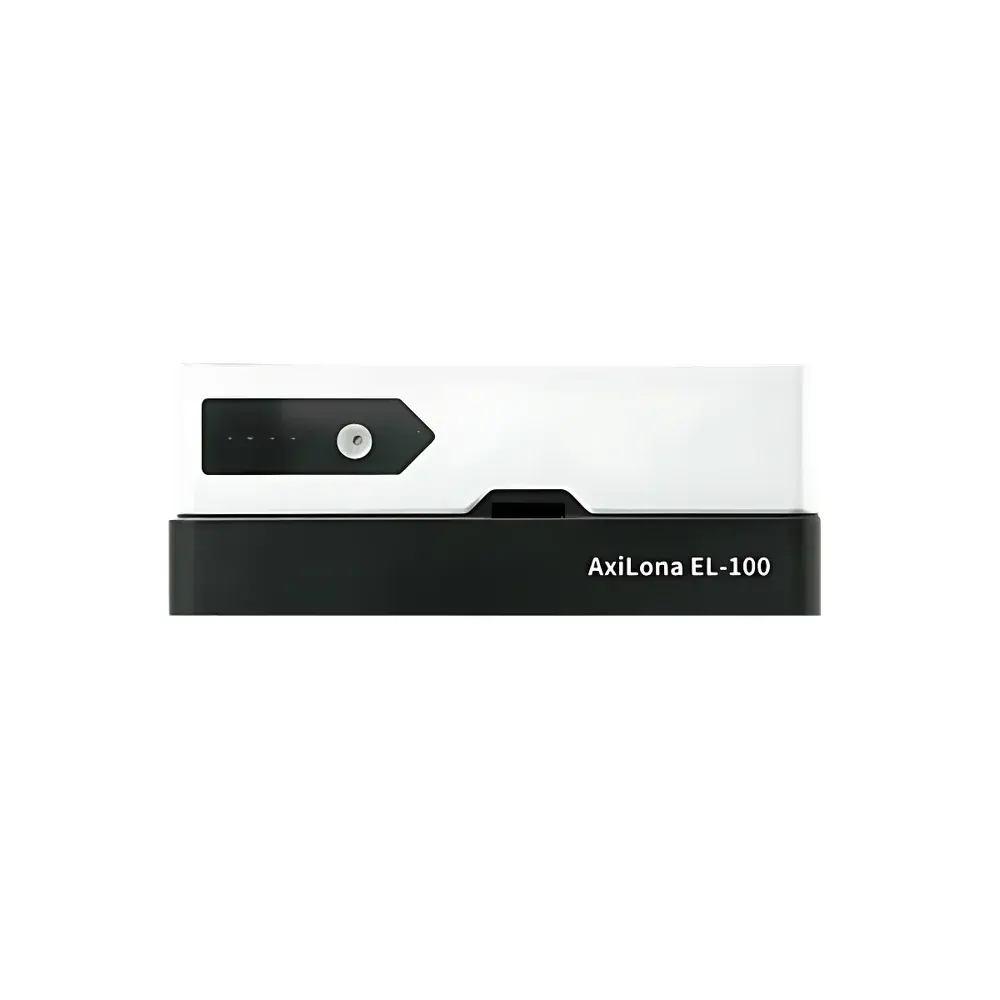
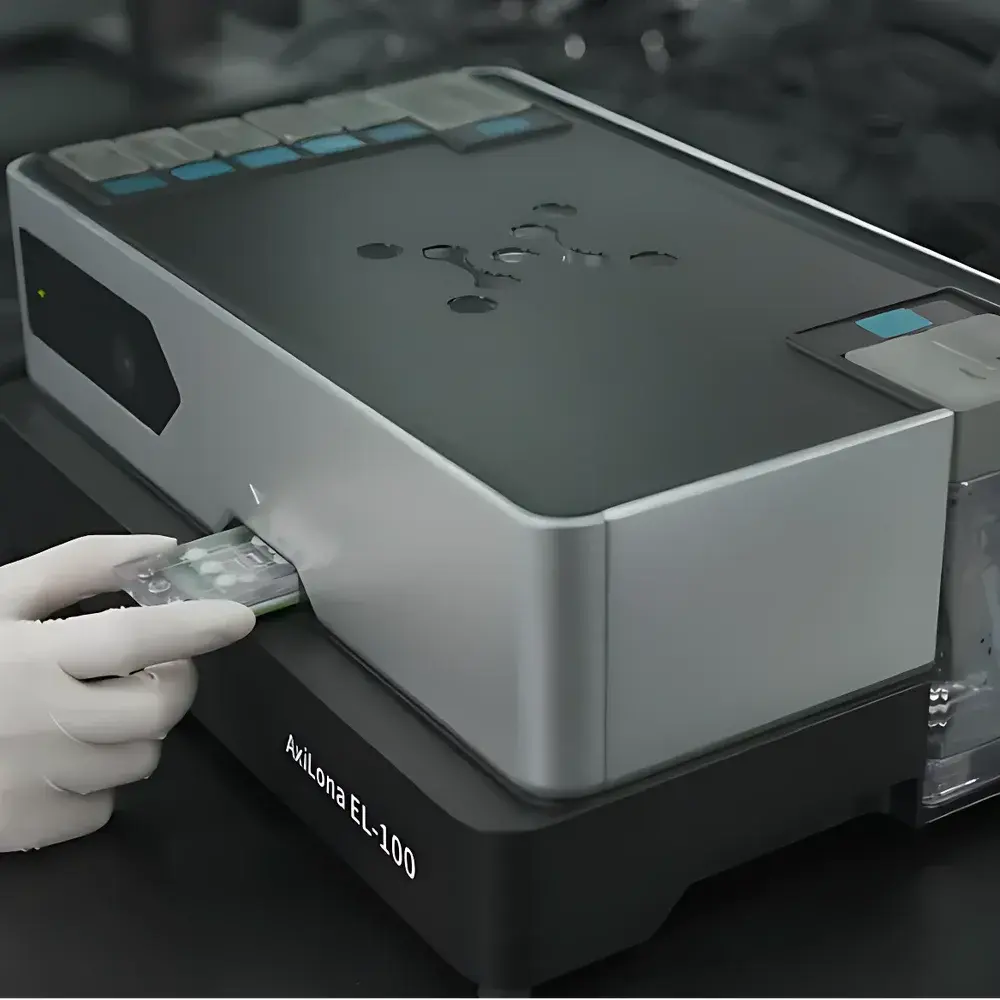
Anxuyuan AxiLona EL-100 Microarray-Based Electrochemical Nucleic Acid Hybridization Analyzer
| Brand | Anxuyuan |
|---|---|
| Origin | Guangdong, China |
| Manufacturer Type | Original Equipment Manufacturer (OEM) |
| Regional Classification | Domestic (PRC) |
| Model | AxiLona EL-100 |
| Instrument Category | Nucleic Acid Hybridization Analyzer |
| Pricing | USD 84,000 (FOB Guangdong) |
Overview
The Anxuyuan AxiLona EL-100 is a benchtop microarray-based electrochemical nucleic acid hybridization analyzer engineered for high-throughput, multiplexed detection of DNA and RNA targets without optical labeling. Unlike fluorescence-dependent platforms—such as conventional microarray scanners or real-time PCR systems—the EL-100 employs a proprietary electrochemical transduction architecture that converts hybridization events directly into quantifiable current signals via redox-active reporter probes immobilized on functionalized gold electrode arrays. This label-free, enzyme-free detection modality eliminates photobleaching, background autofluorescence, and costly fluorophore conjugation steps, enabling reproducible quantification across >500 discrete genomic loci in a single run with sub-femtomolar sensitivity. Designed for core laboratories, clinical molecular diagnostics units, and translational research facilities, the EL-100 bridges the performance gap between low-plex PCR assays and high-cost, long-turnaround metagenomic next-generation sequencing (mNGS), delivering targeted multiplex profiling in under 3.5 hours—including sample prep, hybridization, washing, and signal readout.
Key Features
- Electrochemical microarray platform with 16 independently addressable gold electrode channels, each supporting up to 64 probe spots (1,024 total features per chip)
- Integrated thermal control system maintaining hybridization temperature stability within ±0.3 °C across 37–65 °C range
- Automated fluidic handling module with precise reagent dispensing (±2 µL accuracy), sequential washing, and waste management
- Onboard potentiostat with 100 fA current resolution and linear sweep voltammetry (LSV) / differential pulse voltammetry (DPV) acquisition modes
- Modular cartridge design: disposable, pre-patterned microarray chips with covalently immobilized oligonucleotide probes (custom or catalog panels available)
- CE-IVD compliant hardware architecture; meets IEC 61010-1 safety standards for laboratory equipment
Sample Compatibility & Compliance
The EL-100 accepts purified nucleic acid extracts from diverse biological matrices—including plasma, serum, bronchoalveolar lavage fluid (BALF), formalin-fixed paraffin-embedded (FFPE) tissue lysates, and bacterial cultures—following standard extraction protocols (e.g., QIAamp DNA/RNA kits). Input requirements are 5–50 ng total RNA or DNA per assay. All assay cartridges undergo rigorous lot-release testing per ISO 13485:2016 quality management standards. The system supports audit-ready operation under GLP and clinical laboratory regulatory frameworks: full electronic log retention, user-access controls, and configurable audit trails align with FDA 21 CFR Part 11 requirements for electronic records and signatures. Assay validation data packages—including limit of detection (LoD), precision (within-run and between-run CV ≤ 8.2%), and cross-reactivity profiles—are provided per CLSI EP17-A2 and EP05-A3 guidelines.
Software & Data Management
Control and analysis are managed through AxiLona Studio v3.2—a Windows-based application with dual-mode operation (guided workflow for routine testing; advanced mode for method development). Raw voltammograms are processed using baseline-corrected peak integration algorithms, followed by normalization against internal reference probes and calibration curves derived from serial dilutions of synthetic oligonucleotide standards. Output includes quantitative target concentration (copies/µL), z-score–based outlier detection, hierarchical clustering heatmaps, and exportable .csv/.xlsx reports compatible with LIMS integration (HL7 v2.5 and ASTM E1384-compliant metadata tagging). Software updates follow a documented change control process; version history, patch notes, and cybersecurity hardening logs are maintained for regulatory inspection readiness.
Applications
- Targeted pathogen panels: simultaneous detection of antimicrobial resistance (AMR) genes, viral variants (e.g., SARS-CoV-2 spike mutations), and fungal/bacterial species in respiratory or bloodstream infections
- Oncology biomarker profiling: multiplexed assessment of fusion transcripts (e.g., ALK, ROS1, RET), hotspot SNVs, and methylation markers from liquid biopsy cfDNA
- Gene expression screening: low-input transcript quantification in rare cell populations (e.g., CTCs, PBMC subsets) without amplification bias
- Food safety and environmental monitoring: rapid identification of foodborne pathogens (Listeria, Salmonella) and waterborne viruses in field-deployable configurations
- Research use only (RUO) applications: CRISPR guide efficiency validation, aptamer binding kinetics, and SNP genotyping in population genetics studies
FAQ
What types of nucleic acid modifications are compatible with the EL-100?
The system supports unmodified DNA and RNA, as well as common backbone modifications (e.g., phosphorothioates, 2′-O-methyl), but does not accommodate heavily modified analogs such as locked nucleic acids (LNAs) without prior empirical validation.
Can the EL-100 be integrated into automated sample preparation workflows?
Yes—via standardized RS-232 and Ethernet interfaces, the instrument supports bidirectional handshake protocols with third-party liquid handlers (e.g., Hamilton STAR, Tecan Fluent) for walk-away operation.
Is assay development support available for custom probe sets?
Anxuyuan provides end-to-end assay co-development services including probe design, chip fabrication, analytical validation, and CLIA/CAP documentation support under NDA-protected collaboration agreements.
What is the shelf life and storage condition for unused microarray cartridges?
Cartridges retain full performance for 12 months when stored desiccated at –20 °C; no cold-chain shipping required for domestic distribution.
Does the EL-100 meet regulatory requirements for clinical diagnostic use outside China?
The platform holds CE marking for IVDR Class C in vitro diagnostic use in the EU; FDA 510(k) clearance and PMDA approval pathways are actively underway as of Q2 2024.