
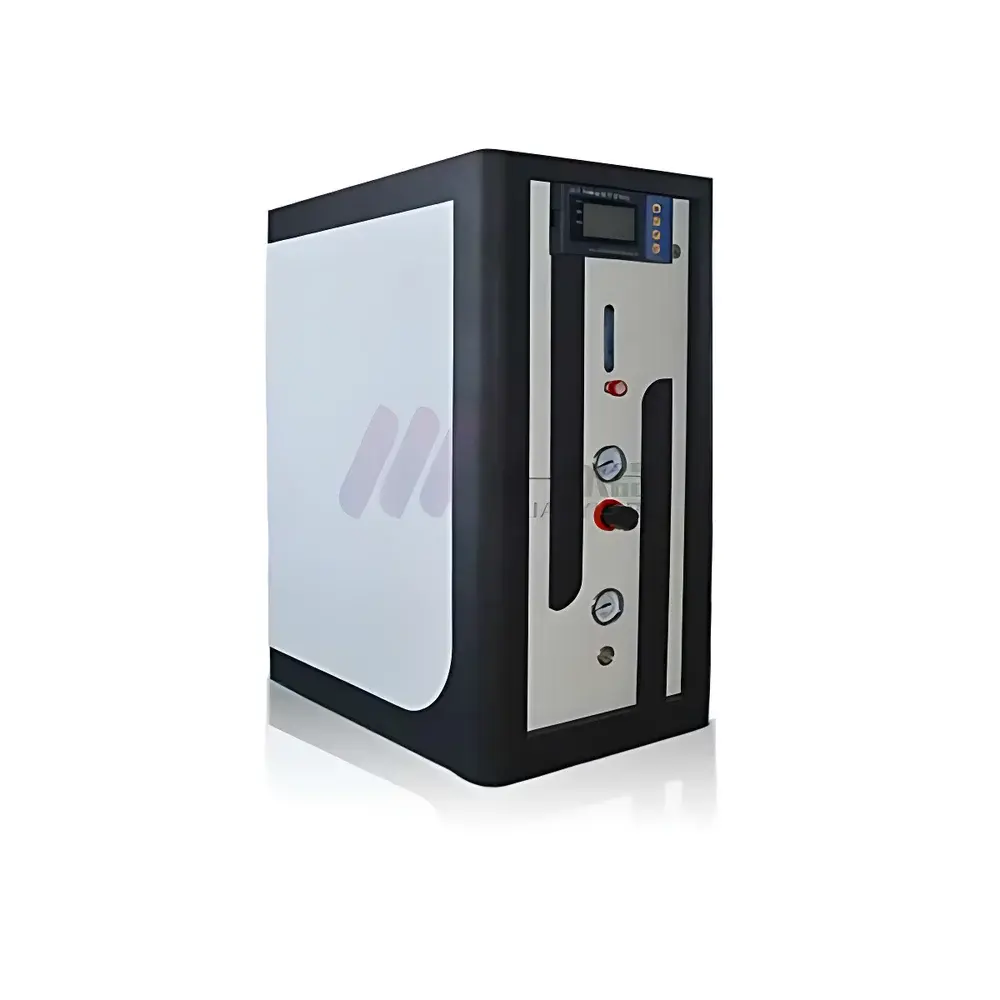
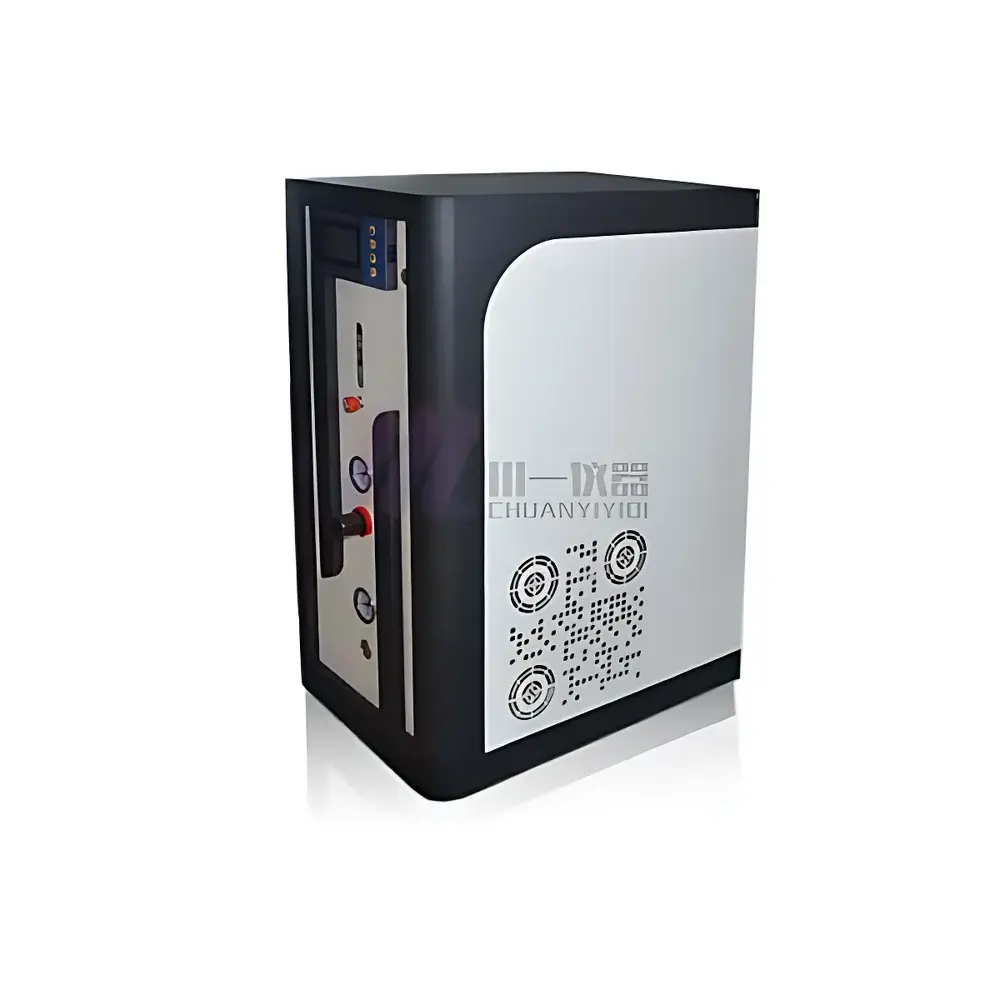
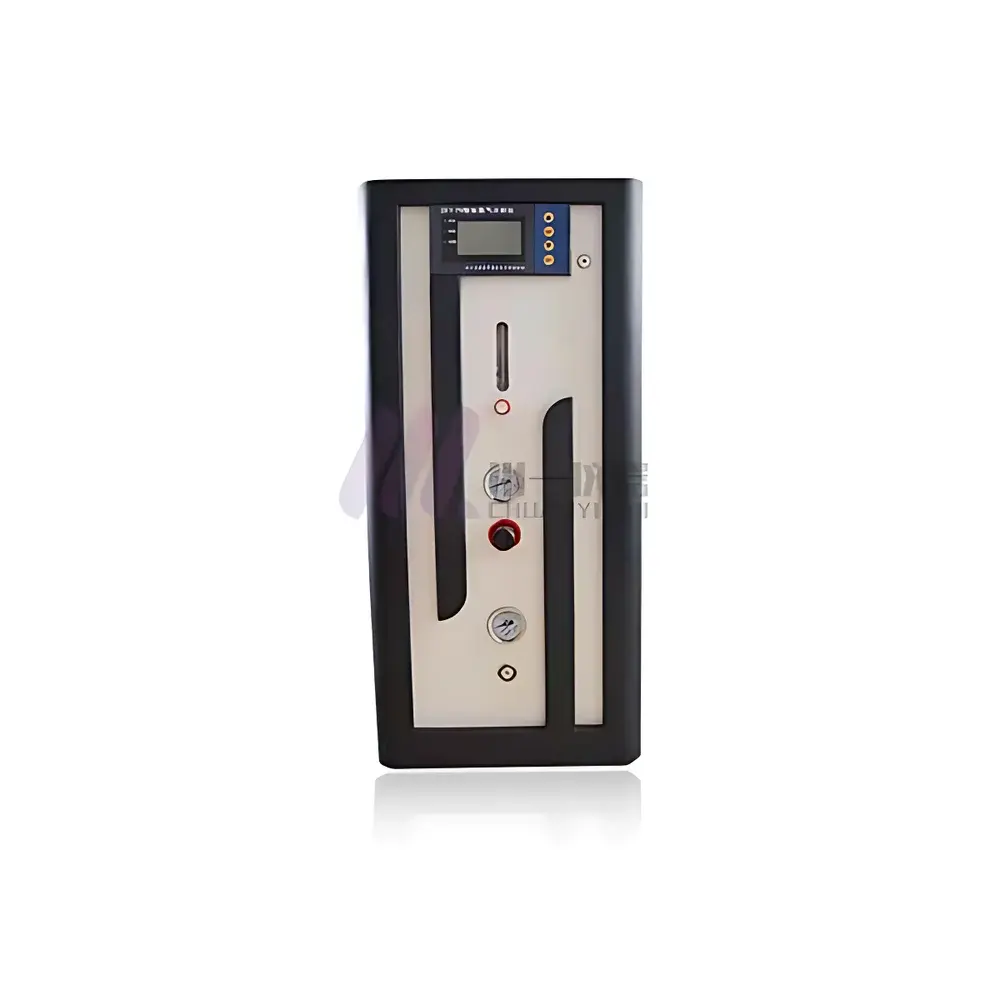
Anyan AYAN-300ML High-Purity Membrane Nitrogen Generator
| Brand | Anyan |
|---|---|
| Origin | Zhejiang, China |
| Model | AYAN-300ML |
| Output Flow Rate | 300 mL/min |
| Output Pressure | 0–0.4 MPa |
| Nitrogen Purity | >99.999% |
| Dew Point | −45 °C |
| Power Consumption | 150 W |
| Input Power | AC 230 V, 50/60 Hz |
| Dimensions (L×W×H) | 400 × 250 × 350 mm |
| Operating Temperature | 10–40 °C |
| Relative Humidity | <85% RH (non-condensing) |
| Feed Air Requirement | Clean, oil-free, dried compressed air or ambient air with ≥1 MΩ·cm resistivity water for integrated humidification (if equipped) |
| Output Port | 3 mm OD tubing or 1/8″ NPT (M8×1 external thread) |
Overview
The Anyan AYAN-300ML is a compact, membrane-based nitrogen generator engineered for continuous on-site production of high-purity nitrogen gas (≥99.999%) from ambient or compressed air. Unlike pressure swing adsorption (PSA) systems that rely on carbon molecular sieves and cyclic pressurization/depressurization, this unit employs asymmetric hollow-fiber polymeric membranes—selectively permeating oxygen, water vapor, CO₂, and other trace gases while retaining nitrogen molecules due to differential solubility and diffusivity. The resulting nitrogen stream exhibits low dew point (−45 °C), minimal hydrocarbon carryover, and stable output pressure (0–0.4 MPa) with pressure stability better than ±0.2%. Designed for integration into analytical instrumentation (e.g., LC-MS, GC carrier gas), pharmaceutical packaging lines, food inerting systems, and laboratory glove boxes, the AYAN-300ML delivers consistent, oil-free, and particle-free nitrogen without reliance on high-pressure cylinders or cryogenic supply chains.
Key Features
- Membrane separation technology ensures silent, vibration-free operation with no moving parts in the core separation module
- Continuous-duty design supports 24/7 unattended operation under controlled environmental conditions (10–40 °C, <85% RH)
- Integrated pressure regulation and precision flow control maintain stable delivery across variable downstream demand
- Low power draw (150 W) enables deployment in space-constrained labs or cleanroom-adjacent utility zones
- Modular construction allows field serviceability; membrane cartridges are replaceable per manufacturer-recommended intervals
- Output port compatible with standard 3 mm OD tubing or 1/8″ NPT (M8×1 external thread) for direct connection to analyzers, packaging machines, or purge manifolds
- No external air dryer or coalescing filter required when fed with ISO 8573-1 Class 3:4:3 compressed air; optional integrated desiccant pre-filter available for ambient-air intake configurations
Sample Compatibility & Compliance
The AYAN-300ML generates nitrogen meeting stringent purity requirements for regulated applications. Its ≥99.999% N₂ output (≤10 ppm O₂, ≤5 ppm H₂O, ≤0.1 ppm total hydrocarbons) complies with ISO 8573-1:2010 Class 1.2.1 for gaseous media used in pharmaceutical primary packaging (e.g., vial headspace flushing per USP ), food packaging (FDA 21 CFR Part 117, Annex I), and analytical carrier gas (ASTM D6349, ISO 10156). While not certified to ISO 13485 or CE Medical Device Directive, its performance aligns with GMP-aligned utilities specifications for non-sterile manufacturing environments. For GLP/GMP validation, users may perform IQ/OQ protocols per ASTM E2500 and document traceable calibration of pressure, flow, and purity sensors using third-party-certified reference standards.
Software & Data Management
The AYAN-300ML operates as a standalone hardware system with analog monitoring only—no embedded microcontroller, touchscreen interface, or digital communication ports (e.g., RS-232, Ethernet, Modbus). All operational parameters—including inlet pressure, outlet pressure, and runtime hours—are indicated via mechanical gauges and LED status indicators. This architecture eliminates cybersecurity risks associated with networked lab devices and simplifies qualification under FDA 21 CFR Part 11 where electronic records are not generated. For facilities requiring audit trails, external data loggers (e.g., calibrated pressure transducers + time-stamped acquisition systems) may be deployed upstream/downstream to capture real-time pressure, flow, and temperature metrics for periodic review and deviation investigation.
Applications
- Pharmaceutical Manufacturing: Vial inerting, lyophilizer backfilling, API synthesis blanketing, and solvent evaporation under inert atmosphere
- Food & Beverage Packaging: Modified atmosphere packaging (MAP) for snacks, coffee, dairy powders, and ready-to-eat meals to inhibit lipid oxidation and microbial growth
- Analytical Laboratories: Carrier gas for gas chromatography (GC), make-up gas for mass spectrometry (MS), and purge gas for headspace samplers
- Electronics Manufacturing: Reflow soldering inerting, semiconductor wafer annealing purge, and display panel encapsulation
- Research & Development: Controlled-atmosphere glove boxes, catalyst testing reactors, and material aging studies requiring ultra-low O₂ environments
- Museums & Archives: Oxygen-free storage enclosures for parchment, photographic film, and organic artifacts susceptible to oxidative degradation
FAQ
What feed air quality is required for optimal membrane performance?
Compressed air must be oil-free and dried to a dew point ≤ −40 °C (ISO 8573-1 Class 3.4.3) to prevent membrane fouling. Ambient-air intake models require pretreatment with a desiccant dryer and particulate filtration (0.01 µm absolute rating).
Can output purity be adjusted for lower-specification applications?
No—membrane generators deliver fixed purity based on design flux ratio. To achieve 99%, 99.9%, or 99.99% grades, users must select appropriately rated models (e.g., AYAN-100L for 99.99%); purity cannot be reduced via flow throttling.
Is routine maintenance required beyond membrane replacement?
Yes—pre-filters (particulate, coalescing, activated carbon) must be replaced per schedule (typically every 6–12 months depending on air quality); inlet pressure regulators and outlet check valves should be inspected annually.
Does the unit comply with explosion-proof or hazardous-area certifications?
No—the AYAN-300ML is rated for general-purpose indoor use only (IEC 61000-6-3 EMC, IEC 61000-6-2 immunity) and is not certified for Zone 1/2 or Class I Division 1 environments.
How does membrane longevity compare to PSA carbon molecular sieve life?
Hollow-fiber membranes typically operate for 15,000–20,000 hours before replacement, unaffected by pressure cycling; CMS beds in PSA systems degrade faster under frequent adsorption/desorption stress and require regeneration every 2–5 years.



