
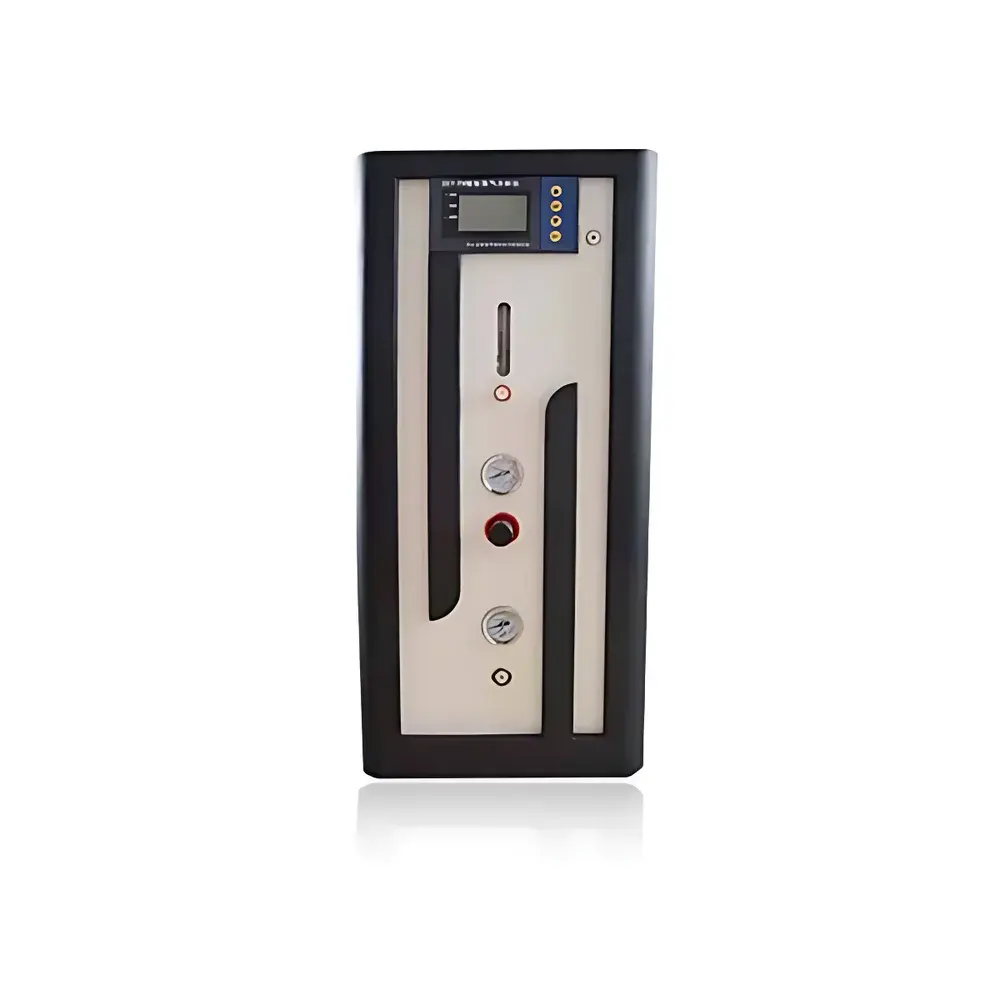
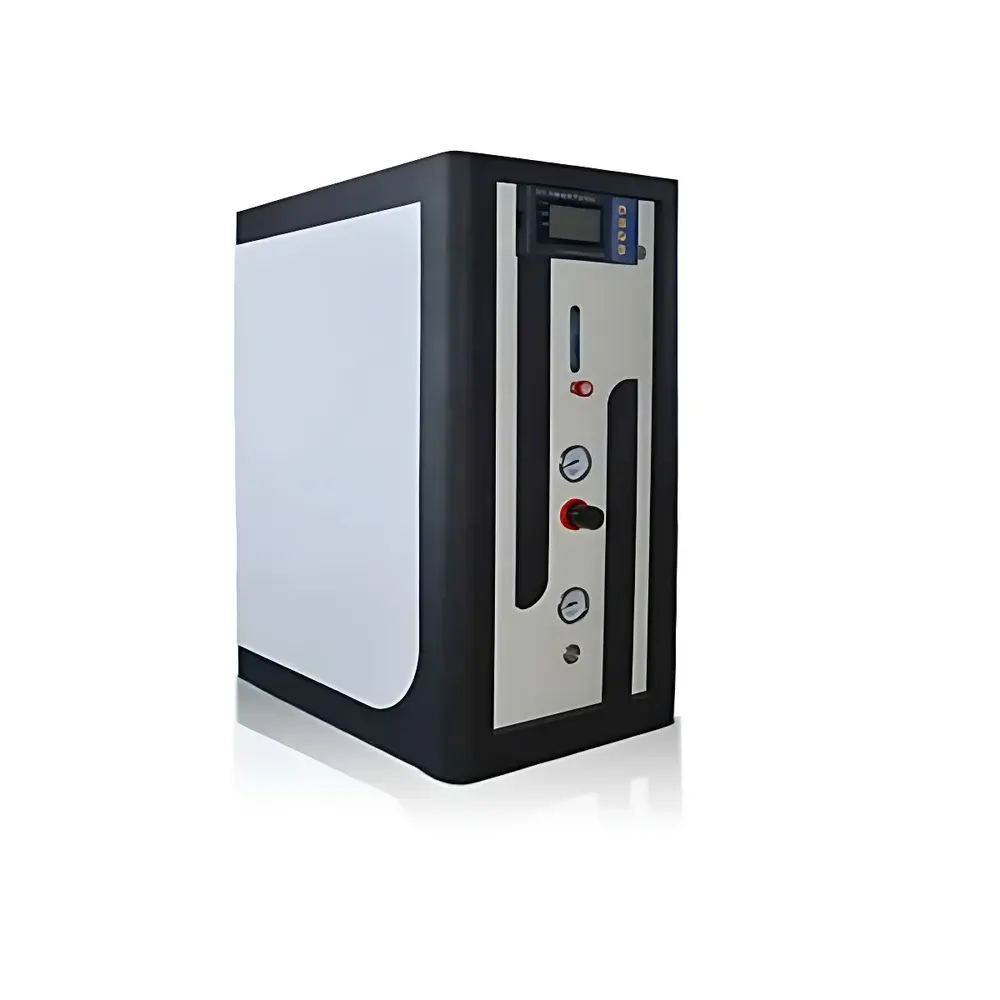
ANYAN AYAN-300ML Membrane-Based High-Purity Nitrogen Generator
| Brand | ANYAN |
|---|---|
| Origin | Shanghai, China |
| Model | AYAN-300ML |
| Nitrogen Generation Principle | Hollow-Fiber Membrane Separation |
| Output Flow Rate | 500 mL/min |
| Output Pressure Range | 0–0.4 MPa |
| Nitrogen Purity | >99.999% (v/v) |
| Dew Point | –40 °C to –60 °C (at 0.1 MPa, typical for membrane systems) |
| Power Consumption | ≤150 W |
| Pressure Stability | <±0.2% FS |
| Output Interface | 3 mm OD tubing or 1/8" NPT (M8×1 external thread) |
| Water Consumption | ~10 mL/h |
| Feed Air Requirement | Oil-free, particle-filtered compressed air (ISO 8573-1 Class 1.2.1 recommended) |
| Power Supply | AC 230 V, 50/60 Hz, 2 A fuse |
| Operating Environment | 10–40 °C, RH <85%, non-condensing, low-dust |
| Dimensions (L×W×H) | 400 × 250 × 350 mm |
| Weight | ~18 kg |
| Compliance | CE-marked per Machinery Directive 2006/42/EC and EMC Directive 2014/30/EU |
| Software Interface | None (standalone analog control) |
Overview
The ANYAN AYAN-300ML is a compact, continuous-duty nitrogen generator engineered for laboratories requiring ultra-high-purity nitrogen gas without reliance on high-pressure cylinders. It employs hollow-fiber membrane separation technology—based on selective permeation of oxygen, water vapor, and CO₂ through polymeric membranes under controlled pressure differential—to extract nitrogen from clean, oil-free compressed air. This physical separation process avoids chemical consumables, catalytic degradation, or regeneration cycles, delivering stable >99.999% (5.0 grade) nitrogen with dew points consistently below –40 °C (typical range: –40 to –60 °C at 0.1 MPa), suitable for sensitive analytical applications including LC-MS, GC carrier gas, and inert atmosphere glove boxes. Unlike pressure swing adsorption (PSA) systems, the membrane architecture offers inherently silent operation, zero moving parts in the separation stage, and immunity to feed-air humidity fluctuations when paired with integrated coalescing and refrigerated drying stages.
Key Features
- Stable output flow of 500 mL/min at regulated pressure (0–0.4 MPa), maintained within ±0.2% full-scale accuracy via precision back-pressure regulator
- Hollow-fiber membrane module constructed from graded-selectivity polysulfone fibers, rated for >20,000 hours of continuous operation under specified feed conditions
- Integrated dual-stage air pretreatment: particulate filtration (0.01 µm absolute) followed by activated carbon adsorption to remove hydrocarbons and residual compressor oil vapors (meets ISO 8573-1 Class 1.2.1 for oil content)
- Refrigerated dryer (cold-dryer) stage ensures consistent dew point suppression independent of ambient humidity; condensate auto-drain with level sensor
- Low thermal load design: total power draw ≤150 W; optimized heat dissipation pathways minimize ambient temperature sensitivity
- Robust aluminum chassis with IP20-rated enclosure; front-panel pressure gauge, purity indicator LED, and status alarms for low feed pressure, high temperature, or filter saturation
- No routine consumables beyond annual coalescing filter replacement; no molecular sieve regeneration or valve cycling wear mechanisms
Sample Compatibility & Compliance
This generator is designed exclusively for use with instrument-grade nitrogen applications where trace oxygen (<1 ppm), moisture (<1 ppm H₂O), and hydrocarbon contamination must be minimized. It complies with key international standards governing laboratory gas quality, including ASTM D6866 (for carbon-14–free nitrogen in radiocarbon dating), ISO 8573-1:2010 Class 1.2.1 (compressed air purity), and USP requirements for pharmaceutical inerting. While not intrinsically certified for GMP environments, its architecture supports audit-ready operation when deployed with documented preventive maintenance logs, calibrated pressure transducers, and periodic purity verification using trace-level electrochemical or laser-based analyzers (e.g., MOCON PAC, Servomex 4100). The unit bears CE marking under EU Machinery and EMC Directives, confirming conformity with essential health and safety requirements for lab equipment.
Software & Data Management
The AYAN-300ML operates as a standalone analog-controlled system with no embedded microprocessor or digital interface. All operational parameters—including outlet pressure, feed pressure, and internal temperature—are monitored via analog gauges and discrete status LEDs. No firmware, cloud connectivity, or data logging capability is provided. For laboratories requiring electronic audit trails or remote monitoring, third-party integration is supported via 4–20 mA pressure output signals (optional retrofit) and dry-contact alarm relays. When deployed in regulated environments (e.g., GLP or FDA 21 CFR Part 11 workflows), users must implement external validation protocols—including IQ/OQ documentation, periodic purity verification, and calibration of all field instruments used for verification—per institutional SOPs.
Applications
- LC-MS and GC-MS carrier and collision gas supply, eliminating cylinder changeover artifacts and baseline drift
- Inert blanketing for solvent evaporation systems (e.g., nitrogen blow-down concentrators) and reaction vessel purging
- Calibration gas dilution systems requiring stable, oil-free background gas
- Electron microscopy sample preparation chambers and SEM/TEM specimen transfer locks
- Pharmaceutical stability testing chambers requiring oxygen-scavenged atmospheres
- Quality control labs performing ASTM D3612 (dissolved gas analysis in transformer oil) or ISO 11133 (microbiology media preparation)
FAQ
Does this generator require feed air compression? Why can’t it operate directly from ambient air?
Yes. It requires a dedicated oil-free air compressor delivering 0.6–0.8 MPa clean, dry air at ≥1.2 L/min. Ambient air contains particulates, oil aerosols, and variable humidity—none of which are compatible with membrane integrity or long-term purity stability.
How often must filters be replaced, and what happens if they’re not changed on schedule?
The coalescing prefilter and activated carbon trap should be replaced annually or after 8,000 operating hours—whichever occurs first. Delayed replacement risks oil breakthrough, irreversible membrane fouling, and gradual purity decline below 99.999%.
Can this unit supply nitrogen to multiple instruments simultaneously?
Yes—provided total demand does not exceed 500 mL/min at required pressure. Use stainless steel or electropolished copper distribution manifolds with individual needle valves and inline particulate filters at each instrument port.
Is dew point specification affected by ambient temperature or altitude?
Dew point is a thermodynamic property independent of ambient conditions—but refrigerated dryer efficiency declines above 35 °C ambient. For installations above 1,500 m elevation, consult factory for pressure-compensated regulator recalibration.
What verification methods are recommended for ongoing purity assurance?
Electrochemical oxygen sensors (0–10 ppm range) and chilled-mirror hygrometers (–70 to +20 °C dew point) are industry-standard. Annual third-party verification using GC-TCD or FTIR is recommended for regulated environments.



