
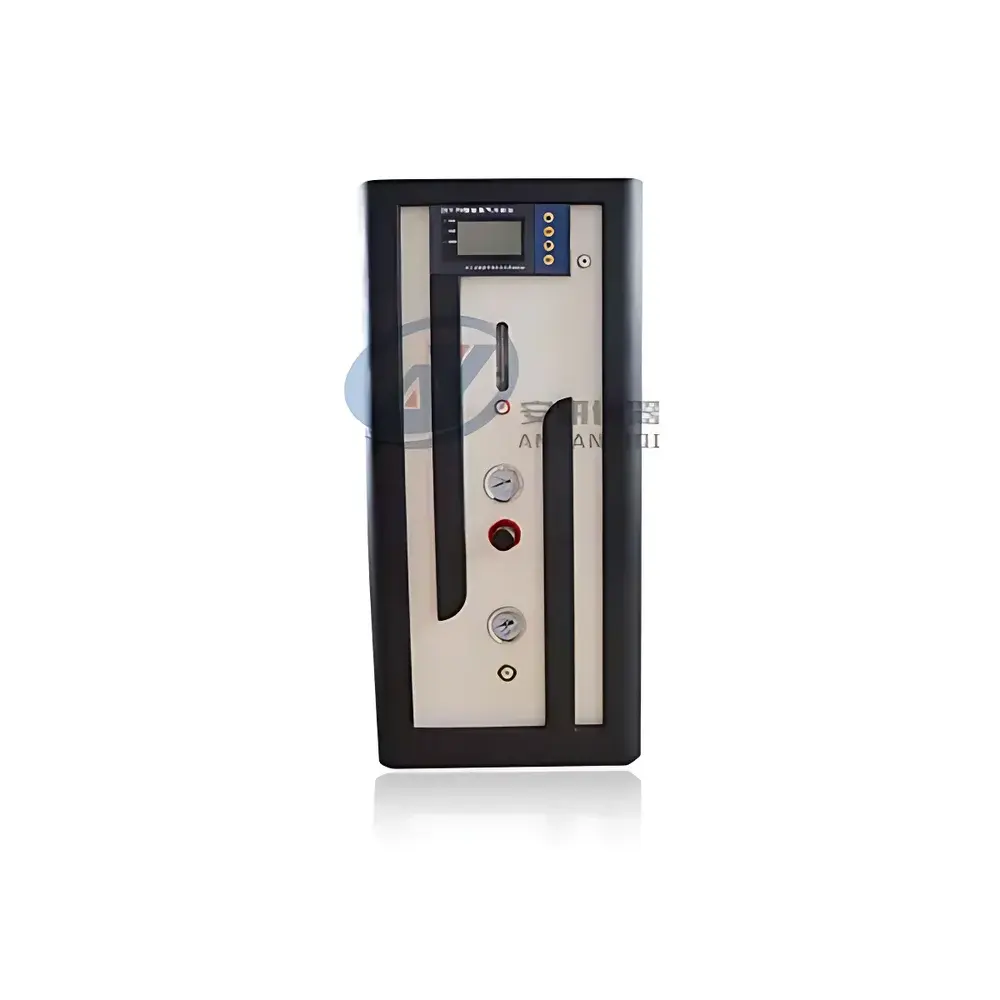
ANYAN AYAN-35L1 Nitrogen Generator for Bruker LC-MS Systems
| Brand | ANYAN (Hangzhou Anyan Instrument Co., Ltd.) |
|---|---|
| Origin | Zhejiang, China |
| Model | AYAN-35L1 |
| Nitrogen Generation Principle | Membrane Separation Technology |
| Output Flow Rate | Not specified in source data |
| Output Pressure | Not specified in source data |
| Nitrogen Purity | 99–99.9% |
| Dew Point | –40 °C |
| Integrated Air Compressor | Yes |
| Noise Reduction | Suspended Acoustic Isolation System |
| Pressure Regulation | Dual-Stage Adjustable |
| Structural Design | All-in-One Modular Integration (Compressor + Pre-Filtration + Membrane Separation + Drying + Buffer Tank) |
| Safety Features | Built-in Pressure Vessel with ASME/ISO-Compliant Safety Valve |
| Mobility | Castor-Mounted Chassis |
| Monitoring | Real-Time Nitrogen Purity Display |
| Maintenance Alerts | Filter Failure Warning System |
| Compliance Context | Designed to support GLP/GMP-compliant LC-MS laboratories requiring continuous, traceable, and auditable nitrogen supply per FDA 21 CFR Part 11 and ISO/IEC 17025 operational expectations |
Overview
The ANYAN AYAN-35L1 Nitrogen Generator is an integrated, on-demand gas supply system engineered specifically for high-sensitivity liquid chromatography–mass spectrometry (LC-MS) platforms—including Bruker’s timsTOF, maXis, and compact QTOF series. It employs asymmetric hollow-fiber membrane separation technology—sourced from South Korean OEM components—to selectively permeate oxygen, water vapor, CO₂, and other trace gases while retaining high-purity nitrogen (99–99.9%) under controlled feed-air pressure. Unlike pressure swing adsorption (PSA) systems, this membrane-based architecture eliminates moving valves, cyclic regeneration downtime, and carbon molecular sieve replacement, enabling continuous operation with ≤3-minute startup-to-specification delivery. The unit integrates a refrigerated-grade air compressor, multi-stage coalescing and activated carbon pre-filtration (ISO 8573-1 Class 2:2:2 compliant), desiccant-assisted dew point control (–40 °C), and a stainless-steel buffer tank with certified safety relief. Its design prioritizes analytical stability: consistent flow and purity minimize ion source fluctuations, reduce baseline noise in ESI/APCI interfaces, and eliminate cylinder-related contamination risks during long-duration acquisition runs.
Key Features
- South Korea-sourced polyimide hollow-fiber membrane modules delivering stable 99–99.9% N₂ purity with <±0.3% measurement repeatability via built-in electrochemical sensor
- Integrated oil-free scroll compressor with suspended acoustic isolation—operating noise <52 dB(A) at 1 m distance
- Three-stage air purification: particulate removal (0.01 µm), oil aerosol coalescence (<0.003 mg/m³), and deep desiccation to –40 °C dew point
- Dual independent pressure regulation: upstream feed pressure (0.7–0.8 MPa) and downstream delivery pressure (0.3–0.6 MPa), both digitally adjustable and logged
- Real-time digital purity display with auto-calibration cycle every 72 hours; configurable alarm thresholds for purity drop or filter saturation
- Modular chassis design with industrial-grade casters, footprint <0.5 m², height <1.2 m—optimized for placement adjacent to LC-MS instrument benches
- Embedded microcontroller with self-diagnostic firmware: monitors compressor duty cycle, membrane differential pressure, filter delta-P, and thermal stability
- Buffer tank equipped with ASME BPVC Section VIII Div. 1–rated safety valve and pressure decay test port for periodic verification
Sample Compatibility & Compliance
The AYAN-35L1 is validated for uninterrupted nitrogen supply to electrospray ionization (ESI), atmospheric pressure chemical ionization (APCI), and heated electrospray ionization (HESI) sources across Bruker’s LC-MS portfolio. It meets ISO 8573-1:2010 Class 2:2:2 for compressed air quality entering the membrane module, ensuring no silicone oil carryover or hydrocarbon contamination that could suppress ionization efficiency or foul quadrupole rods. While not a medical device, its construction adheres to IEC 61000-6-2/6-4 EMC standards and RoHS 2011/65/EU material restrictions. For regulated environments, the system supports audit-ready documentation: all operational parameters (purity, pressure, runtime) are timestamped and exportable via USB-C interface; optional RS-485 Modbus RTU integration enables centralized logging within LIMS or SCADA frameworks compliant with FDA 21 CFR Part 11 electronic record requirements.
Software & Data Management
The generator operates autonomously without external PC dependency. Its embedded controller stores 30 days of operational history—including cumulative runtime, purity deviation events, filter service intervals, and pressure transients—in non-volatile memory. Data export is performed via encrypted CSV files using a standard USB flash drive (FAT32 formatted). No proprietary drivers or cloud connectivity are required. For laboratories implementing electronic lab notebooks (ELN) or instrument control networks, the optional Modbus RTU interface allows polling of real-time purity (%), outlet pressure (bar), and system status (standby/running/alarm) at user-defined intervals (1–60 sec). All firmware updates are delivered as signed binary packages verified via SHA-256 checksum, maintaining integrity in GxP-regulated settings.
Applications
This nitrogen generator serves as a primary or backup gas source for: nitrogen nebulizing and drying gas in LC-MS mobile phase delivery; collision-induced dissociation (CID) and higher-energy C-trap dissociation (HCD) in tandem MS workflows; inert purge gas for autosampler trays and solvent reservoirs; and blanket gas for sample vial storage in automated workflows. It is routinely deployed in pharmaceutical QC labs performing USP method validation, environmental testing labs conducting EPA Method 8270D analysis, and academic proteomics cores running label-free quantitation over 72-hour gradients. Its reliability eliminates manual cylinder changes—reducing operator intervention frequency by >95% compared to high-pressure gas cylinders—and mitigates risk of pressure surges during source maintenance.
FAQ
What is the expected membrane lifetime under continuous operation?
Typical service life exceeds 15,000 operating hours when inlet air meets ISO 8573-1 Class 2:2:2 specifications and ambient temperature remains within 10–35 °C.
Does the system require external cooling water or exhaust ventilation?
No. The unit is air-cooled and designed for ambient laboratory deployment without dedicated HVAC ducting or chilled water loops.
Can output pressure be adjusted to match Bruker’s specific LC-MS interface requirements?
Yes. Dual-stage pressure regulation allows independent setting of feed pressure (to optimize membrane flux) and delivery pressure (to meet instrument manifold specs: typically 3–6 bar for ESI sources).
Is the purity sensor factory-calibrated and field-verifiable?
The electrochemical O₂ sensor is calibrated against NIST-traceable gas standards prior to shipment and includes a two-point verification protocol accessible via service menu.
How does the system handle power interruptions?
Upon power restoration, the controller performs full self-diagnostics before resuming nitrogen production—no manual reset is required, and buffer tank pressure maintains instrument operation for up to 90 seconds.



