
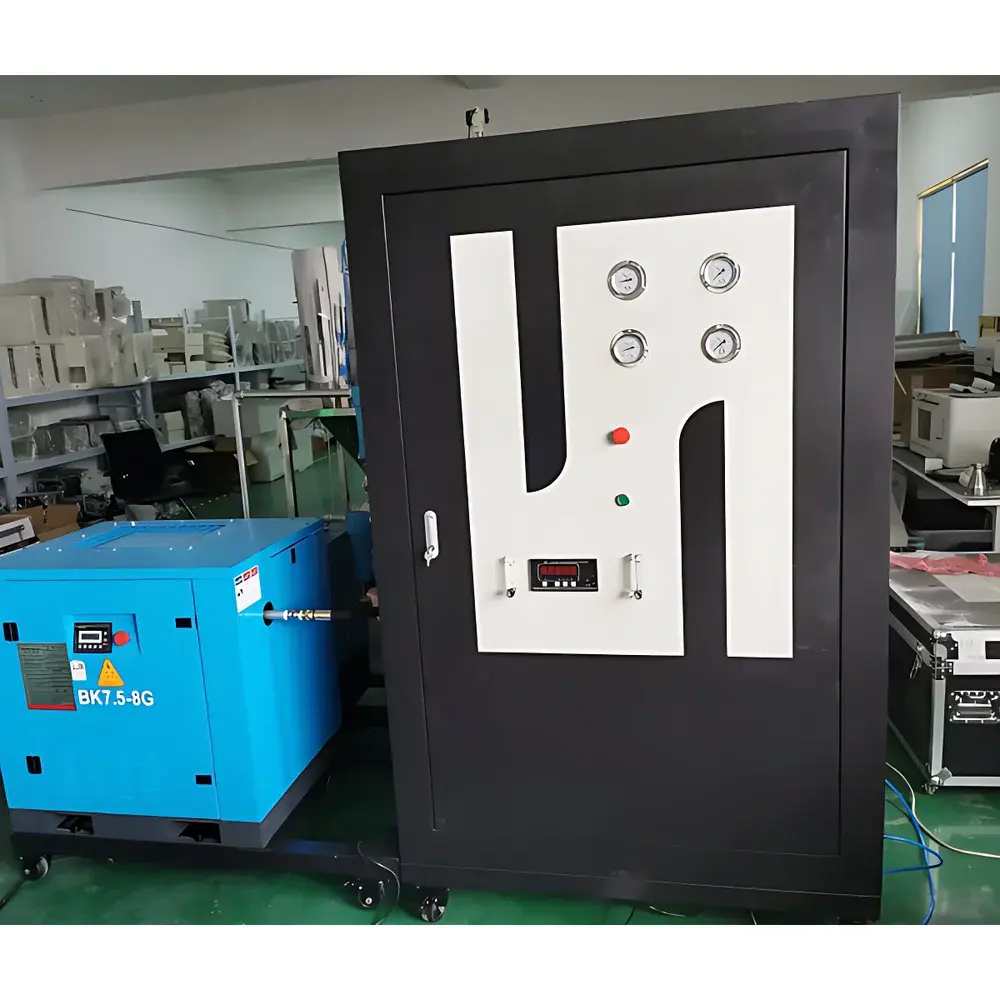
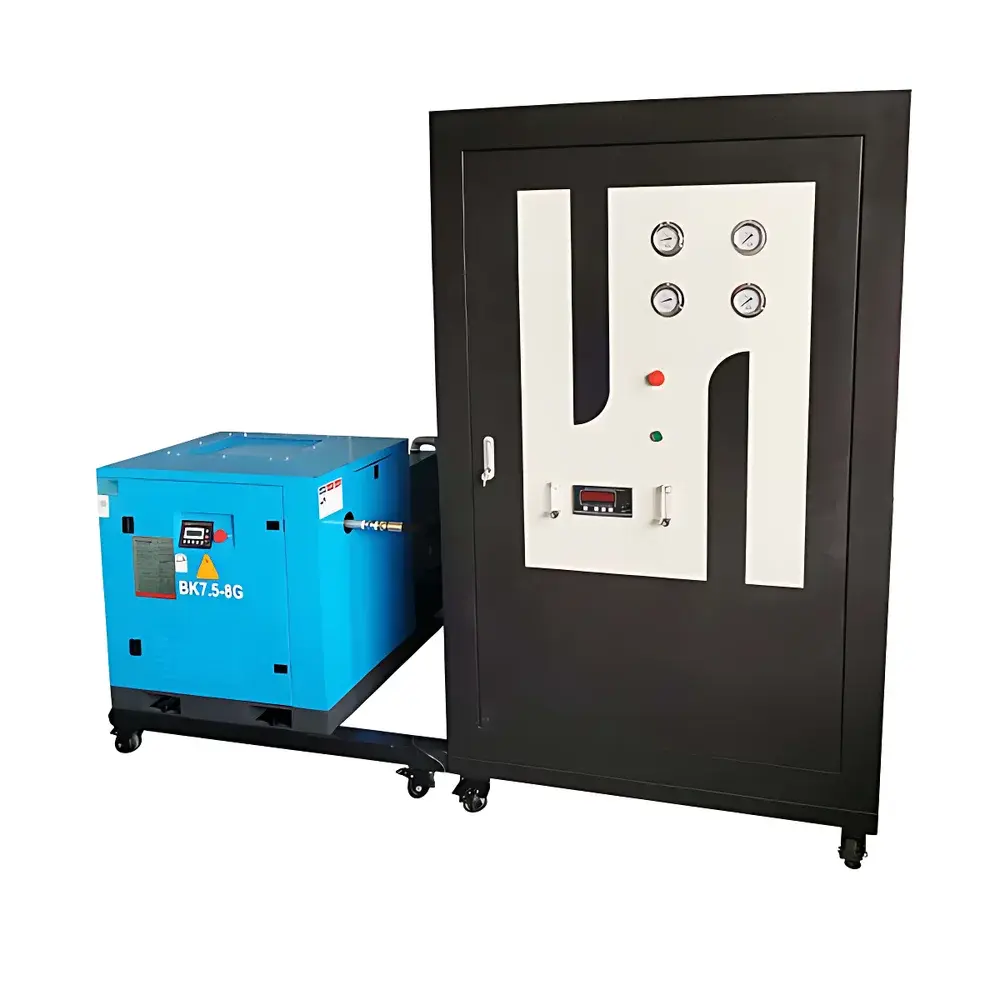
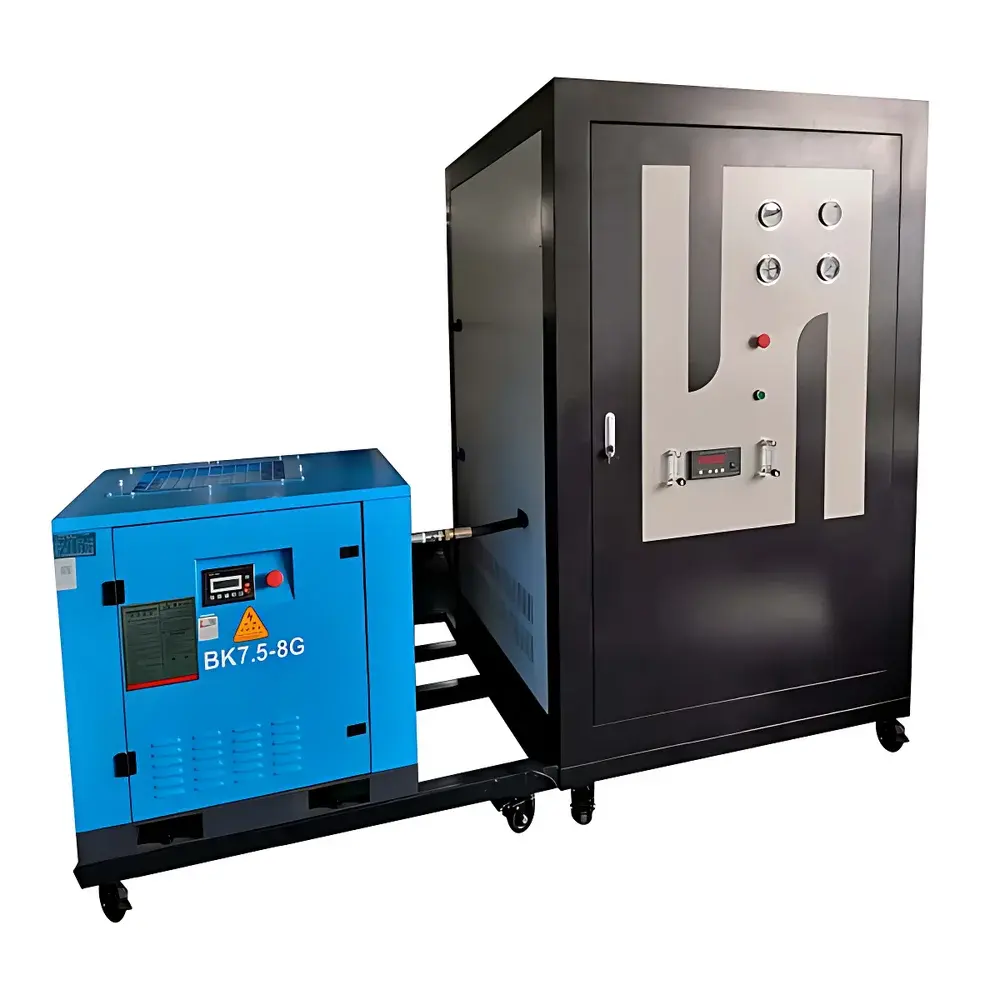
Anyan AYAN-50LB High-Purity Nitrogen Generator (PSA Technology)
| Brand | Anyan Instruments |
|---|---|
| Origin | Zhejiang, China |
| Manufacturer Type | Authorized Distributor |
| Country of Origin | China |
| Model | AYAN-50LB |
| Nitrogen Production Principle | Pressure Swing Adsorption (PSA) with Carbon Molecular Sieve (CMS) |
| Output Flow Rate | 50 L/min |
| Output Pressure | 0–0.6 MPa (Factory Set at 0.5 MPa) |
| Nitrogen Purity | 99% |
| Dew Point | −40 °C |
| Power Supply | 220 V ±10%, 50 Hz ±5% |
| Power Consumption | 3200 W |
| Noise Level | ≤65 dB(A) |
| Ambient Operating Conditions | 10–40 °C, RH ≤85%, non-corrosive, low-dust environment |
| Dimensions (W×D×H) | 1200 × 900 × 1400 mm |
| Weight | 220 kg |
| Compliance | Designed per ISO 8573-1:2010 Class 2.2.2 for compressed air quality |
Overview
The Anyan AYAN-50LB High-Purity Nitrogen Generator is an integrated, on-site nitrogen supply system engineered for continuous, reliable operation in analytical laboratories, pharmaceutical QC environments, and industrial R&D settings. It employs proven Pressure Swing Adsorption (PSA) technology, utilizing carbon molecular sieve (CMS) media to separate nitrogen from ambient air based on kinetic diameter differences between oxygen (0.346 nm) and nitrogen (0.364 nm) molecules. The CMS bed selectively adsorbs oxygen, CO₂, and moisture under elevated pressure, allowing high-purity nitrogen (>99% N₂) to pass through into the product stream. This process eliminates dependency on liquid nitrogen dewars or high-pressure cylinders—reducing logistical overhead, safety risks, and long-term operational cost. The unit incorporates a built-in oil-free scroll air compressor, refrigerated air dryer, multi-stage coalescing and activated carbon filtration (including a dedicated micro-oil adsorber), dual CMS adsorption towers with automatic valve sequencing, nitrogen buffer tank, real-time purity monitoring via electrochemical O₂ sensor, and mass flow control—all housed within a single, floor-standing enclosure.
Key Features
- Integrated architecture: All critical subsystems—including air compression, drying, pre-filtration, PSA separation, and nitrogen conditioning—are factory-assembled and pre-aligned for plug-and-play commissioning.
- Robust CMS protection strategy: Dedicated micro-oil adsorption stage upstream of CMS beds prevents trace hydrocarbon contamination, extending CMS service life and maintaining consistent purity performance over >20,000 operating hours.
- Stabilized gas delivery: Air and nitrogen buffer tanks dampen pressure pulsations, minimize flow transients, and ensure uniform CMS bed loading—critical for reproducible separation efficiency and reduced mechanical stress on valves and seals.
- Real-time process visibility: Front-panel digital display shows instantaneous nitrogen purity (%N₂), volumetric flow rate (L/min), output pressure (MPa), and system status alerts—enabling immediate verification against method requirements.
- Mobility and installation flexibility: Heavy-duty casters with locking brakes allow safe repositioning within lab spaces; minimal footprint (1.2 m²) accommodates tight utility corridors without requiring external ventilation ducting.
- Energy-optimized PSA cycle management: Adaptive timer-based tower switching logic reduces unnecessary purge consumption, achieving up to 25% lower specific energy consumption (kWh/kg N₂) compared to legacy fixed-cycle designs.
Sample Compatibility & Compliance
The AYAN-50LB delivers nitrogen meeting ISO 8573-1:2010 Class 2.2.2 specifications for compressed air quality—ensuring particulate, water, and oil content remain below thresholds relevant to sensitive instrumentation. While rated at 99% purity (≤1,000 ppmv O₂), optional configurations support upgrade paths to 99.9%, 99.99%, and 99.999% N₂ upon request—each validated per ASTM D6349 for trace oxygen analysis. The generator is compatible with GC carrier gas inlets, LC-MS nitrogen curtain gas ports, glovebox purging, and inert atmosphere reactors. Its electrical design conforms to IEC 61000-6-3 (EMC emission limits) and IEC 61000-6-2 (immunity). No hazardous chemicals or consumables are required during normal operation; CMS replacement intervals are typically 3–5 years under continuous use and proper inlet air conditioning.
Software & Data Management
The AYAN-50LB operates as a standalone hardware platform without proprietary software dependencies. All operational parameters are accessible via local HMI with non-volatile memory logging of daily uptime, cumulative runtime, and alarm history (e.g., filter clogging, dew point excursion, purity deviation). Optional RS-485 Modbus RTU interface enables integration into centralized facility monitoring systems (BMS/SCADA) for remote status polling and event-triggered notifications. While not FDA 21 CFR Part 11 compliant out-of-the-box, the unit supports audit-ready operation when paired with external electronic loggers that capture timestamped purity and flow data—fully traceable for GLP, GMP, or ISO/IEC 17025 accreditation audits.
Applications
- Gas chromatography (GC) carrier and detector make-up gas, especially for FID, TCD, and ECD systems requiring stable, dry, hydrocarbon-free N₂.
- LC-MS nitrogen supply for nebulizer, desolvation, and curtain gas functions where consistent dew point and O₂ content directly impact ionization stability and signal-to-noise ratio.
- Pharmaceutical stability testing chambers and accelerated degradation studies requiring controlled inert atmospheres.
- Electron microscopy sample preparation (e.g., freeze-fracture, sputter coating) where residual oxygen causes oxidation artifacts.
- Material science labs performing thermal analysis (TGA/DSC) under inert purge conditions to suppress oxidative decomposition pathways.
- Microelectronics cleanrooms using nitrogen for wafer handling, chamber purging, and solvent dispensing line blanketing.
FAQ
What is the typical service life of the carbon molecular sieve (CMS) under standard operating conditions?
CMS lifespan averages 36–60 months depending on inlet air quality, duty cycle, and adherence to scheduled filter maintenance. Units operated with ISO Class 2 inlet air and annual filter replacement consistently achieve >40,000 hours of effective adsorption capacity.
Can the output pressure be adjusted beyond the factory-set 0.5 MPa?
Yes—the pressure regulator is field-adjustable from 0 to 0.6 MPa. For applications requiring ≥0.7 MPa, a downstream booster pump must be installed externally, as internal components are rated to 0.6 MPa maximum working pressure.
Is the nitrogen output suitable for use with flame ionization detectors (FID)?
Yes—provided the configured purity meets instrument manufacturer specifications (typically ≥99.9% for high-sensitivity FID). For 99% base configuration, verify compatibility with your GC vendor; optional higher-purity modules are available.
Does the unit require external cooling water or special exhaust venting?
No—heat rejection occurs via convection-cooled condenser and cabinet fans. Ambient airflow clearance of ≥30 cm on all sides is recommended for thermal management. No external venting or drainage is needed.
How frequently should the pre-filters and desiccant be replaced?
Coalescing filters: every 1,500–2,000 operating hours or annually (whichever occurs first). Activated carbon and fine particulate filters: every 3,000 hours or biannually. Refrigerated dryer desiccant: only if dew point exceeds −30 °C continuously—indicating refrigeration system fault.



