
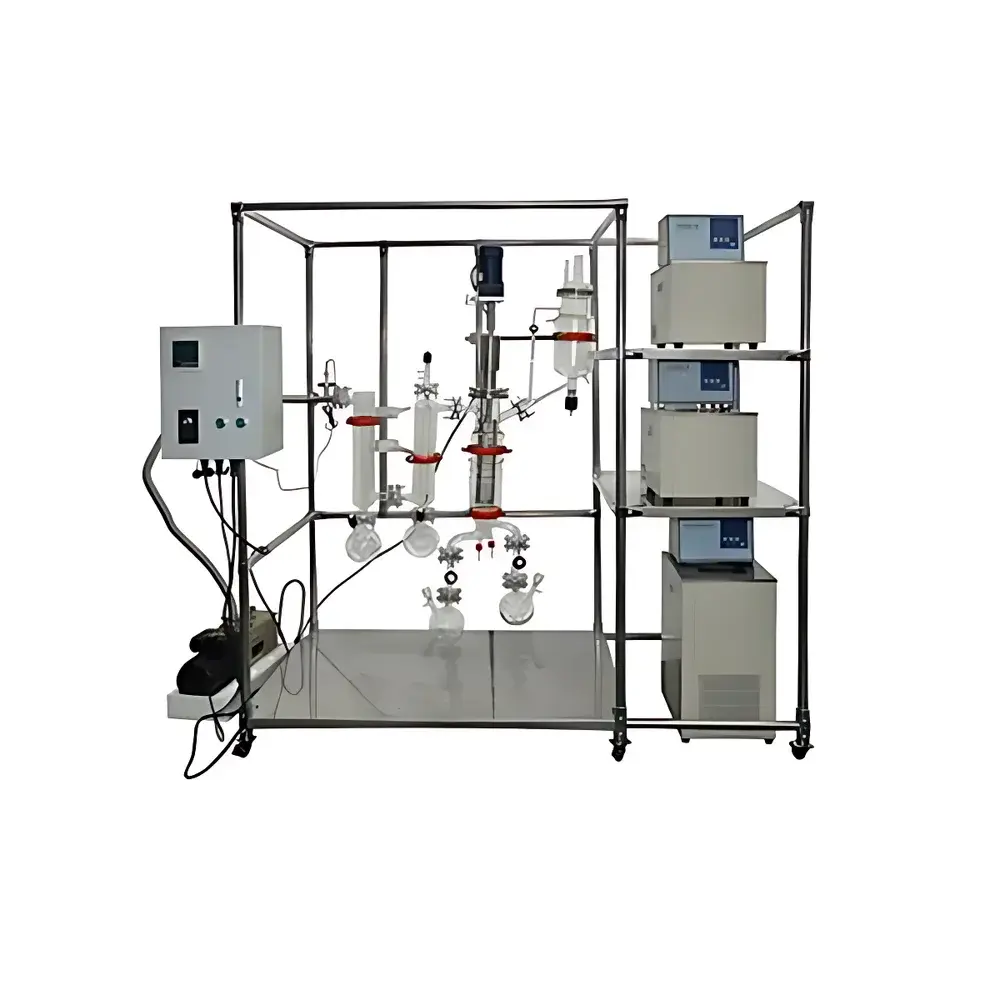
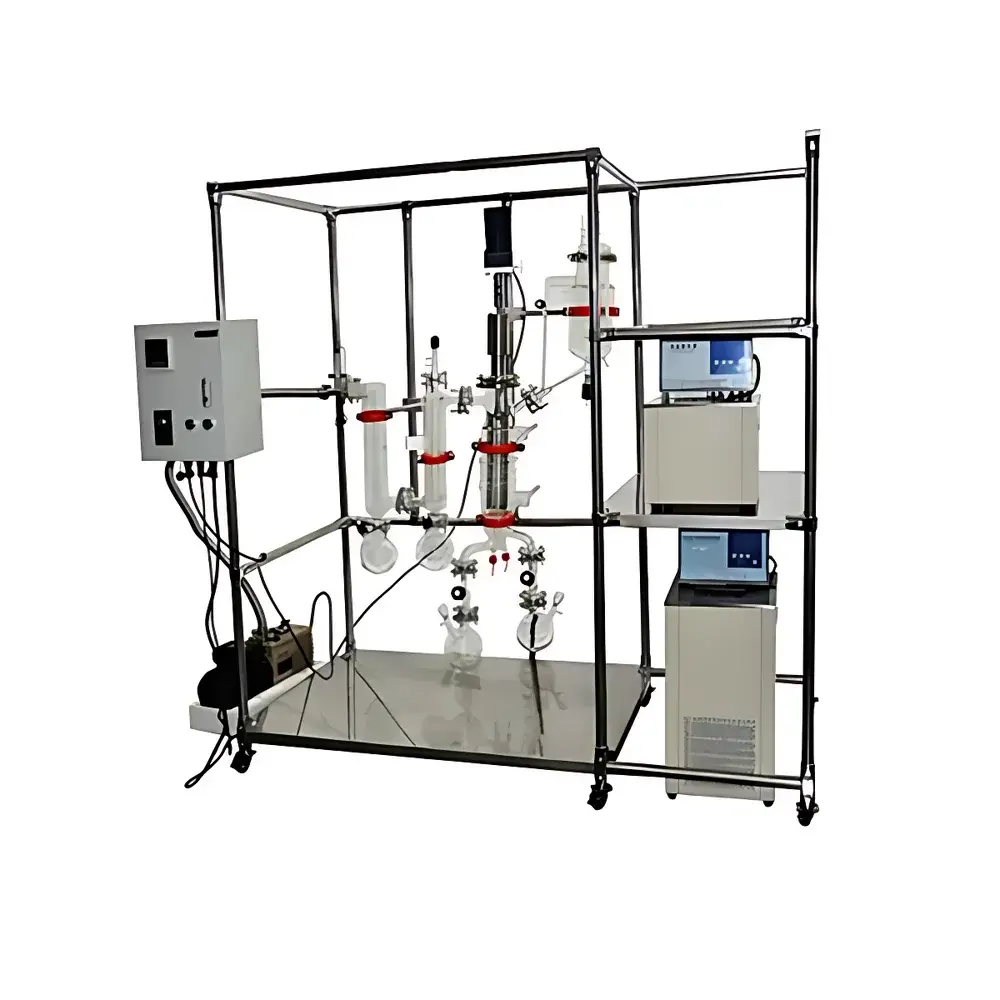
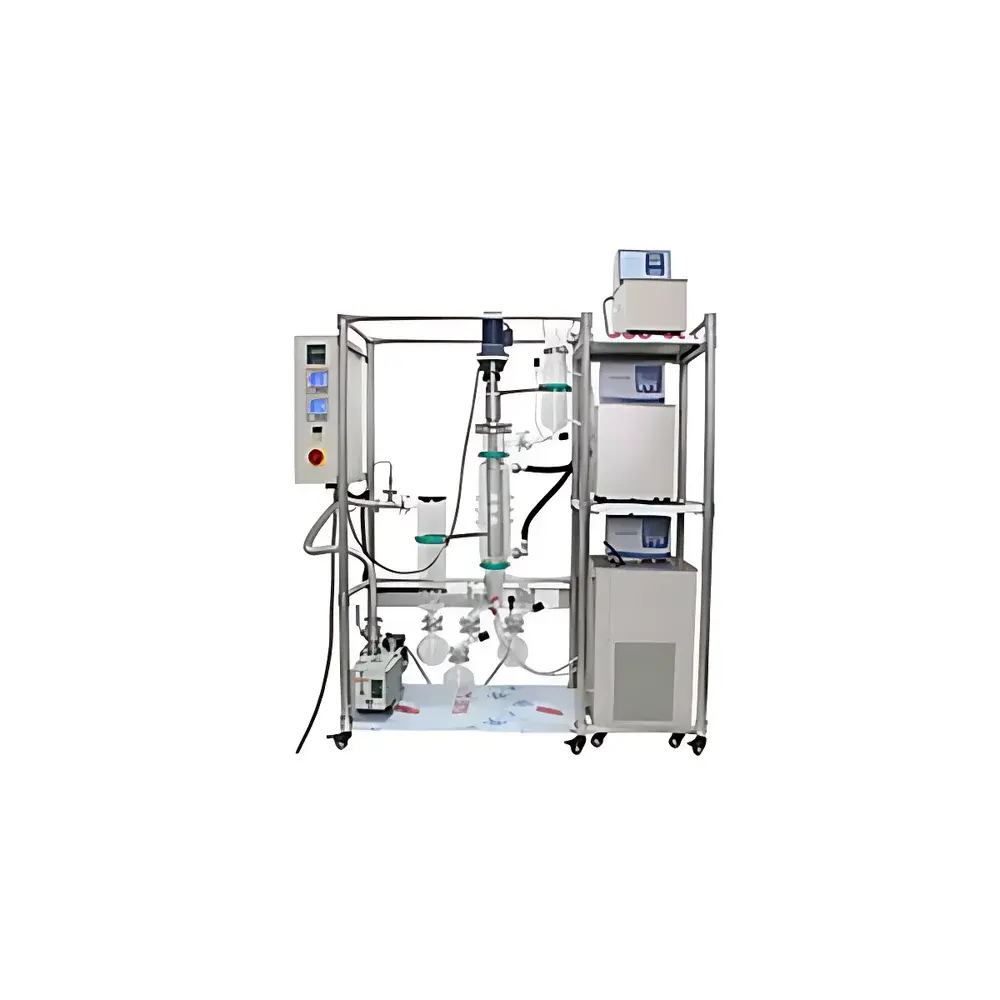
Anyan AYAN-B100 Lab-Scale Wiped-Film Evaporator for Thermal-Sensitive Botanical Extracts
| Brand | Anyan (Hangzhou Anyan Instrument Co., Ltd.) |
|---|---|
| Origin | Zhejiang, China |
| Model | AYAN-B100 |
| Evaporator Internal Diameter | 100 mm |
| Evaporation Area | 0.15 m² |
| Condensation Area | 0.25 m² |
| Feed Volume | 2 L |
| Processing Flow Rate | 0.5–5.0 L/h |
| Motor Power | 120 W |
| Max Rotational Speed | ≤450 rpm |
| Light Fraction Collection Bottle | 2 L |
| Heavy Fraction Collection Bottle | 2 L |
| Cold Trap | Integrated |
| External Condenser | Equipped |
| Cooling System | Built-in |
| Ultimate Vacuum | <100 Pa |
| Heating Temperature Range | Ambient to 200 °C |
| 刮板材质 | PTFE (standard), optional carbon fiber for >150 °C operation |
Overview
The Anyan AYAN-B100 is a precision-engineered, benchtop wiped-film evaporator designed specifically for gentle, high-efficiency solvent removal and molecular distillation of thermally labile botanical extracts—including essential oils, cannabinoids, terpenes, and polyphenol-rich fractions. Operating on the principle of short-path, high-vacuum thin-film evaporation, the AYAN-B100 generates a uniform, continuously renewed liquid film on a heated cylindrical surface via a rotating wiper system. This configuration minimizes residence time (typically <30 seconds), suppresses thermal degradation, and enables separation under ultra-low pressure (<100 Pa), thereby lowering boiling points by up to 100 °C compared to atmospheric conditions. Its core architecture—comprising a vertically oriented stainless-steel evaporation cylinder, precision-machined rotor assembly, tangential feed distributor, and integrated cold trap—ensures reproducible mass transfer, consistent film dynamics, and reliable phase separation across variable feed viscosities (up to 50,000 cP) and surface tensions.
Key Features
- Stainless-steel evaporation cylinder (100 mm ID) with optimized length-to-diameter ratio for balanced heat transfer and vapor path efficiency
- Adjustable-speed motor-driven rotor (0–450 rpm) coupled with a modular wiper system supporting PTFE sliding blades (≤150 °C) or carbon fiber variants (≥150 °C) for tailored shear control
- Tangential feed distributor ensuring uniform radial distribution and immediate film formation upon entry
- Integrated dual-stage condensation: primary internal condenser (0.25 m²) + auxiliary external condenser for enhanced volatile recovery
- Full vacuum compatibility down to <100 Pa, supported by corrosion-resistant vacuum seals and calibrated pressure monitoring
- Heating jacket with PID-controlled temperature regulation (ambient to 200 °C, ±1 °C accuracy) and thermal insulation to minimize axial gradient
- Dual-collection manifold with 2 L light-fraction and 2 L heavy-fraction receivers, both equipped with quick-release flanges and sight glasses
Sample Compatibility & Compliance
The AYAN-B100 accommodates a broad spectrum of natural product matrices: crude ethanol or CO₂ extracts, glycerin-based tinctures, viscous resinoids, and crystallizing phytochemical concentrates. Its design conforms to fundamental engineering requirements outlined in ASTM E2654 (Standard Guide for Validation of Analytical Methods for Volatile Organic Compounds) and supports GLP-compliant workflows when paired with validated operating procedures. While not certified to ISO 9001 or FDA 21 CFR Part 11 out-of-the-box, the system’s mechanical traceability—via fixed rotational speed settings, calibrated temperature zones, and documented vacuum profiles—facilitates audit-ready process mapping. All wetted surfaces are electropolished 316L stainless steel or FDA-compliant PTFE, meeting USP Class VI biocompatibility criteria for non-implantable devices.
Software & Data Management
The AYAN-B100 operates as a standalone instrument with analog/digital hybrid controls: digital RPM display, dual-channel PT100 temperature readouts (jacket and feed line), and analog vacuum gauge. Optional RS485/Modbus RTU interface enables integration with third-party SCADA or LIMS platforms for automated logging of operational parameters (temperature setpoint, actual jacket temp, rotational speed, vacuum level). Raw data export (CSV) supports post-run analysis of thermal history and residence time distribution. For regulated environments, users may implement supplementary electronic logbooks with timestamped operator entries and change-control records—fully compatible with ALCOA+ data integrity principles when deployed within validated IT infrastructure.
Applications
- De-solventization of botanical extracts prior to chromatographic purification or formulation
- Molecular distillation of omega-3 fatty acids, vitamin E acetate, and squalene from plant oils
- Removal of residual methanol or ethanol from reaction mixtures in API intermediate synthesis
- Concentration of heat-sensitive enzymes or peptides without denaturation
- Recovery and purification of acetic acid and propionic acid from low-pressure carbonylation waste streams (per documented industrial protocol)
- Preparative-scale isolation of monoterpenes from citrus peel oil via fractional wiped-film distillation
FAQ
What is the maximum allowable feed viscosity for stable film formation?
The AYAN-B100 maintains consistent film hydrodynamics up to 50,000 cP at 60 °C using PTFE wipers; above this threshold, carbon fiber wipers and pre-heated feed (>80 °C) are recommended.
Can the system handle crystallizing feeds such as rosin or diterpene resins?
Yes—hinged wipers and adjustable rotor clearance minimize fouling; periodic hot-purge cycles (180 °C, 30 min under N₂) restore performance between runs.
Is the vacuum specification of “<100 Pa” measured at the evaporator body or at the pump inlet?
Measured directly at the evaporator chamber using a capacitance manometer, reflecting actual process pressure—not pump-side backpressure.
Does the unit include provisions for inert gas sparging during operation?
A dedicated 1/8″ VCR inlet port is provided on the feed line for controlled nitrogen or argon purging to prevent oxidation of unsaturated compounds.
How is cleaning validation performed for multi-product use?
Standard SOP includes hot ethanol rinse (60 °C, 2× 500 mL), followed by water flush and visual inspection of wiper edges and cylinder wall; residue testing per ICH Q5C is user-defined.



